How to Reduce Cycle Time on Your Team
A practical guide to reducing cycle time, covering how to find where elapsed time is actually lost, where teams commonly lose it, the five changes that reliably help, how to run an improvement properly, and what makes it worse.

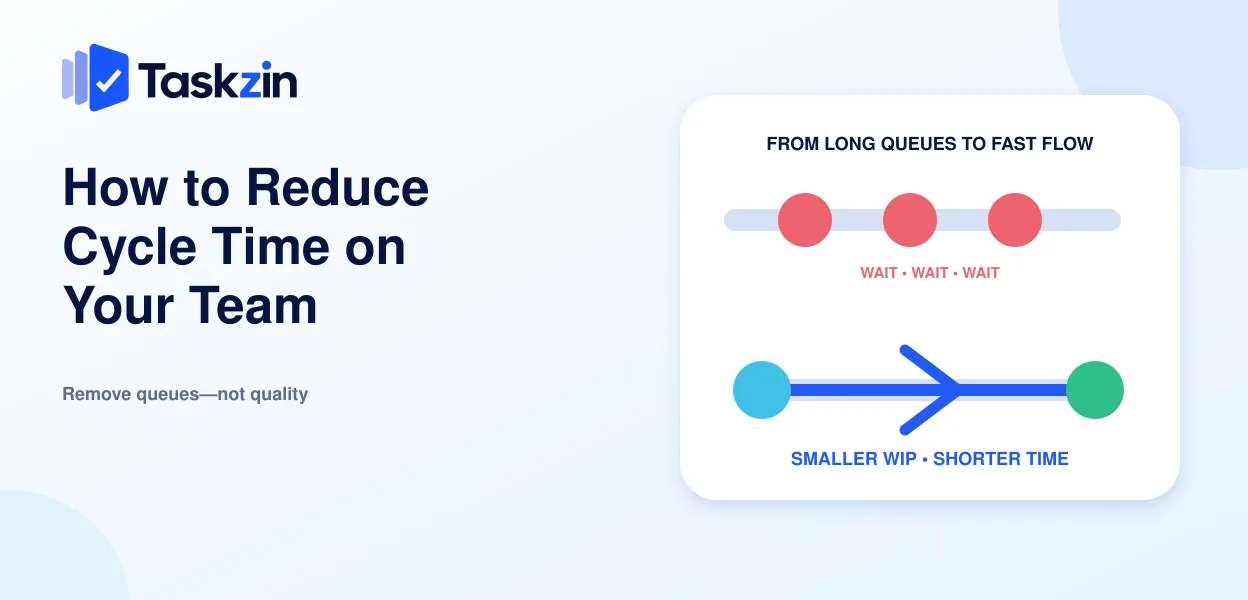
Most attempts to speed up delivery start in the wrong place: with the people doing the work.
That is understandable and almost always mistaken, because in most teams the majority of elapsed time is spent waiting rather than working.
Reducing cycle time is largely a matter of finding the queues and removing them. It is unglamorous, it does not require anyone to work harder, and it produces larger improvements than effort ever does.
This guide covers how to find where time goes, the five changes that reliably help, and how to run an improvement properly.
Quick answer: Quick answer: Reduce cycle time by limiting work in progress, making items smaller, and attacking waiting time rather than working time. In most teams, items spend far more elapsed time queuing — for review, approval, testing or release — than being actively worked on, so removing queues produces bigger gains than any increase in individual speed.
Find Out Where the Time Actually Goes
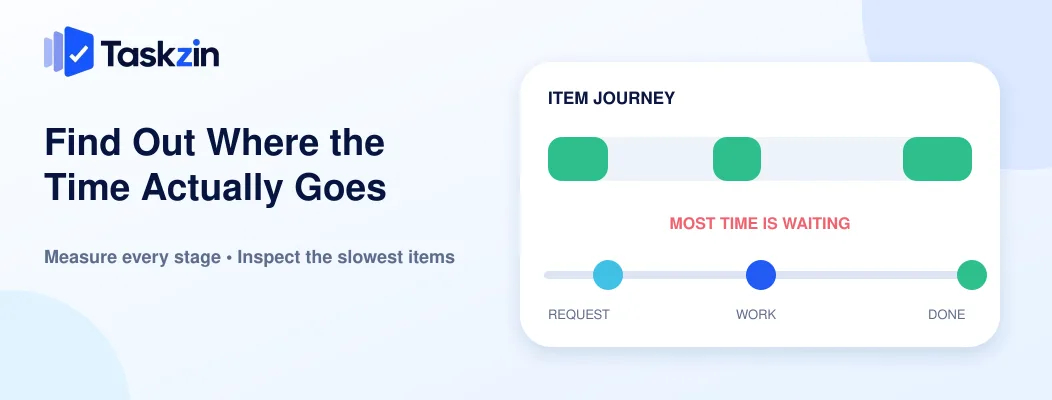
Before changing anything, measure how long items spend in each stage and calculate what proportion of total elapsed time was active work — the answer is usually uncomfortable.
Measure time in each stage, not just total
Total cycle time tells you there is a problem. Time per stage tells you where.
Most tools record when items entered and left each column. If yours does not, a fortnight of manual recording is enough to identify the pattern. The result almost always concentrates in one or two stages, and those are the only ones worth working on.
Calculate flow efficiency
Flow efficiency is active working time divided by total elapsed time, expressed as a percentage.
Teams measuring this for the first time typically find figures between 5 and 25 percent. That means an item taking ten days involved perhaps one or two days of actual work. The remaining eight are queue, and queue is far easier to remove than work is to accelerate.
Look at the slowest items, not the average
Averages hide the problem. Examine the slowest ten percent of items individually and ask what happened to each.
The answers cluster. A handful of causes will explain most of the outliers — a specific approver, a dependency on another team, a category of work that always stalls. Those causes are your improvement backlog.
Where Cycle Time Is Usually Lost
Stage Typical waiting cause Difficulty to fix Impact Backlog to started WIP already full Easy High In progress Blocked on a question Medium Mediu m
Code review Reviewer availability Easy High Testing Manual test bottleneck Hard High Approval Single approver unavailable Medium High Awaiting release Release batching Medium High Dependency on another team Their priorities Hard High
The Five Highest-Impact Changes

Five changes reliably reduce cycle time: limit work in progress, split items smaller, target waiting time, reduce handoffs, and release more frequently in smaller batches.
Limit work in progress
The fastest available improvement and the one with the strongest arithmetic behind it. Little's Law means halving concurrent work roughly halves cycle time at constant throughput.
It requires no tooling and no budget — only the discipline to stop starting and start finishing.
Most teams find this uncomfortable for two weeks and then normal.
Make items smaller
A five-day item cannot complete in less than five days. A one-day item can. Smaller items move through queues faster and reveal problems sooner.
Splitting also reduces variability, which matters as much as speed. Predictable delivery is worth more to stakeholders than fast-but-erratic delivery.
Attack the waiting, not the working
Given flow efficiency around 15 percent, halving the active work time improves cycle time by roughly 7 percent. Halving the waiting time improves it by over 40 percent.
That comparison should determine where you spend your effort. Review queues, approval delays and handoff waits are where the improvement is, and they are usually addressable by agreement rather than by investment.
Reduce handoffs between people
Every handoff creates a queue and a context transfer. Work passing through four people waits four times.
Cross-training, pairing, or giving one person end-to-end ownership all reduce this. The gain is not just the removed wait — it is also the removed misunderstanding at each transfer.
Batch less, release more often
Work finished on Tuesday but released with a monthly batch has a cycle time including three weeks of doing nothing.
Increasing release frequency reduces cycle time mechanically, and it usually reduces risk too, since smaller releases are easier to verify and to reverse.
How to Run a Cycle Time Improvement
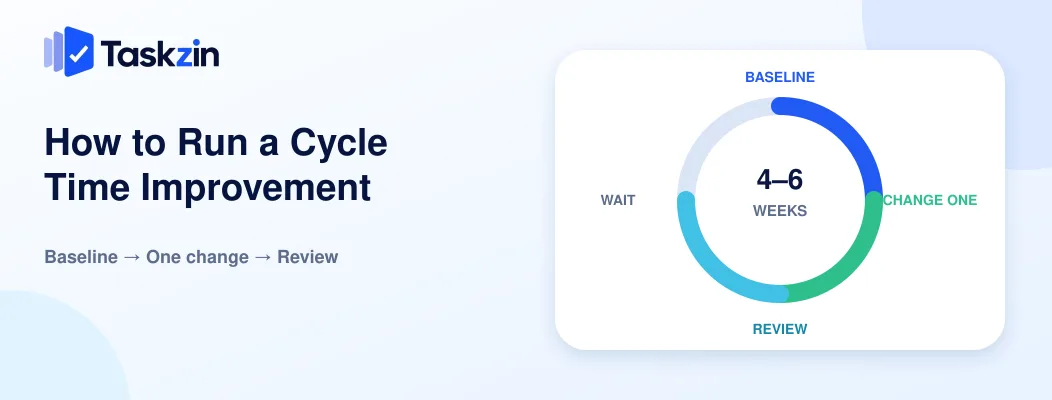
Establish a baseline, change one thing, and wait four to six weeks before judging — changing several things at once tells you nothing about which worked.
Establish a baseline first
Record current cycle time percentiles and flow efficiency before making changes. Without a baseline you cannot demonstrate improvement, and you will end up arguing about whether things feel better.
Four to six weeks of history is enough for a usable baseline.
Change one thing at a time
Introduce a WIP limit, or start splitting items, or set a review response commitment. One change.
Teams that change five things simultaneously and see improvement have no idea which change caused it, which means they cannot repeat it elsewhere or defend it when someone wants to reverse it.
Give it four to six weeks
Cycle time is a lagging measure. Items already in flight complete under the old conditions, so the effect of a change takes weeks to appear in the numbers.
Judging after one week produces false conclusions in both directions. Set the review date when you make the change and hold to it.
What Not to Do
Three approaches make cycle time worse: asking people to work faster, setting cycle time as a target, and removing quality steps to save time.
Asking people to work faster
If flow efficiency is 15 percent, individual speed governs 15 percent of the outcome. Pressure applied there produces stress, mistakes and rework — which lengthens cycle time rather than shortening it.
Setting a cycle time target
The moment cycle time becomes a target, it gets gamed. Items are split artificially, started later so the clock runs shorter, or marked done before they are.
Use it as a diagnostic the team owns, not as a number reported upward for evaluation.
Removing quality steps
Skipping review or testing shortens cycle time this month and lengthens it next month, when defects return as rework that bypasses your process entirely.
The goal is removing waiting, not removing checking. A review that takes ten minutes of work and three days of waiting has a waiting problem, not a review problem. The fix is a team agreement on review turnaround — reviews before new work each morning, for instance — rather than fewer reviews.
Rework is also the most expensive form of waiting, because it re-enters the process at the front and consumes capacity that was allocated to something else. A team cutting quality steps to improve cycle time usually sees the number improve for one month and worsen for the following three.
Frequently asked
How do you reduce cycle time?
Limit work in progress, split items smaller, and target waiting time rather than working time. Most elapsed time is queue, so removing queues produces far larger gains than working faster.
What is a good cycle time?
There is no universal figure — it depends on the size and nature of your items. Compare against your own history rather than a benchmark, and aim for a shrinking 85th percentile.
What is flow efficiency and what is typical?
Active working time divided by total elapsed time. Teams measuring it for the first time commonly find 5 to 25 percent, meaning most of an item's life is spent waiting.
Does reducing cycle time mean working faster?
No. In most teams individual speed governs a small fraction of elapsed time. The improvements come from removing waiting, reducing concurrent work and making items smaller.
How long does it take to see improvement?
Four to six weeks. Cycle time is a lagging measure, so items already in flight complete under the old conditions before the change shows in the numbers.
Should you set a cycle time target?
No. Targets get gamed — items split artificially or started later to shorten the clock. Keep it as a diagnostic the team owns rather than a number reported for evaluation.
What is the single biggest cause of long cycle time?
Too much work in progress. It lengthens cycle time for everything simultaneously and is the fastest thing to change, requiring only the discipline to stop starting new items.
Sanju Shrestha is a SaaS content writer at Taskzin who explores smarter ways to manage work, organize priorities, and improve team performance. Her content covers productivity strategies, digital workflows, collaboration, and task management, with a focus on helping modern teams work more efficiently and stay aligned.
All posts by Sanju Shrestha


Comments