How to Build and Maintain a Healthy Product Backlog
A practical guide to product backlog management, covering what a healthy backlog looks like, how to build one from outcomes, the refinement habit that keeps it usable, prioritising without endless debate, and how to prune it.

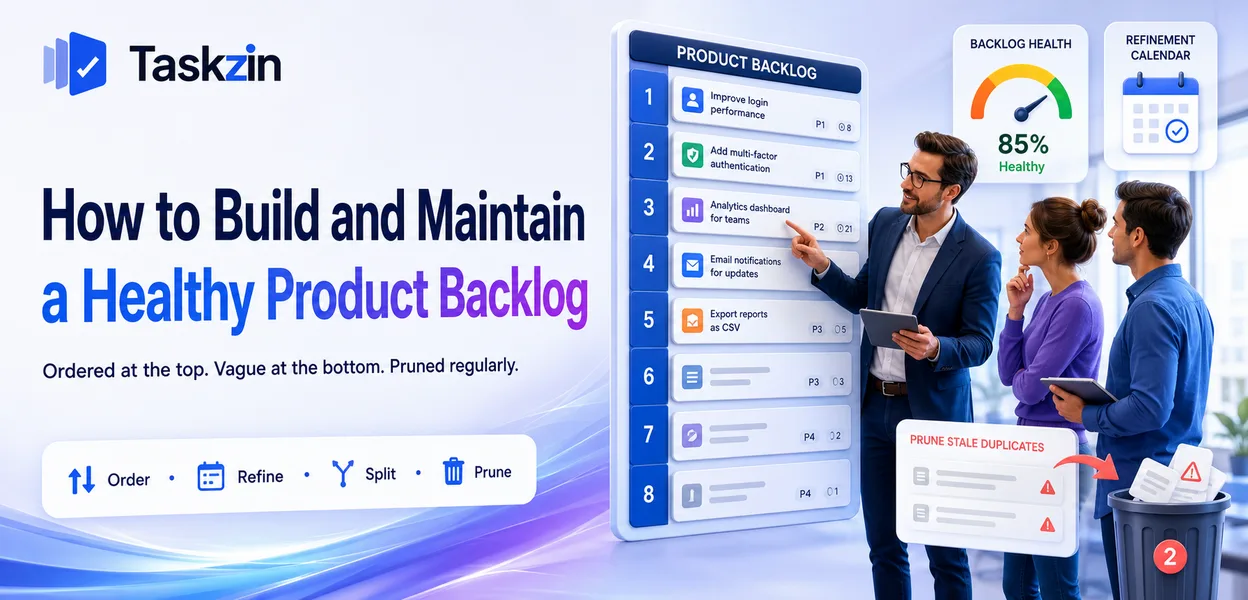
The failure is gradual. Every request gets added because adding is easier than saying no. Two years later there are 600 items, the product owner cannot remember what most of them mean, and the team ignores everything below the top twenty. The backlog has become an archive of requests rather than a plan.
This guide covers what healthy looks like, how to build one, the refinement habit that keeps it usable, and the pruning step nearly everyone skips.
Quick answer: A healthy product backlog is a single ordered list where the top items are detailed enough to start and the bottom items are deliberately vague, small enough that one person can read all of it, and pruned regularly of anything nobody intends to build. Most backlog problems are size problems: the list has grown past the point where anyone can hold it in their head, so nothing in it is trusted.
What a Healthy Backlog Looks Like
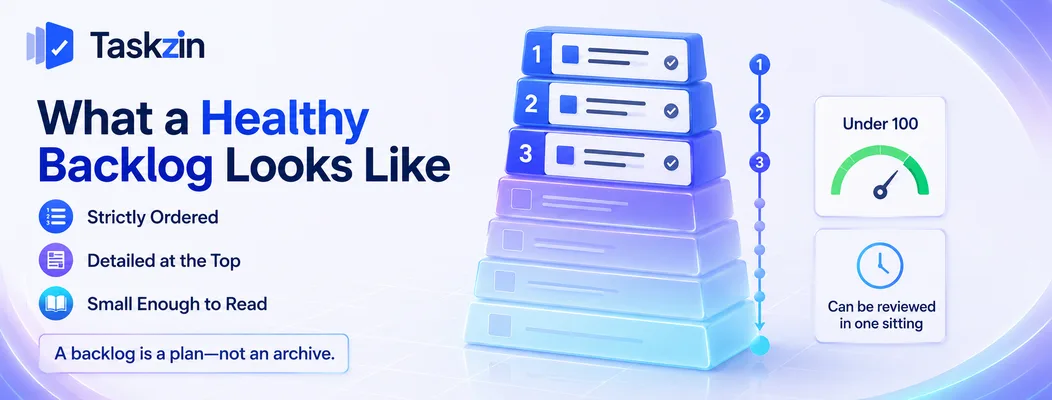
A healthy backlog is a single ordered list, detailed at the top and vague at the bottom, small enough to be read end to end in one sitting.
Those three properties do most of the work. A backlog with all three is useful for planning; one missing any of them tends to be ignored.
Ordered, not categorised
The backlog is a sequence, not a set of buckets. Item one is worked before item two. There is no tie for first place.
Teams resist this because ordering forces trade-offs that categorisation lets you avoid. Labelling twelve things "high priority" defers the decision; ordering them makes it. The discomfort of ordering is the point — it is where prioritisation actually happens, and a backlog with fifty items marked high priority contains no information.
Detailed at the top, vague at the bottom
Items near the top should be small, understood, estimated and ready to start. Items near the bottom can be a title and a sentence.
This is deliberate, not laziness. Detailing something you will build in eight months wastes effort, because the requirement will have changed by then. Progressive refinement means detail is added as an item approaches, when the information is current and the work is likely to actually happen.
Small enough that someone reads all of it
If the product owner cannot review the entire backlog in a sitting, it is too big. For most teams that means somewhere under a hundred items, often considerably fewer.
Beyond that, the bottom of the list is effectively invisible. Items sit there for years, occasionally resurfacing to confuse a planning session. A backlog nobody reads in full is not a backlog; it is a graveyard with search.
Backlog Health Signals
Signal Healthy Warning sign Total size Under ~100 items Hundreds, growing Top items Ready to start Need discussion first Age of oldest item Months Years Ordering Strict sequence Priority labels only Refinement Regular cadence Only during planning Rejected requests Closed explicitly Parked indefinitely Duplicates Merged promptly Multiple versions exist
Building the Backlog
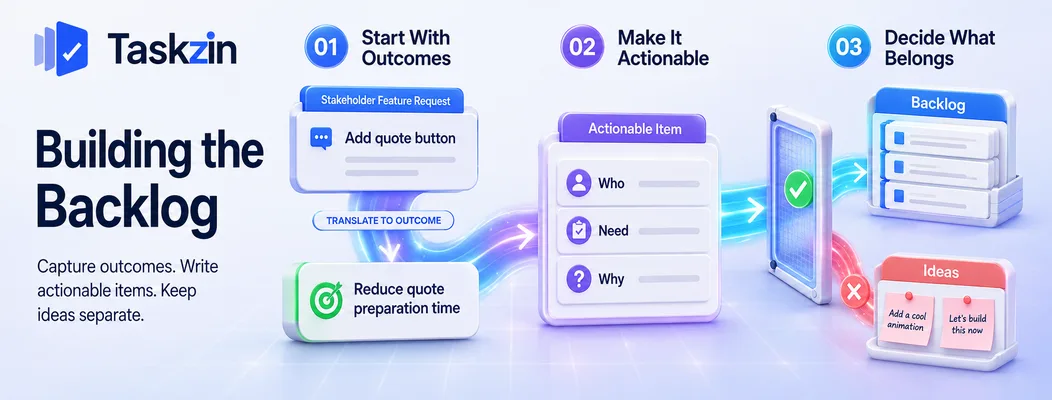
Build the backlog from outcomes rather than feature requests, write items the team can act on, and decide explicitly what does not belong in it.
Start from outcomes, not feature requests
A backlog assembled from stakeholder feature requests becomes a list of solutions, each attached to whoever asked loudest, with no way to judge relative value.
Capture the problem instead. "Sales spend twenty minutes preparing each quote" is a better backlog item than "add a quote template button", because it leaves room for a better solution and makes the value explicit. Requests still arrive as solutions — the product owner's job is to translate them back into the underlying need.
Write items people can act on
An item should state who it is for, what they need, and why. It does not need to be a formal user story, but it needs enough that someone reading it in three months understands the intent.
The test is whether a developer could pick it up and know what problem to solve without finding the person who wrote it. Items failing that test generate a research task every time they surface.
Decide what does not go in the backlog
Not everything belongs. Vague ideas, one-line thoughts, requests you have no intention of building, and bugs trivial enough to fix immediately all clutter the list without adding information.
Keep an ideas list separate from the backlog. The backlog is for work you intend to do; the ideas list is for things you might. Merging them is the main reason backlogs grow past readability.
Refinement: The Habit That Keeps It Healthy
Run refinement as its own regular session, refine roughly two sprints ahead, and split large items before they reach the top of the list.
Run it as a separate session, not inside planning
If refinement happens during sprint planning, planning runs long every time, because you are discovering and deciding simultaneously.
Hold a separate session — commonly an hour mid-sprint — where the team looks at upcoming items, asks questions, adds acceptance criteria and estimates. Planning then becomes selection from a set of ready items, which is fast.
Refine two sprints ahead, no further
Detailing further out wastes effort on work that may be reprioritised or changed by information you do not yet have.
Two sprints of ready work is enough to plan confidently and absorb a surprise. Teams that refine six sprints ahead redo that work regularly, and the rework quietly consumes a meaningful share of capacity.
Split large items before they reach the top
An item too large for one sprint should be broken down during refinement, not discovered as a problem during planning.
Useful splits follow the work rather than the technical layers: by user journey step, by data variation, by simple case first and edge cases later. Splitting into "backend" and "frontend" produces halves that deliver nothing individually, which defeats the purpose.
Prioritising Without Endless Debate
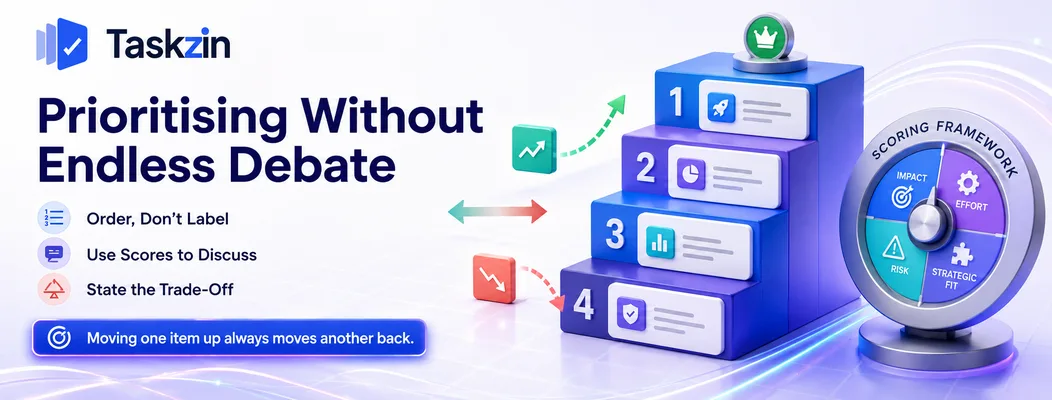
Order the list rather than labelling it, use a framework to start the conversation rather than to settle it, and state the trade-off explicitly when something moves up.
Order the list, don't label it
Priority labels let everyone avoid the decision. Ordering forces it, and forcing it is the entire value.
When a stakeholder wants their item higher, the question becomes concrete: which of these three things should it go above? That is a real conversation with a real answer, rather than an abstract argument about importance.
Use a framework as a conversation starter
RICE, MoSCoW, weighted scoring and similar frameworks are useful for structuring discussion and less useful as decision engines.
The numbers depend on estimates of reach and impact that are themselves uncertain, so treating the output as authoritative imports false precision. Use the framework to surface disagreement about assumptions — that disagreement is usually the thing worth resolving.
A practical approach is to score only the items people actively disagree about rather than the whole backlog. Scoring everything takes hours and mostly confirms what was already obvious; scoring the contested handful is where the framework earns its time.
Make the trade-off explicit
Every prioritisation decision delays something else. Saying so out loud changes the conversation, particularly with stakeholders.
"We can do this next, which pushes the reporting work to the following quarter" invites a genuine decision. "We'll add it to the backlog" invites the belief that everything can be accommodated, which is how backlogs become unreadable.
Pruning: The Step Everyone Skips
Delete items untouched for six months, close duplicates and superseded work, and reject requests explicitly rather than parking them indefinitely.
Delete anything untouched for six months
If an item has sat unchanged and unconsidered for six months, you are not going to build it.
Deleting it loses nothing — if the need is real, it will come back.
Run this quarterly. Most teams find they can remove a third of the backlog in an hour, and the remaining list becomes genuinely useful again.
Close duplicate and superseded items
Long-lived backlogs accumulate several versions of the same request, written by different people at different times, sometimes contradicting each other.
Merge them, keep the clearest version, and close the rest with a reference. Duplicates are corrosive because they make the list untrustworthy — nobody is sure whether an item is the current thinking.
Say no explicitly rather than parking things
Adding a request to the bottom of the backlog to avoid a difficult conversation is a common habit and a costly one. The requester believes it is coming; you know it is not.
Declining honestly is better for everyone. "We're not planning to build this, and here's why" preserves trust in a way that indefinite parking does not, and it keeps the backlog a description of intent rather than a record of everything ever asked for.
Keeping a visible list of declined requests with the reasoning helps here. It shows stakeholders their request was considered rather than ignored, and it gives you a record when the same idea returns six months later — sometimes with new information that genuinely changes the answer, which is worth being able to recognise.
The wider principle is that a backlog is a commitment device. Every item in it implies intent, and a list containing things you will never build devalues everything else on it.
Frequently asked
What is a product backlog?
A single ordered list of everything a team might work on, maintained by the product owner. Items near the top are detailed and ready to start; items further down are deliberately less defined.
How big should a product backlog be?
Small enough for the product owner to read in one sitting — typically under a hundred items. Beyond that, the bottom of the list is effectively invisible and stops informing decisions.
What is backlog refinement and how often should it happen?
A regular session where the team clarifies, splits and estimates upcoming items. Most teams run it once per sprint for about an hour, refining roughly two sprints ahead.
Who owns the product backlog?
The product owner owns ordering and content. The development team contributes estimates, technical items and feasibility input, but ordering is a single person's accountability.
Should bugs go in the product backlog?
Significant bugs that compete with features for capacity, yes. Trivial fixes are usually better handled immediately or in a small ongoing allowance, rather than added to the list.
How far ahead should a backlog be detailed?
About two sprints. Detailing further out means redoing the work when priorities change, which happens often enough to make the effort wasteful.
How do you deal with a backlog that has grown out of control?
Delete everything untouched for six months, merge duplicates, and close anything you would not start in the next quarter. Most teams remove a third or more in one session, and the remaining list becomes usable again.
Binita Ray is a content writer at Taskzin, creating insightful and practical content on task management, team collaboration, productivity, workflow optimization, and SaaS solutions. She focuses on helping businesses, teams, and professionals simplify their work processes, improve efficiency, and make better use of modern productivity tools.
All posts by Binita Ray

Comments