Remote Work Productivity Statistics
An evidence-led roundup of remote work productivity statistics, covering the randomised trial findings on hybrid and fully remote work, current working patterns, retention and cost effects, the perception gap, and how to use these figures responsibly.

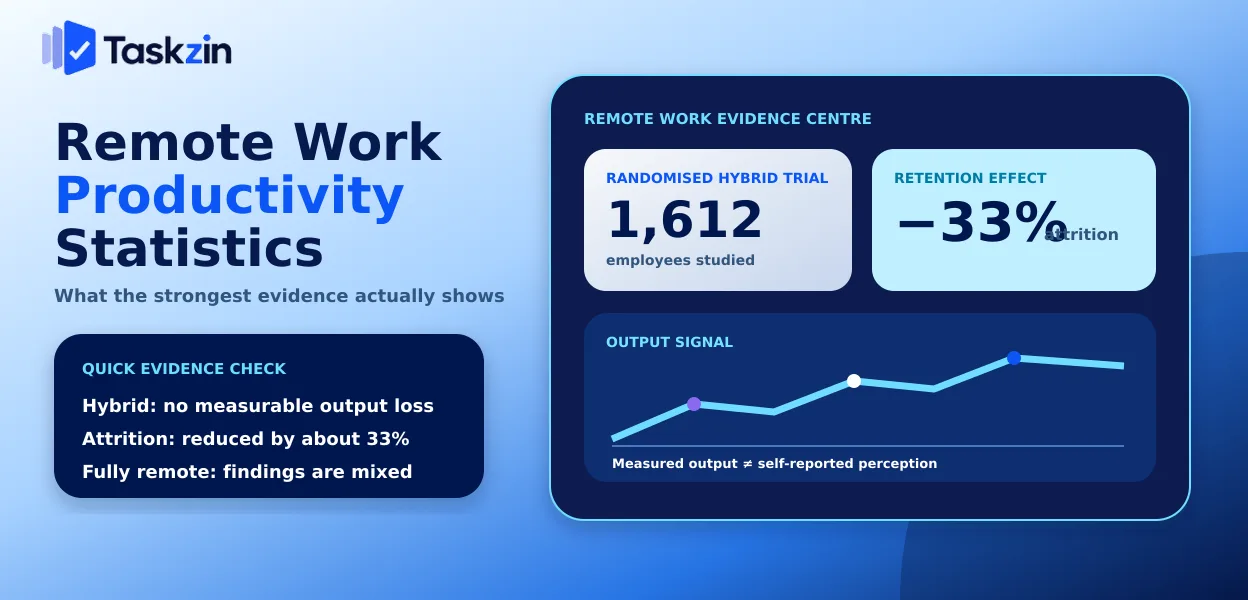
This matters because the remote work debate is unusually badly served by statistics. Self-report surveys, manager opinion polls and measured output studies all get quoted interchangeably, and they measure completely different things.
This roundup separates the rigorous evidence from the rest, and flags which commonly quoted figures deserve caution.
Quick answer: The strongest available evidence — a randomised controlled trial of 1,612 employees published in Nature — found that hybrid work had no measurable effect on performance while reducing attrition by about a third. Findings on fully remote work are more mixed, and much of what circulates online is self-reported perception rather than measured output.
What the Strongest Evidence Shows [IMG]
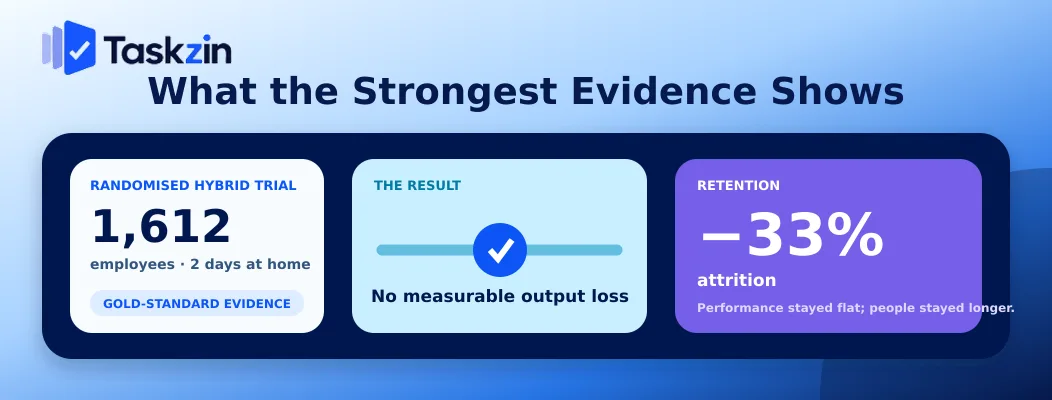
Two randomised trials dominate this field, and they reach different conclusions because they tested different arrangements.
The randomised trial on hybrid work
A 2024 randomised controlled trial of 1,612 employees published in Nature and led by Stanford's Nicholas Bloom found that hybrid work — two days from home — had no measurable effect on performance grades, promotions or output, while reducing attrition by about 33 percent.
Random assignment is what makes this the gold standard, because it isolates the effect of hybrid work from the type of person who chooses it. That distinction matters enormously: most remote work studies compare people who chose remote work with people who did not, which measures the people as much as the arrangement.
The earlier fully-remote trial
An earlier Stanford randomised trial produced a different headline. A Stanford trial recorded a 13 percent performance gain, with 9 points attributed to longer working minutes and 4 points to faster task handling.
The decomposition is the interesting part. Most of the gain came from working more minutes — fewer commute interruptions, fewer sick days — rather than from being more effective per minute.
Why randomised trials matter here
Nearly every other data point in this field is either self-reported or observational, and both are heavily confounded.
When someone reports feeling more productive at home, that is a genuine finding about experience and a poor proxy for output. When a company that adopted remote work reports strong results, the company may have been well-run to begin with. Randomisation removes both problems, which is why these two studies carry more weight than any number of surveys.
How People Actually Work Now
Measure Figure Source Remote-capable US employees working hybrid ~52% Gallup, 2025 Fully remote ~27% Gallup, 2025 Fully on-site (remote-capable roles) ~21% Gallup, 2025 US adults working from home for pay ~35 million BLS Global average WFH days per week ~1.27 Stanford WFH Research Trend since 2022 1.6 → 1.33 → ~1.27 days Stanford WFH Research
Stanford's global research found working-from-home levels stabilised after falling from pandemic highs, declining from 1.6 days per week in 2022 to 1.33 in 2023, then settling around 1.27 days in 2024/2025.
Fully Remote vs Hybrid: Different Findings [IMG]
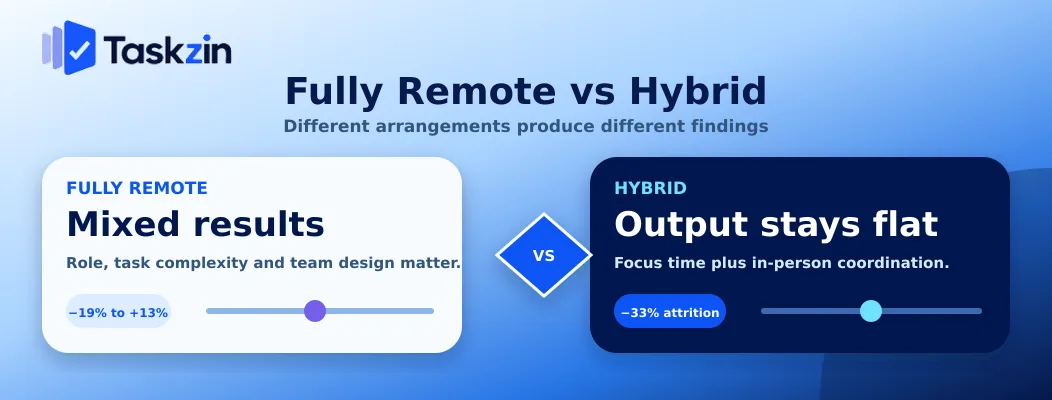
Hybrid arrangements show roughly flat performance against full-time office work; fully remote findings vary considerably by study and by role.
Hybrid shows roughly flat output
The Nature trial is the clearest evidence: no measurable performance difference, with substantially better retention.
The same Stanford work notes that hybrid working from home can be profitable for companies because it reduces recruitment and retention costs without reducing productivity. That framing — neutral on output, positive on cost — is the honest summary of the hybrid evidence.
Fully remote findings are mixed
Some studies suggest going fully remote may reduce individual output by 8 to 19 percent, in contrast to hybrid work, which shows a roughly flat impact on performance.
Set against the earlier trial showing a 13 percent gain, this looks contradictory. The resolution is that "fully remote" covers very different situations — role type, task complexity, whether the team was designed for it, and whether people were assigned or self-selected.
What explains the difference
Hybrid preserves the in-person contact that supports mentoring, onboarding and unplanned coordination while providing uninterrupted time for focused work.
Fully remote removes both the commute and the ambient coordination. Where the work is independent and well-defined, that trade favours remote. Where it depends on frequent informal contact, it does not — which is why the aggregate figures conflict.
The Retention and Cost Side
The most consistent finding across studies is not about output at all — it is that flexibility substantially improves retention and is valued highly by employees.
Attrition effects
The Nature trial's roughly one-third reduction in attrition is the single most robust finding in this literature, and it is economically significant. Replacing an experienced employee typically costs a substantial multiple of monthly salary.
An arrangement that is output-neutral and retention-positive is straightforwardly worth adopting on the numbers.
What flexibility is worth to employees
Stanford research led by Bloom finds that employees value hybrid flexibility at roughly the equivalent of an 8 percent pay raise.
That figure is useful for a specific decision: whether removing flexibility will cost you more in wage pressure and turnover than it returns.
Employer cost savings
Employers save about $11,000 per year per remote worker according to Global Workplace Analytics, primarily through reduced property and facilities costs.
Treat this as directional rather than precise — the figure depends heavily on local property costs and how much space is actually released.
The Perception Gap [IMG]
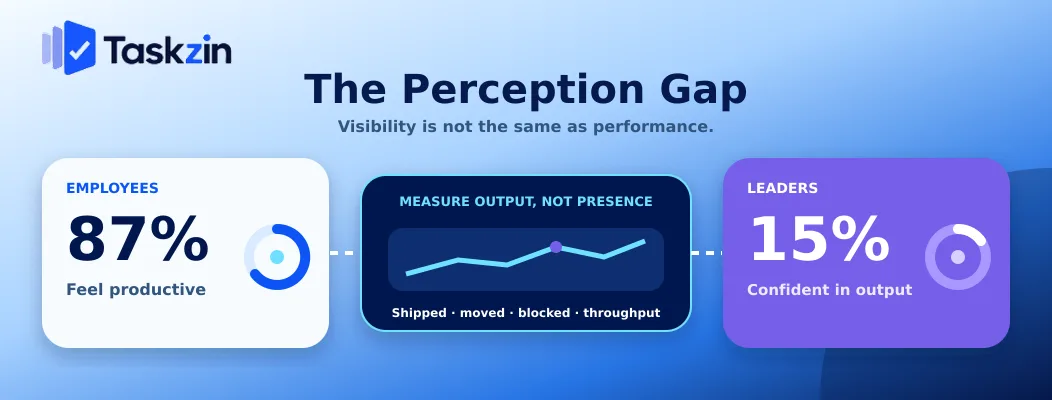
Employees, managers and executives hold markedly different views of remote productivity, and direct experience shifts manager opinion.
Employees, managers and executives disagree
A "productivity paranoia" gap exists where 87 percent of employees feel productive while only 15 percent of leaders feel confident in that output.
That gap is about visibility rather than performance. Executives lose the presence signals they previously used as a proxy, and in the absence of output measurement, they substitute anxiety.
Why managers change their minds
Managers initially expected the hybrid model to reduce output by 2.6 percent; by the end of the experiment, those same managers believed hybrid arrangements improved performance by 1 percent — direct experience changed their minds.
Separately, 70 percent of managers say remote or hybrid work makes their teams more productive, with only 12 percent reporting a decrease.
Measuring output rather than presence
The practical response to the perception gap is measurement. Teams that track what shipped, what moved and what is blocked can answer the productivity question with evidence rather than assertion.
This is a straightforward tooling matter: a shared project system where status is current gives leadership the visibility that presence used to provide. Any tool with cycle time and throughput reporting — Taskzin's dashboards among them — closes the gap without resorting to activity monitoring, which damages trust and measures the wrong thing.
Using These Statistics Responsibly
Distinguish self-reported perception from measured output, check what each study actually compares, and be wary of widely repeated figures with no traceable source.
Distinguish self-report from measured output
Around 77 percent of remote employees report being more productive when working remotely — one of the most consistent findings across surveys.
This is a real and useful finding about experience. It is not evidence of output, and presenting it as such is the most common error in remote work articles.
Check what is being compared
Fully remote against fully office is a different question from hybrid against fully office.
Self-selected remote workers are a different population from randomly assigned ones.
Most apparent contradictions in this field dissolve once you check which comparison a study actually ran.
Beware of figures with no traceable source
Several dramatic statistics circulate widely with attribution that dissolves on inspection — extrapolated economic totals, round-number percentage losses attributed vaguely to a research body.
If you cannot find the study, the sample size and the method, do not publish the number. Citing a solid finding with a modest effect size is more persuasive than citing a spectacular one that falls apart.
Frequently asked
Is remote work more productive?
The strongest evidence — a randomised trial published in Nature — found hybrid work had no measurable effect on performance. An earlier trial of fully remote work found a 13 percent gain, mostly from working more minutes rather than working faster.
What percentage of workers are hybrid or remote?
Among remote-capable US employees, Gallup's 2025 data shows roughly 52 percent hybrid, 27 percent fully remote and 21 percent fully on-site. Around 35 million US adults work from home for pay.
Does hybrid work reduce productivity?
The randomised trial evidence says no — performance grades, promotions and output showed no measurable difference against full-time office work, while attrition fell by around a third.
Does remote work reduce attrition?
Yes. The Nature trial found hybrid work reduced attrition by approximately 33 percent, which is the most robust and economically significant finding in this literature.
How much do employees value remote flexibility?
Stanford research values hybrid flexibility at roughly the equivalent of an 8 percent pay rise, which is a useful figure when weighing the cost of removing it.
Do managers think remote teams are productive?
Around 70 percent say remote or hybrid work makes teams more productive, with 12 percent reporting a decrease. Managers who initially expected a decline revised their view after direct experience.
Which remote work statistics should you not trust?
Self-reported productivity presented as measured output, comparisons between self-selected groups presented as causal, and dramatic economic totals with no published methodology behind them.
Binita Ray is a content writer at Taskzin, creating insightful and practical content on task management, team collaboration, productivity, workflow optimization, and SaaS solutions. She focuses on helping businesses, teams, and professionals simplify their work processes, improve efficiency, and make better use of modern productivity tools.
All posts by Binita Ray

Comments