SAFe for Small Companies: Worth It or Overkill?
An honest assessment of SAFe for small companies, covering what the framework adds above Scrum, when it is disproportionate, the conditions that justify it, lighter alternatives worth trying first, and how to adopt it sensibly.

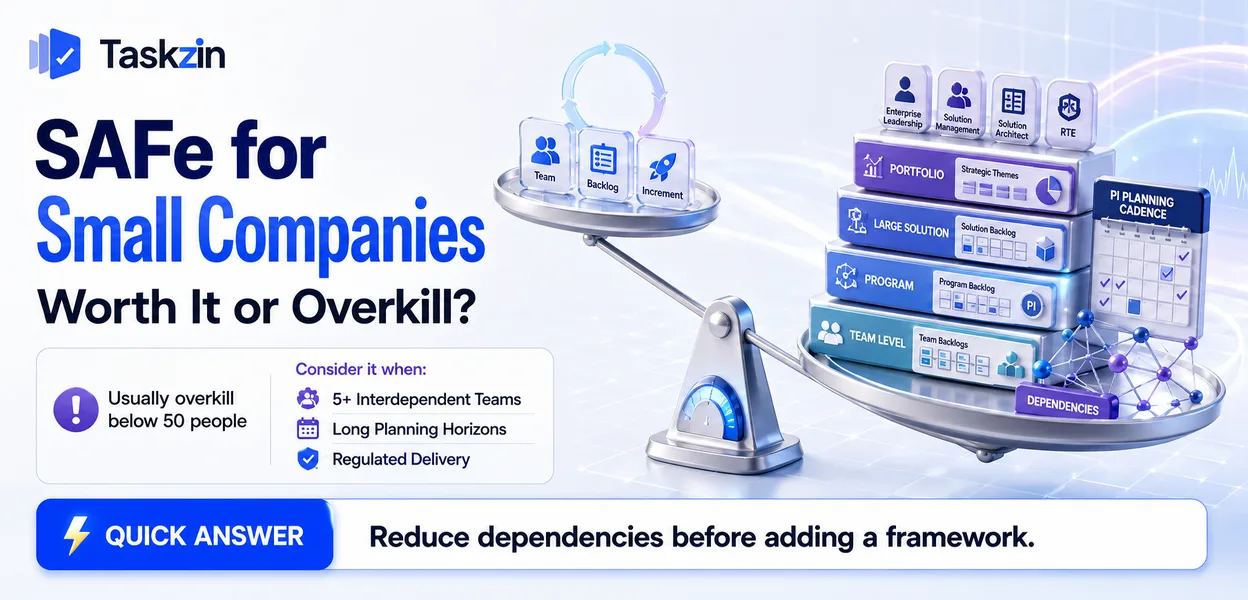
That said, "overkill" is not "never". Some small companies genuinely face the problems SAFe addresses, usually because of external constraints rather than internal size.
This guide covers what SAFe is, when it is disproportionate, when it starts to make sense, and the lighter alternatives worth trying first.
Quick answer: SAFe is overkill for most companies under about fifty people or fewer than four or five teams — it was designed to coordinate dozens of teams in large enterprises, and its ceremonies and roles cost more than they return at small scale. Smaller organisations almost always get more from reducing dependencies between teams than from adding a framework to manage them.
What SAFe Actually Is
SAFe is a framework for coordinating many agile teams working toward shared goals, adding planning cadences, roles and structures above the team level that Scrum does not define.
Scrum describes how one team works. SAFe describes how twenty teams stay aligned.
The problem it was built to solve
Its origin is a real and difficult problem. When many teams contribute to one product, dependencies multiply, teams block each other, and nobody can see across the whole effort.
SAFe addresses this with synchronised planning, shared cadence and explicit coordination roles. Whether that solution suits you depends entirely on whether you have that problem, and organisations frequently adopt it for reasons of aspiration rather than need.
The four configurations
SAFe comes in four levels of scope. Essential SAFe is the smallest, covering an agile release train — typically five to twelve teams working on a common product. Above it sit Large Solution, Portfolio and Full SAFe, each adding structure for larger contexts.
Most discussion of "SAFe" refers to the full framework, which is why it appears so heavy.
Essential SAFe alone is considerably lighter, and it is the only configuration a small company should even consider.
What it adds on top of Scrum
The main additions are the program increment — a planning cycle of typically eight to twelve weeks — and PI planning, a large synchronised event where all teams plan together and surface dependencies.
It also adds roles: release train engineer, product management above product owners, and system architect. Each exists to solve a coordination problem that only appears at scale, and each carries cost whether or not the problem is present.
SAFe Against the Alternatives at Small Scale
Approach Teams suited Coordination overhead Training cost Best for Scrum alone 1–3 Very low Low Most small companies Scrum of scrums 3–6 Low Very low Light cross-team sync LeSS 2–8 Low Medium Scaling with minimal additions Essential SAFe 5–12 High High One large product, many teams Full SAFe 12+ Very high Very high Enterprise portfolios
When SAFe Is Overkill
SAFe is disproportionate below roughly fifty people, with fewer than four or five teams, or wherever your coordination problems could be solved by changing team boundaries instead.
Under about fifty people
At this size the coordination problem SAFe solves largely does not exist. People know each other, decisions happen in conversation, and cross-team visibility is achievable by asking.
Adopting SAFe here adds planning events, roles and artefacts to manage complexity you do not have. The overhead is not theoretical — a PI planning event consumes one to two days from everyone, several times a year, which is a substantial share of a small company's capacity.
When you have one or two teams
SAFe's structures assume multiple teams contributing to a shared increment. With one or two, the release train concept has nothing to coordinate.
Two teams that occasionally depend on each other need a conversation, not a framework. A weekly fifteen-minute sync between the two leads handles what SAFe would address with a formal ceremony and a dedicated role.
When your dependencies are fixable
This is the important one. SAFe manages dependencies extremely well. It does not remove them.
If your teams are split by technical layer — a frontend team, a backend team, a database team — almost every feature crosses all three, so every piece of work is a coordination exercise.
Restructuring into cross-functional teams that can deliver a feature end to end eliminates the
dependency rather than scheduling it. That restructure is harder politically and far cheaper operationally than adopting a scaling framework to manage a problem you created.
When SAFe Starts to Make Sense
SAFe becomes reasonable when several teams genuinely contribute to one product, when external commitments force long planning horizons, or when regulation requires formal traceability across teams.
Multiple teams on one product
Once five or more teams work on a single product with genuine interdependence, informal coordination stops working and something structured is needed.
At that point the question is which framework rather than whether. SAFe is one option; LeSS is a lighter alternative worth evaluating alongside it.
Long planning horizons imposed from outside
If you sell to enterprises that require twelve-month roadmaps, or you operate under contracts specifying delivery dates months ahead, you need a planning mechanism that reaches further than a sprint.
The program increment provides exactly that. This is a legitimate reason for a smaller company to adopt some SAFe practice — the constraint is external and cannot be removed by better team design.
Regulated or contract-driven delivery
Environments requiring documented traceability from requirement through delivery across multiple teams get real value from SAFe's structure, because the artefacts it produces are the evidence auditors ask for.
If you are building medical devices, financial systems or defence software, the overhead buys you something concrete. The test is whether you would have to produce equivalent documentation anyway. If the answer is yes, a framework that generates it as a by-product of planning is cheaper than assembling it separately before each audit.
Lighter Alternatives Worth Trying First
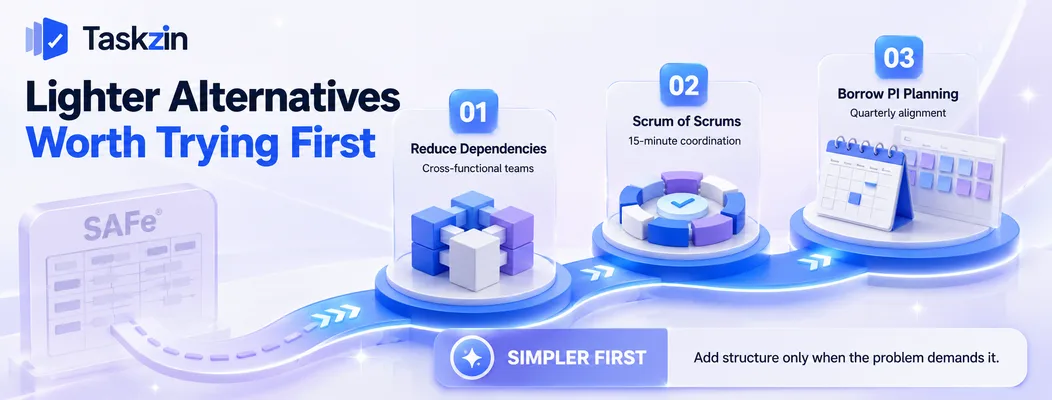
Before adopting a scaling framework, try reducing dependencies through team design, running a scrum of scrums for coordination, or borrowing PI planning without the rest of SAFe.
Reduce dependencies instead of coordinating them
This is the highest-return option and the least often taken, because it involves reorganising teams rather than adding process.
Organise teams around products, customer journeys or value streams rather than technical layers, so each can deliver something complete without waiting. A team that can ship a feature end to end has no dependency to manage. Every coordination mechanism you avoid needing is permanent savings.
Scrum of scrums
A short regular meeting where one representative from each team surfaces cross-team blockers. Fifteen minutes, two or three times a week.
It costs almost nothing and handles most coordination needs up to five or six teams. Try this before anything heavier — many organisations that adopted SAFe would have been adequately served by it.
Borrow PI planning without adopting SAFe
PI planning is genuinely useful, and you can run it without the surrounding framework. Get all teams in a room for a day each quarter, plan the next few months together, and make dependencies visible on a shared board.
You get most of the alignment benefit without the roles, certifications and permanent ceremony overhead. Several organisations run exactly this and call it a quarterly planning day.
If You Do Adopt SAFe
Start with Essential SAFe only, budget honestly for training, and decide explicitly what you will stop doing to make room for the new ceremonies.
Start with Essential SAFe only
Do not adopt Portfolio or Full SAFe because the diagram includes them. Essential SAFe is the smallest viable configuration and covers what most organisations actually need.
Add levels only when a specific problem demands them. Adopting the full framework at once is how SAFe earns its reputation for bureaucracy.
Budget for the training honestly
SAFe adoption involves certification and training costs, plus the time everyone spends in it. For a small company this is a material investment, and it is frequently underestimated because only the course fees get counted.
Include the time cost of PI planning across all participants, several times a year. If the total is uncomfortable, that discomfort is useful information about whether the problem justifies the solution.
Agree what you will stop doing
The most common adoption failure is adding SAFe's ceremonies on top of everything already happening. Teams then have sprint events, SAFe events, and whatever management reporting existed before.
Before starting, list what the new structure replaces. If nothing is being removed, you are adding overhead rather than changing how you work, and the framework will be blamed for a decision you made.
Typical candidates for removal are the monthly status report that PI planning now supersedes, the separate roadmap document that duplicates the program board, and any standing coordination meeting whose purpose is now served by a formal ceremony. Write the list down and check it three months in — the old artefacts have a way of quietly surviving alongside the new ones.
Frequently asked
What is SAFe in agile?
The Scaled Agile Framework, a set of practices for coordinating many agile teams working toward shared goals. It adds planning cadences, roles and structures above the team level that Scrum does not define.
Is SAFe suitable for small companies?
Usually not. Below roughly fifty people or four to five teams, it adds ceremonies and roles for coordination problems that do not yet exist. Exceptions are external planning obligations and regulated delivery.
What is the minimum team size for SAFe?
An agile release train is typically five to twelve teams, or roughly fifty to one hundred and twenty-five people. Below that, the structures have little to coordinate.
What is PI planning?
Program increment planning — a synchronised event, usually one to two days each quarter, where all teams plan the coming increment together and surface dependencies. It can be run without adopting SAFe.
What are the alternatives to SAFe?
Reducing dependencies through cross-functional team design, scrum of scrums for light coordination, LeSS as a lighter scaling framework, or borrowing quarterly planning without the rest of SAFe.
Why do people criticise SAFe?
Chiefly that it adds hierarchy and process that can undermine team autonomy, and that organisations adopt it to look agile while preserving existing command structures. The criticism is strongest when it is adopted at inappropriate scale.
Can you use parts of SAFe without adopting all of it?
Yes, and many organisations do. Quarterly planning events and dependency boards are useful in isolation. Taking the practices that solve a problem you actually have is generally better than adopting the whole framework.
Binita Ray is a content writer at Taskzin, creating insightful and practical content on task management, team collaboration, productivity, workflow optimization, and SaaS solutions. She focuses on helping businesses, teams, and professionals simplify their work processes, improve efficiency, and make better use of modern productivity tools.
All posts by Binita Ray
Comments