Daily Standup Alternatives for Async Teams
A practical guide to replacing the daily standup on async teams, covering why live standups break down across time zones, six alternatives compared, how to run a written standup properly, and how to choose and introduce the right one.

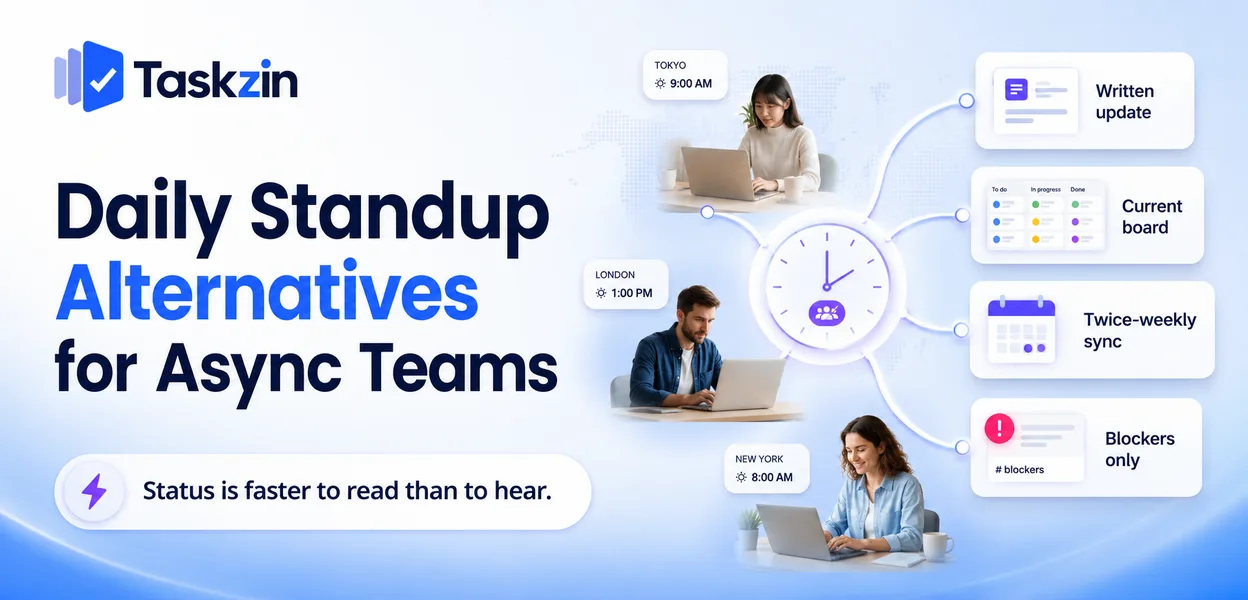
Most teams replace it with a written update. That works, provided the update stays short and — crucially — provided people respond to it. A written standup nobody reacts to is worse than the meeting it replaced.
Quick answer: The live daily standup breaks down across time zones because someone is always inconvenienced and because status is faster to read than to hear. The main alternatives are a written standup, board-driven coordination with no update at all, a twice-weekly live sync, or a blockers-only channel. Which one fits depends on what your standup was actually providing.
Why the Live Standup Breaks Down Async
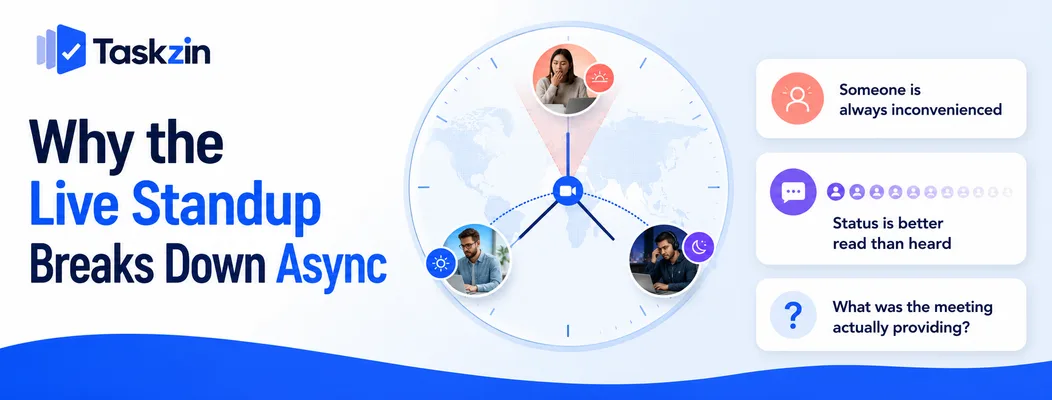
A daily live meeting across time zones inconveniences someone every day, delivers information less efficiently than reading, and often was not doing what people assumed.
Someone is always inconvenienced
With a spread beyond about four hours, there is no time that suits everyone. Somebody joins early, late, or from a different day.
Doing that daily accumulates. Rotating the time distributes the inconvenience without removing it, and for wide spreads there is no acceptable slot at all.
Status is better read than heard
Six people speaking for two minutes each is twelve minutes of listening, most of it irrelevant to any given listener.
The same information written takes ninety seconds to read, is skimmable, stays searchable, and can be consumed when convenient. For pure status, writing wins decisively.
What the standup actually provided
Before replacing it, be honest about what it was doing. Sometimes coordination — people discovering overlap or offering help. Sometimes just visibility for a manager. Sometimes the only routine human contact in a distributed team.
Those need different replacements. Replacing a social function with a written update removes something that mattered, and the team will feel the loss without necessarily naming it.
Six Alternatives Compared
Alternative How it works Best for Main risk
The Written Standup
Everyone posts a short update daily Teams needing daily visibility Becomes a report nobody reads
Board-driven No update; the board is current Mature teams with accurate boards Blockers surface late
Twice-weekly live sync
Two short live syncs instead of five Moderate time zone spread Two days between coordination Blockers-only channel Post only when stuck Experienced, low-dependency teams Loses incidental coordination Async video Short recorded update Teams wanting more human contact Not searchable, slower to consume Weekly written plus daily blockers One planning post, blockers as they arise Most distributed teams Requires discipline on both
What should a written standup include?
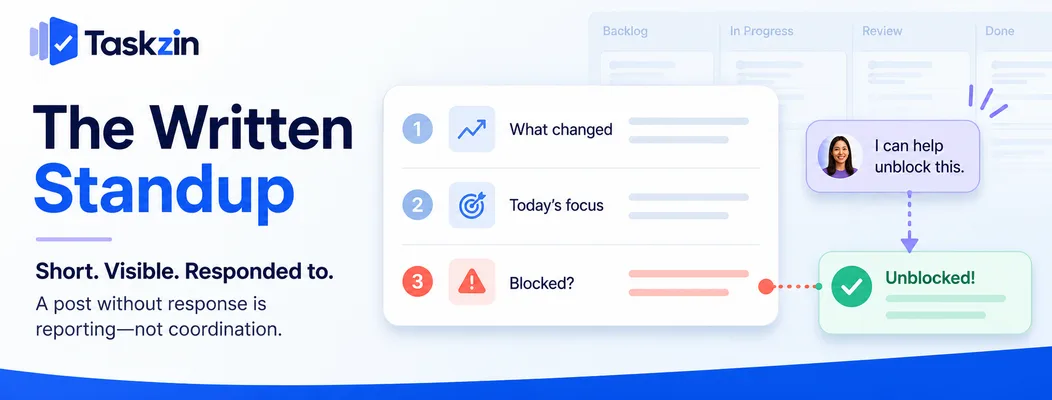
A written standup works when it is three short lines, posted somewhere people already look, and treated as something to respond to rather than to file.
What to include, and what to leave out
Three lines: what changed since yesterday, what you are working on today, and anything blocking you.
Leave out activity narration. "Attended two meetings and reviewed some PRs" is not information anyone needs. If nothing material changed, saying so is a legitimate and useful update.
The blocker line is the one that matters. If nobody on the team ever posts a blocker, either the format has become a formality or people do not feel able to say they are stuck.
Where to post it
Wherever the team already looks — a channel they read, or attached to the work itself.
Posting into a place people must remember to visit means the update is written and not read.
Where the project tool holds the work, posting updates against the relevant items keeps them in context rather than in a separate stream.
Why responses matter more than posts
The failure mode is a channel where six people post daily and nobody replies. That is reporting, not coordination, and people stop investing effort within a fortnight.
Make responding the norm. If someone posts a blocker and nobody engages, the format has failed at the only thing it was for. One person taking responsibility for reading and reacting each morning is usually enough to establish the habit.
Alternatives That Are Not Written Updates
Three options avoid a daily update entirely: relying on an accurate board, reducing to two live syncs, or a channel used only for blockers.
Board-driven, no update at all
If the board is genuinely current, the standup information already exists — who is working on what, what is blocked, what moved.
This works for mature teams with reliable board hygiene and fails immediately for teams whose board is updated weekly. The prerequisite is strict, but where it holds, this is the lightest option available.
Twice-weekly live sync Rather than five short meetings, two slightly longer ones — Monday and Thursday, for example.
This preserves live contact and coordination while cutting the count by 60 percent. It suits teams with a moderate time zone spread where a live meeting is workable but daily is excessive.
Blockers-only channel
No routine updates. People post only when stuck or when something changes that affects others.
This is the lightest possible option and requires a mature team. Its risk is losing incidental coordination — the discovery that two people are working on adjacent things, which routine updates surface and blocker-only posting does not.
Choosing and Introducing the Right One
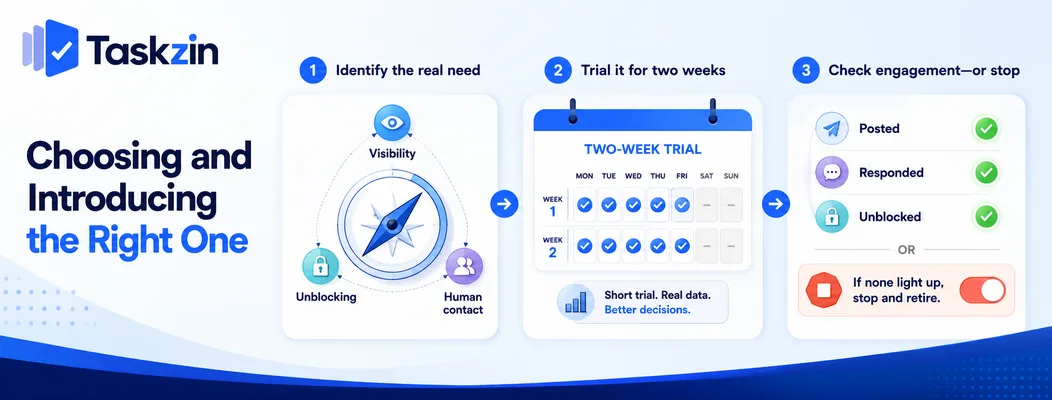
Identify what the standup was solving, trial the replacement for two weeks, and stop the update entirely if nobody engages with it.
Start from what the standup was solving
Ask the team what they would miss. The answers usually cluster: knowing what others are doing, getting unblocked quickly, or simply seeing colleagues.
Choose the replacement that addresses the actual answer. A team that valued the human contact will not be well served by a written update, however efficient.
Trial for two weeks
Run the replacement for two weeks with the explicit understanding that it is a trial and will be reviewed.
This removes the political weight from the change and makes it easy to adjust. Most teams need one revision — a shorter format, a different posting location, or a different frequency.
Kill the update if nobody reads it
Check honestly after a month. Are people posting? Is anyone responding? Has anything been unblocked as a result?
If the answer to all three is no, the update is overhead. Stop it and rely on the board plus a blockers channel. A discontinued practice that was not working is a better outcome than one continued out of habit.
Common Mistakes With Async Standups
The three failures are updates that become reports, posting into silence, and keeping both the meeting and the written update.
Written updates that become reports
When the update is written for a manager rather than for peers, it becomes performative — people list activity to demonstrate productivity.
The signal is length. Updates growing past a few lines have usually become reports, and the fix is a format constraint rather than a reminder.
Posting into silence
An update channel where nobody responds trains everyone that posting is a formality.
Someone needs to read and react daily, at least while the habit forms. Without that, the practice decays within a month.
Keeping both the meeting and the update
Teams sometimes adopt a written standup and keep the live one, on the basis that more communication must be better.
It is not — it is the same information twice, and one of them will be neglected. Choose one.
Frequently asked
What can replace a daily standup?
A written standup, board-driven coordination with no update, a twice-weekly live sync, or a blockers-only channel. Which fits depends on what your standup was actually providing.
What should a written standup include?
Three short lines: what changed since yesterday, what you are working on today, and anything blocking you. Not a narration of activity.
Do async teams need a daily standup at all?
Not necessarily. Teams with accurate boards and low dependency between members often function well with blockers-only posting and no routine update.
How do you stop written standups becoming status reports?
Constrain the format to three lines, make responding the norm, and check whether people are writing for peers or for a manager. Length growing is the earliest signal.
Is a twice-weekly standup enough?
For many teams, yes. It preserves live coordination while cutting the meeting count substantially, and it suits teams with moderate rather than extreme time zone spreads.
Can the board replace the standup?
Only if the board is genuinely current. Where board hygiene is reliable, the standup information already exists and a separate update is duplication. Where it is not, blockers surface too late.
How do you handle blockers without a daily meeting?
A dedicated channel or a flag on the item, with an expectation that someone responds within a defined window. The response obligation is what makes it work rather than the channel itself.
Sanju Shrestha is a SaaS content writer at Taskzin who explores smarter ways to manage work, organize priorities, and improve team performance. Her content covers productivity strategies, digital workflows, collaboration, and task management, with a focus on helping modern teams work more efficiently and stay aligned.
All posts by Sanju Shrestha


Comments