Eat the Frog: Does Doing the Worst Task First Work?
An honest assessment of the eat the frog method, covering what it prescribes, why it works when it works, where the advice breaks down, a more useful version of the rule, and the mistakes people make applying it.

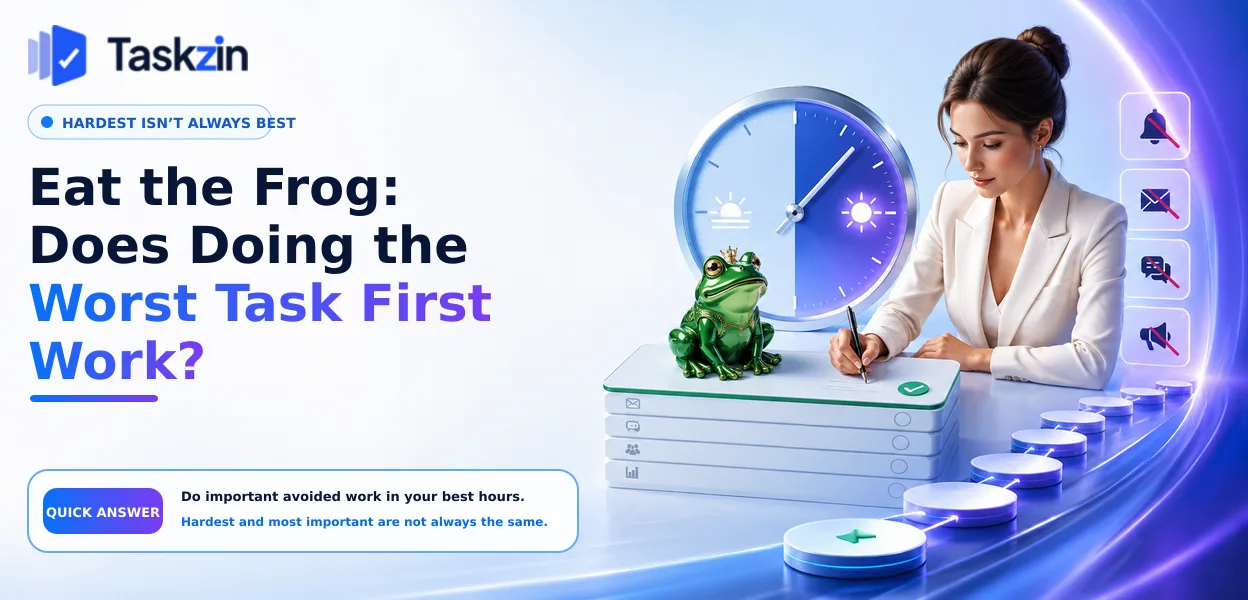
The advice is sound in its core insight and frequently over-applied. A more useful version keeps the mechanism and drops the rigidity.
Quick answer: The rule says do your hardest or most avoided task first thing, before anything else. It works for a specific reason — resistance to starting is highest when a task has been sitting unaddressed, and your capacity to override that resistance is highest before the day has depleted it. It fails when people confuse unpleasant with important, or when their best hours are not the morning.
What the Method Says
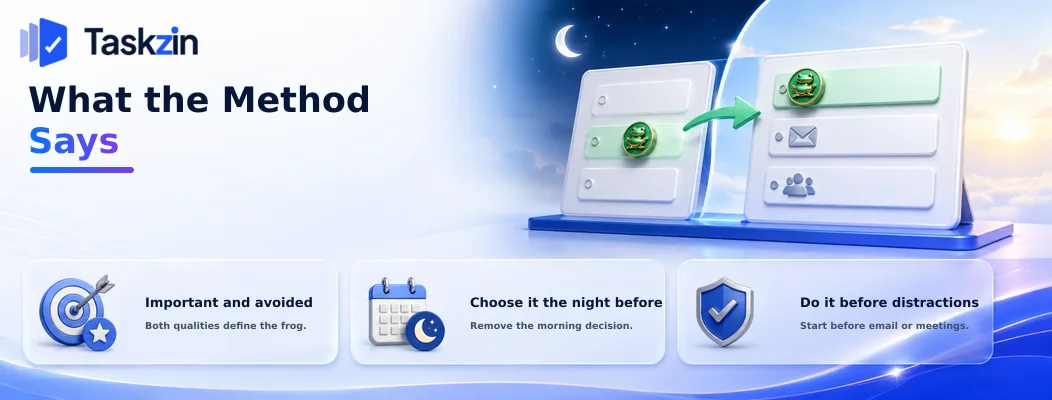
Identify the task you are most likely to avoid, and do it first thing before anything else can displace it.
The rule
Popularised by Brian Tracy and drawing on a line attributed to Mark Twain — if you have to eat a frog, do it first thing, and if you have to eat two, eat the biggest one first.
Applied practically: pick your hardest or most avoided task the day before, and start on it before email, meetings or anything else.
What counts as a frog
In the original framing, the frog is the task with the greatest consequence that you are most likely to procrastinate on. Both parts matter — consequential and avoided.
In practice, people frequently apply it to whatever they dislike most, which is a different and less useful selection criterion. The distinction is the main source of the method's failures.
The reasoning behind it
Two claims underpin it. First, that self-control and decision-making capacity deplete over a day, so the hardest thing is best attempted early. Second, that an avoided task consumes attention while it remains undone, so clearing it early frees the rest of the day.
The second claim is the stronger of the two and matches most people's experience directly.
When It Works and When It Does Not
Situation Does it work? Why Task you have deferred repeatedly Yes, strongly Resistance is highest and the method targets exactly that Genuinely important work needing focus Yes
Your best hours may not be the morning
day fills Unpleasant but low-value task Counterproductive Spends peak hours on something that did not matter
You are a late-day worker Poorly "First thing" is the wrong slot for your peak Morning is full of meetings Poorly The slot does not exist Task needs warm-up or input from others Poorly Cannot start cold Frog is really a multi-week project Poorly Cannot be eaten in a sitting
Why It Works When It Works
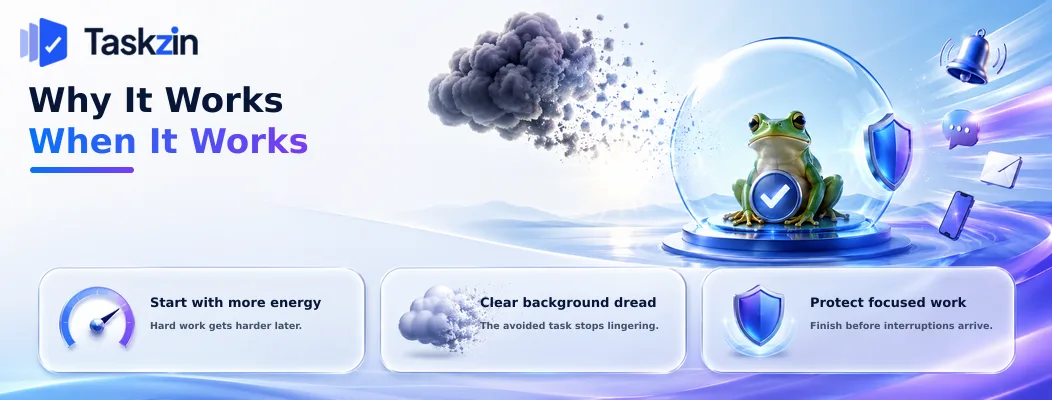
Three mechanisms explain the method's effect: limited willpower early in the day, the attentional cost of an undone task, and protection from interruption.
Willpower and decision fatigue
The claim that self-control depletes over a day is contested in its strongest form, but the practical observation holds for most people: hard things are harder to start at 4pm than at 9am.
Whether the mechanism is depletion or accumulated interruption matters less than the pattern, which is consistent enough to plan around.
Removing the background dread
An avoided task consumes attention while it remains undone. You are aware of it during other work, and it colours the day.
Clearing it early removes that. This is the effect people report most consistently, and it is arguably the method's strongest justification — the benefit is as much about the rest of the day as about the task itself.
Protecting the task from the day
Work scheduled for the afternoon competes with everything that arrives. Work done at 9am competes with nothing.
This is simply about ordering. The morning is the only part of the day whose contents you fully control, so anything genuinely important benefits from being placed there.
Where the Advice Breaks Down
The rule fails when your peak hours are not the morning, when the avoided task is not actually important, and when the task cannot be started cold.
Your best hours may not be the morning People vary genuinely in when they work best. For a meaningful proportion, peak focus is late morning, afternoon or evening.
"First thing" is shorthand for "your best hours", and treating the literal morning as the rule sends late-peaking people to their hardest work at their worst time.
Not every unpleasant task is important
This is the most common misapplication. Expenses, a tedious form, a conversation you are dreading that concerns nothing consequential.
Spending your peak hours on something unpleasant but unimportant is worse than not using the method at all, because you have deliberately allocated your best capacity to low-value work.
Some frogs need a warm-up
Certain work requires assembling context before real progress is possible. Attempting it cold, first thing, produces twenty minutes of unproductive staring.
For that kind of task, a short easier item first — genuinely short — can be the more effective route, despite contradicting the rule.
A More Useful Version of the Rule
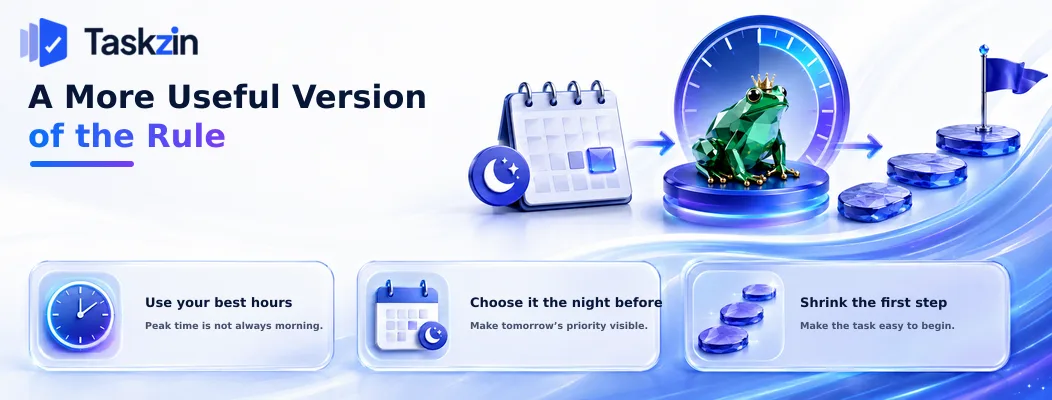
Do the most important thing in your best hours, choose it the evening before, and reduce it to a startable first step.
Do the most important thing in your best hours
This preserves the mechanism and removes the two failure modes. It targets importance rather than unpleasantness, and it respects that peak hours differ.
For most people this is still the morning, so the practical advice frequently looks identical. For the rest, it works where the literal version does not.
Identify the frog the night before
Deciding what matters most at 9am uses the capacity you were trying to protect.
Choose it at the end of the previous day, write it down, and start on it without deliberation.
Removing the morning decision is a meaningful part of the benefit. Having tomorrow's priority visible at the top of a shared list means the decision is already made when you sit down.
Shrink the frog rather than swallowing it
If the task is genuinely large, "do it first" is not achievable in a sitting.
Reduce it to the first concrete step — draft the opening paragraph, sketch the structure, make the call. Doing the first step of the frog is a version of the rule that works for real work, and it is usually enough to break the avoidance.
Common Mistakes With Eat the Frog
The three errors are treating unpleasant as important, using the rule to avoid prioritising properly, and applying it to something that is really a project.
Confusing unpleasant with important
The method's own framing includes consequence, and that part is routinely dropped.
Before applying it, ask whether this task actually matters or is merely disliked. If the latter, batch it into a low-energy slot instead of spending your best hours on it.
Using it to avoid prioritising
"Do the hardest thing first" is not a prioritisation method. It says nothing about what should be done at all, only about ordering within a day.
Pair it with an actual prioritisation approach. On its own it can produce a day where you diligently complete the hardest of several unimportant tasks.
Applying it to a frog that is really a project
A multi-week piece of work cannot be eaten. Attempting to and failing produces exactly the discouragement the method is meant to prevent.
Break it down first, then eat the first piece.
Frequently asked
What does eat the frog mean?
Doing your hardest or most avoided task first thing in the day, before anything else can displace it. The phrase comes from a line attributed to Mark Twain and was popularised by Brian Tracy.
Does eating the frog first actually work?
For tasks you have been avoiding, yes — resistance is highest before you start and your capacity to override it is highest early. It works less well when the avoided task is not actually important.
Should you always do the hardest task first?
Do the most important task in your best hours, which is a slightly different rule. Hardest and most important are not always the same thing, and best hours are not always the morning.
What if you are not a morning person?
Apply the rule to your actual peak hours rather than to the literal morning. The mechanism is about protecting your best capacity, not about the clock.
What if the frog takes all day?
Break it into pieces and do the first concrete step. A task too large to complete in a sitting cannot be "eaten", and attempting it produces the discouragement the method exists to prevent.
How do you identify your frog?
Choose it at the end of the previous day, using two criteria together: which task matters most, and which are you most likely to avoid. The overlap is your frog.
How does eat the frog compare to other prioritisation methods?
It is not really a prioritisation method — it orders work within a day rather than deciding what to do at all. Pair it with something that ranks work, such as a forced ranking or the Eisenhower matrix.
Sanju Shrestha is a SaaS content writer at Taskzin who explores smarter ways to manage work, organize priorities, and improve team performance. Her content covers productivity strategies, digital workflows, collaboration, and task management, with a focus on helping modern teams work more efficiently and stay aligned.
All posts by Sanju Shrestha


Comments