Retrospective Template: 5 Formats to Try
Five retrospective formats with prompts, timings and what each surfaces, covering why rotating formats matters, the one thing that determines whether retros work, facilitation guidance, and common mistakes.


Rotating formats helps, and it is the second-order fix. The first is making one action happen.
Quick answer: A retrospective produces value only if it ends with one owned action that actually happens. Everything else — the format, the sticky notes, the discussion — is a means to that. Teams abandon retros not because the format is stale but because nothing changes afterwards, and after four fortnights of that, attendance becomes compliance.
Why Rotating Formats Matters

The same prompts produce the same answers, and different formats surface different problems.
The same questions produce the same answers
Ask "what went well and what didn't" every fortnight for a year and you get the same answers.
People stop thinking and start reciting.
Format fatigue is real. Changing the prompt changes what people notice, which is the entire mechanism.
What each format surfaces differently
Start, stop, continue produces concrete process changes. Mad, sad, glad surfaces emotional friction that process questions miss. The 4Ls draw out learning. The sailboat surfaces risks and goals. A timeline retro reveals what actually happened versus what people remember.
Choosing a format is choosing what you want to find out, which is worth being deliberate about.
When to change
Change when answers start repeating, when a specific problem needs a specific lens, or roughly every four to six retros.
Not every time. Constant novelty means the team spends its energy learning the format rather than reflecting.
The Five Formats Compared
Format Prompts Best for Time
Format One: Start, Stop, Continue
What should we start, stop, keep doing?
Concrete process changes 45 min Mad, sad, glad What frustrated, disappointed, pleased you?
Emotional friction, team health 60 min 4Ls Liked, learned, lacked, longed for Learning and unmet needs 60 min
Sailboat Wind, anchors, rocks, destination Goals and upcoming risks 60 min Timeline Plot events across the sprint, mark highs and lows Understanding what actually happened 75 min
Format One: Start, Stop, Continue The default format, and the right choice when you want concrete process changes.
Column Prompt What it produces Start What should we begin doing that we are not?
New practices, missing steps Stop What should we stop doing?
Waste, ceremony, unhelpful habits Continue What is working that we should protect?
Recognition, practices worth defending
How to run it: five minutes silent writing, ten minutes grouping similar items, fifteen minutes discussing the largest clusters, ten minutes selecting one action with an owner and a date.
Its weakness: it is process-focused and will not surface interpersonal or morale issues. Rotate away from it when those are the real problem.
Formats Two to Five
Four alternatives, each surfacing something start-stop-continue does not.
Format Columns How to run it Surfaces **Mad, sad, glad** Mad: what frustrated you. Sad: what disappointed you.
Glad: what pleased you.
Silent writing, then group by theme rather than by column Emotional friction, morale, interpersonal strain that process questions miss **4Ls** Liked, Learned, Lacked, Longed for Silent writing, then focus discussion on Lacked and Longed for Learning, and unmet needs the team has not voiced **Sailboat** Wind (helping us), Anchors (holding us back), Rocks (risks ahead), Destination (the goal) Draw it, populate, then discuss rocks before anchors Upcoming risks and whether the team agrees on the goal **Timeline** Plot events across the sprint on a line; each person marks highs and lows Build the timeline together first, then discuss the divergences What actually happened versus what people remember; where experiences differed
The Part That Actually Matters

One owned action with a date, and reviewing the previous one first — this is what separates useful retros from ritual.
One action, owned, with a date
Not five actions. One, with a named owner and a date, small enough to complete before the next retro.
Teams that generate five actions complete none of them. Teams that pick one complete it, and after three fortnights they have three real improvements plus evidence that the retro works.
Reviewing last time's action first
Open every retro with the previous action: did it happen, did it help?
This takes three minutes and is the single highest-value change most teams can make. It creates accountability and demonstrates that retros produce change, which is what sustains participation. Recording the action as a task on the project — owned and dated like any other work — is what makes it reviewable rather than a note in a document.
Why teams stop believing in retros
Not boredom. Futility. After several rounds where nothing changed, attending becomes theatre.
Once that belief sets in, it takes several consecutive retros with completed actions to recover.
Preventing it is far easier than repairing it.
Facilitating Without Dominating
Write before discussing, protect honesty, and timebox tightly.
Write before discussing
Five minutes of silent writing before any discussion. This is not optional.
Without it, the first person to speak anchors the conversation, quieter people contribute less, and the loudest concern dominates regardless of its importance. Silent writing gives everyone equal input.
Keep it safe enough to be honest
If people cannot say what actually went wrong, the retro produces polite fiction.
The facilitator's main job is protecting that. Focus on systems and process rather than individuals, redirect blame toward causes, and be alert to whether the same people speak every time.
Timebox the discussion
Discussion expands indefinitely. Timebox each phase and hold to it.
A retro running to ninety minutes regularly will start getting cancelled. Forty-five to sixty minutes for a two-week sprint is right.
Common Retrospective Mistakes
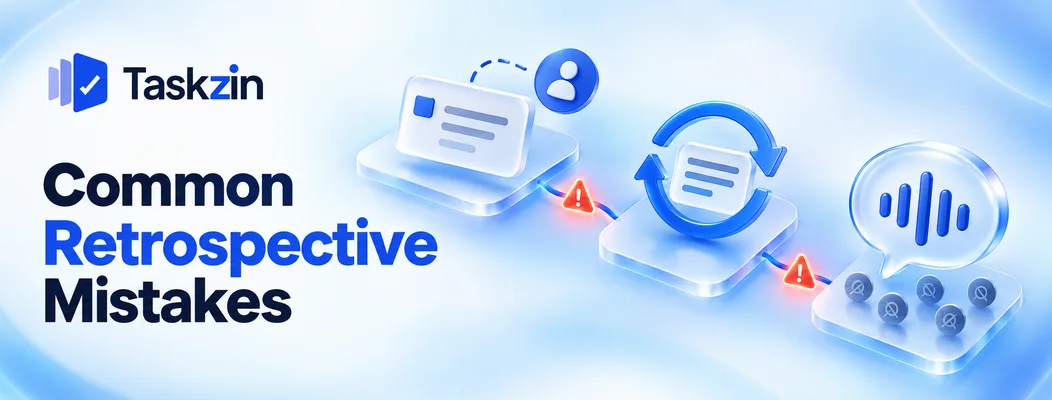
Three failures: unowned actions, unresolved recurring complaints, and managers dominating the discussion.
Actions nobody owns
"We should improve our estimates" is not an action. It has no owner, no date and no definition of done.
Every action needs a name and a date. Without both, it is a wish.
The same complaint every fortnight
When an issue recurs across several retros, it is usually outside the team's control — a dependency, a resourcing decision, an organisational constraint.
Continuing to raise it internally is demoralising. Escalate it explicitly to whoever can act, and record that you did. If it cannot be changed, say so plainly and stop putting it on the board.
Managers dominating the room
A manager who speaks first, speaks most, or reacts defensively will get honest input once and never again.
Managers can attend if the team is comfortable with it, and should speak last. If the team is not comfortable, that is important information about the environment.
Frequently asked
What is a retrospective?
A regular session where a team reflects on how it worked over a period and agrees improvements. Its value comes entirely from the actions that follow, not from the discussion itself.
How long should a retrospective take?
Forty-five to sixty minutes for a two-week sprint. Longer sessions become hard to sustain and start getting cancelled.
What is the start stop continue format?
Three prompts — what to begin doing, what to stop, and what is working and should be protected. It is the default format and produces concrete process changes.
How many actions should come out of a retro?
One. Teams generating five actions typically complete none; teams picking one complete it and accumulate real improvements over time.
Should managers attend retrospectives?
Only if the team is comfortable with it, and they should speak last. A manager who dominates or reacts defensively will get honest input once and never again.
How often should you change the format?
Every four to six retros, or when answers start repeating. Changing every time means the team spends its energy learning formats rather than reflecting.
What do you do when the same issue keeps coming up?
It is usually outside the team's control. Escalate it explicitly to whoever can act, record that you did, and if it genuinely cannot change, say so and stop raising it internally.
Sujan Sharma is a content writer at Taskzin with a strong focus on productivity systems, task management, workflow optimization, team collaboration, and SaaS technology. He creates research-driven, practical content that helps professionals and growing teams improve operational efficiency, streamline processes, and make informed decisions about modern work management tools.
All posts by Sujan Sharma


Comments