Marketing Campaign Brief Template
A marketing campaign brief template with a filled worked example, covering what a brief must settle, how to write the proposition and audience sections, how to brief without a rejection cycle, and common mistakes.


A campaign brief has to settle three things before any work starts: one audience, one message, one action you want them to take. Briefs that name three audiences and four messages produce work that reaches nobody in particular. The discipline is subtraction, and it is the part most briefs skip.
The template below fits on one page, with a worked example and guidance on the two sections people find hardest — the proposition and the audience.
What a Brief Has to Settle
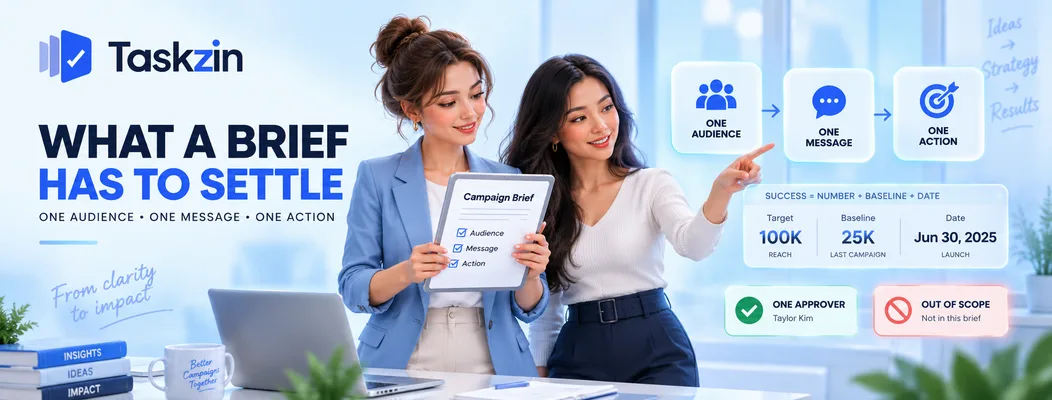
A brief exists to make decisions, not to describe context. If it settles nothing, the decisions get made later and inconsistently.
One audience, one message, one action
Not a primary and two secondary audiences. One.
Every additional audience halves the sharpness of the message, because a message written for two groups is written for neither. If you genuinely have three audiences, you have three campaigns and should brief them separately.
The same applies to the action. What single thing do you want someone to do after seeing this?
Book a demo, download the guide, start a trial — one of them.
What success looks like, numerically
A number, a baseline and a date. "Increase awareness" is not a success measure, and a campaign without one cannot be evaluated afterwards.
Agree this before launch. Metrics chosen after results are in tend to be the ones that look best.
Who approves, and what is out of scope
One named approver. Not a department, not a group.
And an explicit list of what this campaign is not doing — channels you are excluding, messages you are deliberately not making, audiences you are not targeting. Exclusions prevent the scope drift that turns a focused campaign into a general one.
The Campaign Brief Template
One page, eleven fields.
Field Content Length Campaign name Working name for reference One line Business objective What commercial result this serves One sentence Success metrics Numbers, baselines, dates 2–3 measures
Audience One specific group, described by situation not demographics 2–3 sentences Insight What we know about them that makes this work One sentence
The single-minded proposition
The one thing we want them to take away One sentence Call to action The single action we want One line Reasons to believe Evidence supporting the proposition 2–3 points Channels Where it runs, and why those Bulleted Budget and timing Spend, start, end, key dates Brief Approver One named person One name Out of scope What this campaign is not doing 3–5 bullets
A Filled Example
A campaign brief for a product marketing team.
Field Content Campaign name Outgrowing Spreadsheets — Q4 Business objective Grow trial starts from teams currently managing projects in spreadsheets, our largest source of qualified signups.
Success metrics Trial starts from campaign traffic: 120 → 300/month by 31 Dec. Trial-to-paid conversion holds at or above 22%. Cost per trial under $18.
Audience Operations and marketing leads at companies of 15–60 people who currently coordinate projects in a shared spreadsheet, and have recently hit a visible failure — a missed deadline, a version conflict, or an overwritten row. Not enterprise buyers, not solo users.
Insight They do not believe their spreadsheet is broken.
They believe *they* are disorganised. The trigger is a specific incident, not a gradual realisation.
Single-minded proposition The problem is not you — spreadsheets simply cannot tell anyone when something changed.
Call to action Start a free plan (no card required).
Reasons to believe Free for up to 10 members with unlimited tasks and projects. Import an existing spreadsheet by CSV in minutes. Full export at any time, so leaving is easy.
Channels Search (high intent: "spreadsheet project tracking problems"). Comparison content. Paid social retargeting on the comparison pages. Newsletter to existing free users' colleagues.
Budget and timing Paid budget as agreed with finance. Runs 1 Oct – 31 Dec. Creative ready 20 Sep.
Approver Head of Marketing Out of scope Enterprise messaging. Competitor-comparison advertising. Video production. Events. Anything requiring product changes.
Writing the Hard Sections

The proposition, the audience and the insight are where briefs succeed or fail — the rest is administration.
The single-minded proposition One sentence stating the single thing you want the audience to take away. Not a list of benefits, not a strapline.
The test: could you remove any word without losing meaning? Could a creative team read it and know what to make? Propositions containing "and" are usually two propositions, and the second one dilutes the first.
Write it last, after the audience and insight, because it should follow from them.
The audience, specifically
Describe them by situation rather than demographics. "Marketing managers aged 30–45" tells a creative team nothing useful. "Operations leads who just lost a week to a version conflict in a shared spreadsheet" tells them everything.
Specificity feels risky because it excludes people. That exclusion is what makes the work land with the people who remain.
The insight behind the message
The thing you know about the audience that makes the proposition work — usually something they feel but have not articulated.
In the example above, the insight is that people blame themselves rather than the tool. That single observation determines the tone of everything: reassurance rather than criticism. Without an insight, briefs produce competent, generic work.
Briefing Without a Second Round
Write it with the people executing, name the exclusions, and agree measurement before launch.
Write it with the people who will execute
Briefs written in isolation and handed over generate a round of questions that could have been answered in the writing.
Spend thirty minutes with the people who will make the work, drafting it together. It costs half an hour and saves a rejection cycle.
Name what you are not doing
The out-of-scope list prevents the drift where a focused campaign gradually acquires an enterprise message, a second audience and a video.
Each exclusion is a decision already made, which means it does not need remaking under pressure later.
Agree the measurement before launch
Set up tracking and agree what you are measuring before anything goes live.
Campaigns measured retrospectively get measured on whatever looks good. Where the campaign runs as a project with the metrics visible on a dashboard from day one, the evaluation is settled in advance rather than negotiated afterwards.
Common Campaign Brief Mistakes
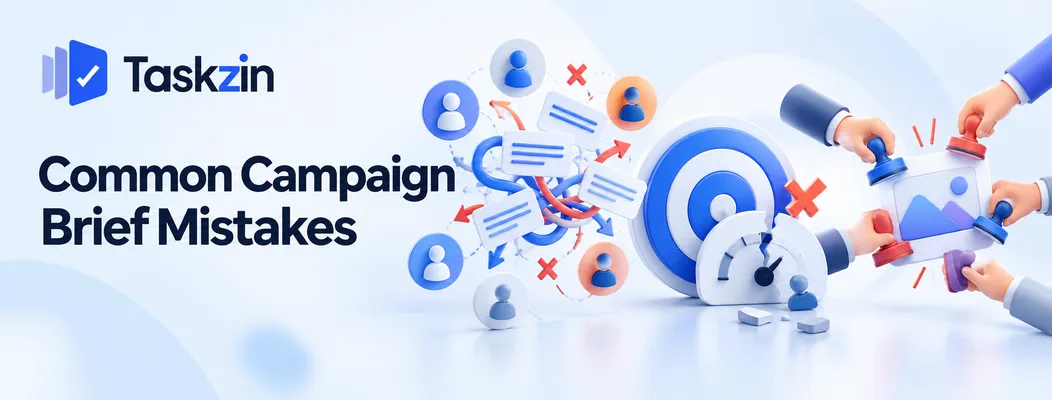
Three failures: too many audiences and messages, unmeasurable objectives, and committee approval.
Three audiences and four messages
The commonest brief failure, usually the result of trying to satisfy several stakeholders in one document.
The output is work that is technically about everything and lands with nobody. If several audiences genuinely matter, brief several campaigns.
Objectives that cannot be measured
"Build awareness", "improve perception", "increase engagement". None of these can be evaluated, so the campaign cannot succeed or fail.
If awareness is genuinely the goal, define how you will measure it — search volume, direct traffic, survey recall — before launch, not after.
Approval by committee
Five approvers produce contradictory feedback and work that has been averaged into safety.
One named approver, with others consulted if genuinely necessary. Consulted means their input is sought; it does not mean they can veto.
Frequently asked
What should a campaign brief include?
Business objective, measurable success metrics, one specific audience, the insight behind the message, a single-minded proposition, one call to action, reasons to believe, channels, budget, one approver, and what is out of scope.
How long should a marketing brief be?
One page. Longer briefs are read less carefully and usually indicate the thinking has not been narrowed down enough.
What is a single-minded proposition?
One sentence stating the single thing you want the audience to take away. If it contains "and", it is probably two propositions, and the second dilutes the first.
Who writes the campaign brief?
The marketing lead, ideally drafting it with the people who will execute the work. Briefs written in isolation generate a round of clarifying questions.
How specific should the audience be?
Very. Describe them by situation rather than demographics — what just happened to them that makes this relevant. Specificity excludes people, and that exclusion is what makes the work land.
What is the difference between a campaign brief and a creative brief?
A campaign brief covers the whole campaign including channels, budget and metrics. A creative brief is narrower, focused on what the creative work must communicate. Small teams frequently combine them.
When should a brief be signed off?
Before any creative or media work begins, by one named approver. Signing off after work has started means the brief is documenting decisions rather than driving them.
Sanju Shrestha is a SaaS content writer at Taskzin who explores smarter ways to manage work, organize priorities, and improve team performance. Her content covers productivity strategies, digital workflows, collaboration, and task management, with a focus on helping modern teams work more efficiently and stay aligned.
All posts by Sanju Shrestha

Comments