Best Project Management Software for Marketing Teams
A comparison of the best project management software for marketing teams, covering why generic tools struggle with parallel campaigns and approvals, ten reviewed options, how to set up campaign templates and approval chains, and what to measure.


The distinguishing feature of marketing is that everything runs in parallel and everything requires approval. Six campaigns are live, each in a different stage, each waiting on a different person for sign-off. The tool's job is to make that legible and to stop work sitting silently in someone's queue.
This guide covers why generic tools struggle, ten options, how to set marketing project management up properly, and what to measure.
What is the best project management software for marketing teams?
campaign coordination, Monday.com for visual tracking, Airtable for content operations at scale, and Taskzin for marketing teams that share a workspace with the rest of the company.
Marketing work has a different shape from product work, and tools built for sequential delivery handle it badly.
Why Marketing Work Breaks Generic Project Tools
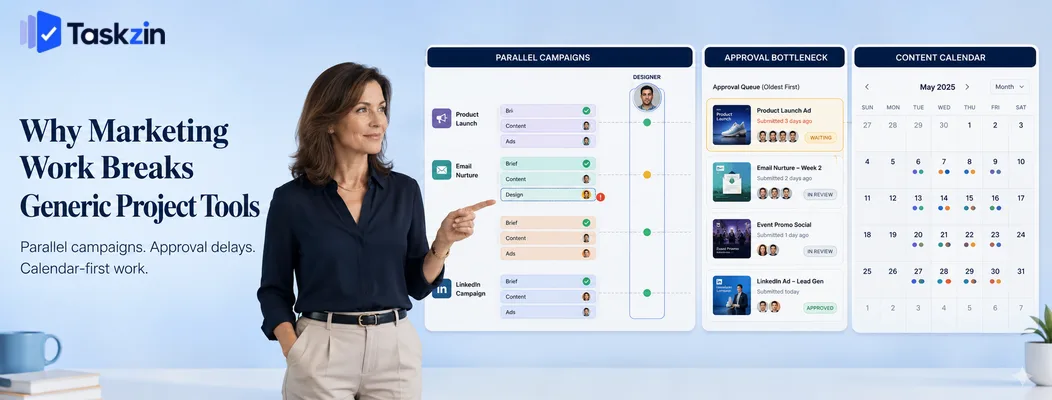
Marketing breaks generic project tools because campaigns run in parallel rather than in sequence, approval cycles dominate the timeline, and content needs a calendar view that most project tools treat as an afterthought.
None of these is exotic. They are simply a different pattern from the one most project software is designed around, which is a team building one thing over time.
Campaigns are parallel, not sequential
A product team ships features one after another. A marketing team runs six campaigns simultaneously, each at a different stage, each competing for the same designer.
The consequence is that per-project views are almost useless on their own. What a marketing lead needs is a view across every campaign showing what is in progress, what is blocked and who is overloaded — and that is a cross-project capability many tools charge extra for or lack entirely.
Review and approval cycles are the real bottleneck
The writing takes two days. The approval takes nine. That ratio is the defining characteristic of marketing delivery and the thing most teams fail to measure.
Approval delay is invisible in most project tools because a task sitting in "In Review" looks identical whether it arrived an hour ago or last Tuesday. Until you make waiting time visible,
every conversation about speed focuses on the people producing work rather than the people holding it up.
Content needs a calendar, not just a board
Marketing work is dated in a way most project work is not. Publication dates, campaign launches, event tie-ins and embargoes all mean the calendar is the primary view, not a secondary one.
A board tells you what stage something is at. A calendar tells you whether you have three things publishing on the same Tuesday and nothing the following week, which is the question a content lead actually needs answered.
Best Marketing Project Management Software at a Glance
Tool Calendar view Approvals Cross-campaign view Free plan Taskzin Yes Yes Yes Yes Asana Yes Via rules Portfolios (paid) Yes Monday.com Yes Yes Dashboards Limited ClickUp Yes Yes Yes Yes Airtable Yes Via automation Yes Yes Notion Yes Manual Manual Yes Trello Via power-up Via power-up No Yes Wrike Yes Strong proofing Yes Limited CoSchedule Yes Yes Yes Limited Basecamp Yes Manual Limited Limited
The Best Marketing Team Tools Reviewed
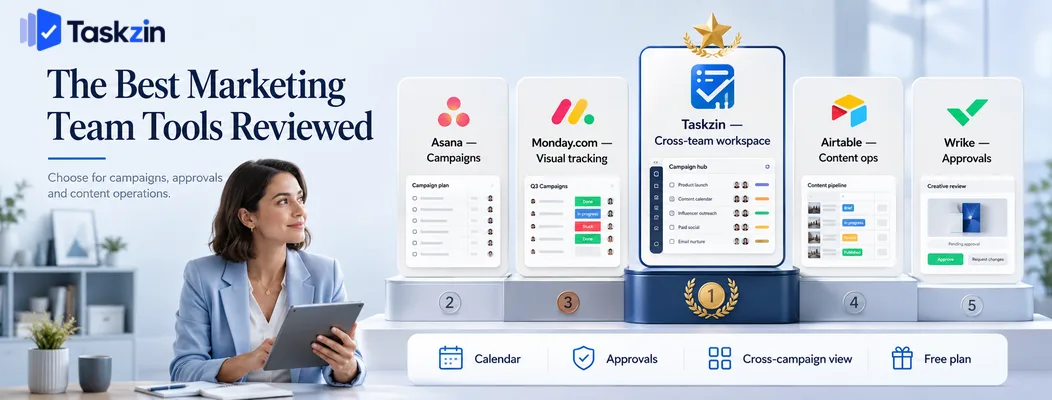
Taskzin — best for marketing teams inside a wider company
Taskzin gives marketing a campaign view, calendar and approval flow while staying in the same workspace as product, sales and operations, which removes the handoff friction of separate systems.
Best for: in-house marketing teams that need to coordinate with other departments.
Trade-off: less specialised than a dedicated marketing platform for very high content volume.
Asana — best for campaign and launch coordination
Asana handles multi-stage campaigns with clear ownership, dependencies and dates, and its rules automate routine handoffs between writers, designers and reviewers.
Best for: teams running structured campaigns with defined stages.
Trade-off: portfolio views and workload sit on higher tiers.
Monday.com — best visual campaign tracking
Monday's colour-coded boards make campaign status readable at a glance, which matters when stakeholders outside marketing need visibility without training.
Best for: teams reporting frequently to leadership or clients.
Trade-off: seat-tier pricing can force overbuying, and proofing is basic.
ClickUp — best all-in-one for lean marketing teams
ClickUp combines tasks, docs, whiteboards, proofing and time tracking, letting a small team run everything in one subscription.
Best for: small teams consolidating a scattered stack.
Trade-off: meaningful setup effort, and the interface can feel busy for casual contributors.
Airtable — best for content operations at scale
When you publish high volumes across many channels, content is really a structured database with views layered on top. Airtable models that better than a task tool.
Best for: content operations, localisation and asset-heavy publishing.
Trade-off: weaker as a day-to-day collaboration and discussion tool.
Notion — best for content strategy and briefs
Notion keeps briefs, research, brand guidelines and drafts alongside a content database, which suits teams where the thinking matters as much as the scheduling.
Best for: strategy-led content teams producing long-form work.
Trade-off: no dependencies, weak notifications, and approvals must be handled manually.
Trello — best simple editorial calendar
A board with columns for idea, brief, draft, review and published covers a small content operation completely.
Best for: teams of two to five publishing on a predictable schedule.
Trade-off: no cross-campaign view, and calendar requires a power-up.
Wrike — best for proofing and approvals
Wrike's proofing tools allow comments directly on images, video and documents, with structured approval workflows — the most developed in this list.
Best for: creative teams where visual review is the main bottleneck.
Trade-off: heavier to learn, and proofing sits on higher tiers.
CoSchedule and marketing-specific platforms
Marketing-specific platforms combine editorial calendars, social scheduling and campaign management in one place.
Best for: teams wanting calendar and publishing in a single tool.
Trade-off: narrower than a general project tool, so non-content marketing work fits awkwardly.
Basecamp — best for agency-client marketing work
Basecamp's flat pricing and simple client access suit marketing teams working closely with external agencies or clients.
Best for: small teams with heavy external collaboration.
Trade-off: no proofing, no dependencies, minimal reporting.
How to Set Up Marketing Project Management
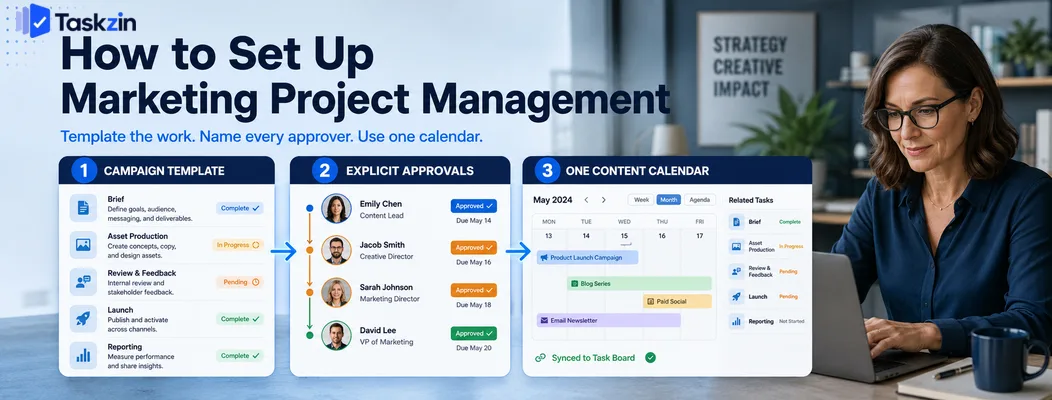
Build one reusable campaign template, make every approval step an explicit named task with an owner, and connect your content calendar to the same tasks rather than maintaining a separate spreadsheet.
Build a campaign template you reuse
Campaigns vary less than they feel. Brief, asset production, review, approval, scheduling, launch, reporting — most follow that shape regardless of channel.
Build it once as a template with standard tasks, owners and relative dates. Every new campaign then starts complete rather than being assembled from memory, which removes both setup time and the things people forget under deadline pressure.
Make the approval chain explicit
Vague approval is where marketing timelines die. "Send it to legal" is not a task; "Legal review — owner: named person — due: Thursday" is.
Name every approver, give each approval its own task with a due date, and decide in advance what happens when a deadline passes. An approval step without an owner and a date is a queue with no exit condition, and work will sit in it indefinitely.
Connect the content calendar to the task board
Maintaining a content calendar in a spreadsheet and the work in a project tool guarantees the two disagree. Someone reconciles them weekly, and between reconciliations both are wrong.
Use one system where the calendar is a view of the same tasks. Change a publication date once and everything reflects it. This single change removes more recurring admin than any other setup decision.
What Marketing Teams Should Actually Measure
Measure cycle time from brief to publish, approval turnaround by approver, and planned versus published volume — these three explain almost every delivery problem a marketing team has.
Cycle time from brief to publish
Track elapsed days from brief approval to publication. This is what stakeholders experience, and it is usually far longer than anyone estimates.
Look at the distribution rather than the average. If most pieces take twelve days and some take fifty, the long tail is where your process breaks, and investigating those specific cases is more productive than trying to speed up the median.
Approval turnaround
Measure how long items sit with each approver. This is the single most valuable metric a marketing team can track, because it converts a vague complaint about slowness into a specific, evidenced conversation.
The data usually shows that one or two reviewers account for most of the delay. That is a solvable problem once it is visible, and almost impossible to raise credibly without numbers.
Planned versus published
Compare what you committed to at the start of the quarter against what actually shipped.
Persistent shortfalls mean your planning is optimistic rather than your team slow.
Marketing teams routinely plan at full theoretical capacity, leaving nothing for the urgent request that arrives every month. Planning at seventy percent produces plans that survive contact with reality.
Common Marketing Project Management Mistakes
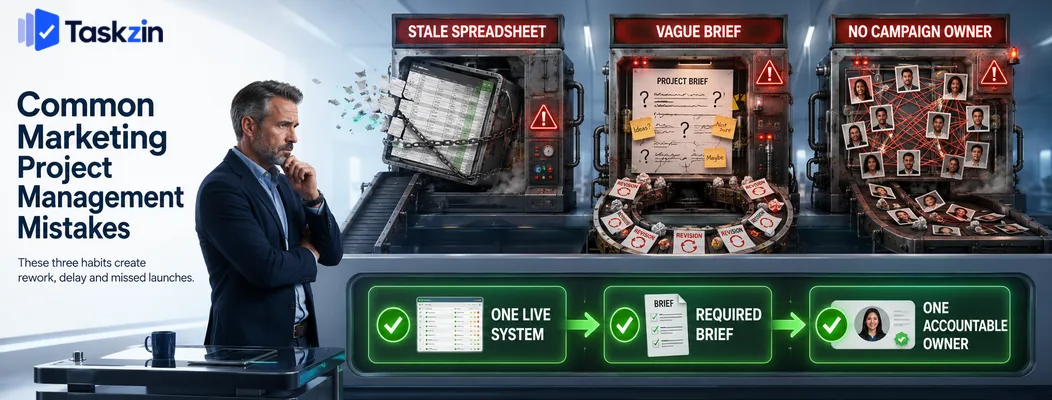
The recurring failures are planning campaigns in a spreadsheet that drifts out of date, writing briefs too vague to execute, and running campaigns without a single accountable owner.
Planning campaigns in a spreadsheet nobody updates
The campaign plan lives in a spreadsheet, the work lives in a project tool, and they diverge within two weeks. Everyone then trusts neither and asks in chat instead.
Vague briefs that generate rework
A brief missing the audience, the offer, the format, the deadline or the approver produces work that fails review for reasons the writer could not have anticipated. That rework is the largest avoidable cost in most marketing teams.
Use a brief template with required fields and refuse to start work until they are complete. The five minutes spent completing it saves days of revision.
No single owner for a campaign
Campaigns with several contributors and no named owner stall at every decision point because nobody has authority to resolve them. Name one owner per campaign, even when everyone is contributing equally.
The owner does not need to do the most work or hold the most seniority. Their job is to make the small decisions that would otherwise sit waiting for consensus — which headline, which
channel, whether to slip a date. Campaigns without that role tend to arrive late for reasons nobody can point to afterwards.
Frequently asked
What is the best free project management tool for marketing?
Asana for campaign coordination, Monday.com for visual tracking, Airtable for high-volume content operations, and Taskzin for in-house teams sharing a workspace with other departments.
What is the best free project management tool for marketing?
ClickUp's free plan covers the most ground including calendar views and proofing basics. Trello, Asana, Notion and Taskzin also have free tiers suitable for small marketing teams.
How do marketing teams manage content calendars?
Most effectively by using a calendar view of the same tasks that hold the work, rather than a separate spreadsheet. This keeps dates and status consistent without weekly reconciliation.
Is Asana or Monday better for marketing?
Asana is stronger on structured campaigns, dependencies and automation. Monday is stronger on visual status for stakeholders. Teams running complex multi-stage campaigns usually prefer Asana.
How should marketing teams handle approvals?
Make each approval a named task with a specific owner and due date, and decide in advance what happens when the date passes. Approval steps without owners and deadlines become indefinite queues.
Do marketing teams need agile project management?
Not formally. Borrowing the useful parts — short cycles, visible work, a regular retrospective — helps. Story points, sprints and velocity generally do not fit content and campaign work well.
How do you stop rework on creative projects?
Use a required brief template covering audience, message, format, deadline and approver, and lock the brief before production starts. Most rework traces back to a brief that never specified something.
Binita Ray is a content writer at Taskzin, creating insightful and practical content on task management, team collaboration, productivity, workflow optimization, and SaaS solutions. She focuses on helping businesses, teams, and professionals simplify their work processes, improve efficiency, and make better use of modern productivity tools.
All posts by Binita Ray

Comments