Project Management for Ecommerce Teams
A practical guide to project management for ecommerce teams, covering the trading calendar, running product launches across four workstreams, preparing for peak, releasing site changes safely, and common mistakes.


The recurring failure is a product that goes live without imagery, or with stock that has not landed, or with pricing that was never entered. Each workstream did its job; nobody owned the point at which they had to converge.
This guide covers the trading year, running launches, managing peak, and releasing site changes without damaging trade.
Quick answer: Ecommerce project work is governed by a trading calendar with fixed peaks, requires every launch to coordinate merchandising, content, stock and development simultaneously, and happens on a site that is generating revenue while you change it. Managing it well means backwards planning from on-sale dates, coordinating the four workstreams as one, and protecting peak periods from disruption.
What Makes Ecommerce Project Work Distinctive [IMG]

The trading calendar sets immovable dates, every launch needs four functions to converge on one moment, and the platform being changed is simultaneously taking orders.
The trading calendar dominates everything
Peak season, seasonal ranges, promotional windows and category moments are fixed by the market rather than chosen by you. Missing a window does not delay revenue; it removes it.
This makes backwards planning the default. Everything is scheduled relative to a date that already exists, and the planning question is what must happen when in order to be ready.
Product launches are cross-functional every time
A product going live requires stock in the warehouse, product data entered, imagery shot and retouched, copy written, pricing and promotions configured, and the page built and tested.
Four different teams, one moment. Any single element missing means the launch either slips or goes live incomplete — and an incomplete product page converts poorly, so launching anyway is rarely the cheaper option it appears to be.
The site is always live
Unlike most software projects, there is no quiet period. Every change is made to a system currently taking money, and a mistake has immediate revenue consequences.
That raises the value of staged releases, rollback plans and careful timing far above what an internal system would justify. It also changes how defects are prioritised. A broken checkout is not a bug in a queue — it is revenue stopping, and the escalation path for that should be agreed before it happens rather than improvised at the time.
The Ecommerce Trading Year
Period Focus Project posture Main risk Post-peak (Jan–Feb) Analysis, clearance Planning and platform work Losing momentum on fixes Spring Range launches, site projects Heavy development Underestimating content lead time Mid-year Promotions, optimisation Iterative changes Change fatigue Late summer Peak preparation begins Build and test Starting too late Autumn Peak campaigns, stock in Reducing change Last-minute development Peak (Nov–Dec) Trade only Change freeze Any change at all Post-peak Returns, reconciliation Wrap-up and review Skipping the review
Running Product and Range Launches

Plan backwards from the on-sale date using real lead times, coordinate merchandising, content, stock and development as one dependent chain, and define explicitly what must be complete before anything goes live.
Work backwards from the on-sale date
Imagery needs shooting, retouching and approval. Copy needs writing and checking. Stock needs booking, shipping, receiving and putting away. Product data needs entering and validating.
Each has a real lead time, and photography is usually the longest and most frequently underestimated — samples have to exist before they can be shot, which pushes the dependency back into product development.
Coordinate merchandising, content and stock together
These three are managed by different people and frequently tracked in different places, which is precisely why launches fail incomplete.
Hold them in one plan against one on-sale date so the dependencies are visible. A shared workspace matters here more than in most functions. In Taskzin, for example, a launch template can carry the stock, content, merchandising and development tasks against the same date, so a slip in photography is immediately visible to the person planning the campaign rather than discovered at go-live.
Define what must be true before going live
Write the launch criteria once: stock received and available, all imagery live, copy approved, pricing and tax configured, page tested on mobile, tracking in place.
Check it before every launch. This is the ecommerce equivalent of a definition of done, and it is what prevents the recurring pattern of products going live in a state that quietly converts badly for a week before anyone notices.
Managing Peak Trading Periods

Freeze changes before peak, plan the promotional calendar months ahead, and prepare specifically for the failures that only appear under peak load.
Freeze changes before peak
Agree a date after which no non-critical change goes to the live site — commonly two to four weeks before peak begins.
The freeze is not caution for its own sake. Peak concentrates a large share of annual revenue into a short window, and the cost of a defect during it dwarfs the benefit of almost any improvement. Everything not finished and tested before the freeze waits until January.
Plan the campaign calendar early
Promotional periods, email sends, paid campaigns, homepage changes and landing pages should be planned and largely built well before peak.
Building a landing page during peak week is exactly the kind of change the freeze exists to prevent, and it is the most common reason freezes get broken. Planning the calendar early removes the pressure that causes it.
Prepare for the failures peak exposes
Peak reveals problems normal trading does not: performance under load, stock synchronisation lag, payment provider limits, fulfilment capacity, support volume.
Load test before the freeze, agree escalation contacts with every provider, and decide in advance what you do if a payment method fails or stock data goes stale. These decisions are far better made in October than at eleven at night in late November.
Running Site and Platform Projects Without Disrupting Trade
Time releases around trading patterns, roll changes out in stages against real traffic, and maintain a tested rollback for every release.
Release around trading patterns
Look at your own hourly and daily traffic before scheduling releases. Most stores have a genuine low period, and releasing into it limits exposure.
Avoid Friday releases as a general rule. A defect discovered on Saturday morning with nobody available costs a full weekend of trade.
Test with real traffic in stages
Where the platform supports it, release to a percentage of traffic first and watch conversion, error rates and performance before going wider.
Staged rollout is the difference between a defect affecting two percent of sessions for twenty minutes and affecting all of them for a day. For a live revenue system, that difference is the entire argument.
Keep a rollback plan for every release
Every release should have a documented way back, tested rather than assumed, including how to handle data written since deployment.
The moment you need a rollback is the moment you have least time to work one out. Writing it beforehand takes fifteen minutes and is the cheapest insurance in ecommerce delivery.
Common Ecommerce Project Management Mistakes
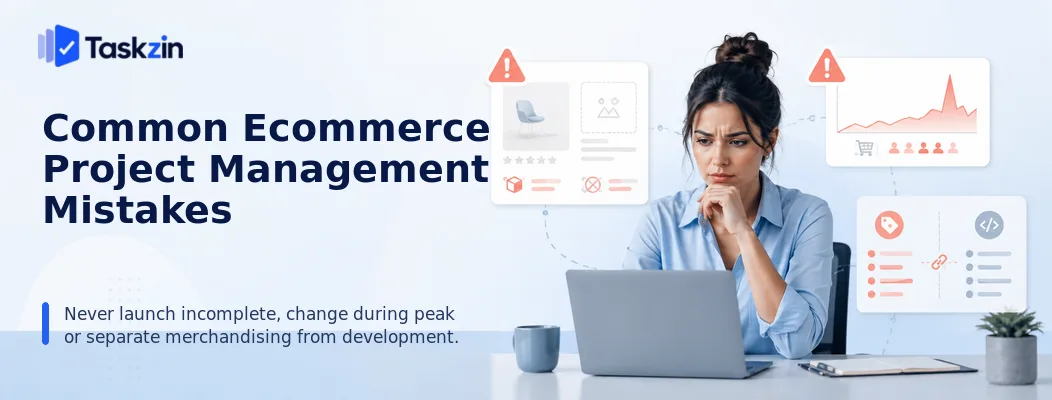
The three most costly habits are launching products before content and stock are ready, changing the site during peak, and running merchandising separately from development.
Launching without stock or content ready
A product page live without imagery converts poorly and damages the brand impression. Live without stock generates disappointed customers and support volume.
Hold the launch criteria and delay rather than launching incomplete. A launch delayed three days costs three days; a bad launch costs the initial traffic burst that never returns.
Changing the site during peak
Every year some teams break their own freeze for a change that seems small and safe.
Sometimes it is. When it is not, the cost is measured in a percentage of annual revenue.
Agree the freeze in advance, agree who can authorise an exception, and make that authority uncomfortable to invoke.
Running merchandising and development separately
When commercial and technical teams plan in separate systems, launches converge badly and each side is surprised by the other's timelines.
One shared plan per launch, with all four workstreams visible against the same date, resolves most of it. The split is usually organisational rather than deliberate — merchandising reports into commercial, development into technology, and each adopts the tooling its function prefers.
Agreeing that launches specifically are planned in one place, whatever each team uses day to day, is a smaller change than a full consolidation and captures most of the benefit.
Frequently asked
How do ecommerce teams manage projects?
By planning backwards from fixed trading dates, coordinating stock, content, merchandising and development in one plan per launch, freezing changes before peak, and releasing site changes in stages with rollback plans.
How far ahead should you plan a product launch?
Typically eight to sixteen weeks, driven by the longest lead time — usually photography, which depends on samples existing, or stock shipping and receiving times.
What is a change freeze and when should you apply one?
A period during which no non-critical change goes to the live site, commonly starting two to four weeks before peak trading and lasting until it ends. It protects the highest-revenue period from avoidable defects.
How do you coordinate stock, content and marketing for a launch?
Hold all workstreams in one plan against a single on-sale date with explicit dependencies, so a slip in one is immediately visible to the others rather than discovered at go-live.
How should ecommerce teams plan for peak season?
Begin in late summer, complete and test all development before the freeze, build campaign assets in advance, load test, and agree escalation contacts with payment, fulfilment and platform providers.
How do you release site changes without disrupting sales?
Release during genuine low-traffic periods, avoid Fridays, roll out to a percentage of traffic first while monitoring conversion and errors, and keep a tested rollback plan for every release.
Do small ecommerce teams need project management software?
Yes, mainly for launch coordination. Even a three-person team runs four parallel workstreams per launch, and the failures come from convergence rather than from any single workstream.
Sanju Shrestha is a SaaS content writer at Taskzin who explores smarter ways to manage work, organize priorities, and improve team performance. Her content covers productivity strategies, digital workflows, collaboration, and task management, with a focus on helping modern teams work more efficiently and stay aligned.
All posts by Sanju Shrestha


Comments