Project Management for Schools and Education
A practical guide to project management in schools, covering the constraints of the academic calendar and teaching time, which cycles to template, inspection readiness, running improvement plans, and common mistakes.

The recognisable pattern is a leadership team that plans ambitiously in September and finds by February that half the improvement plan has not moved. Nothing was badly managed. The plan assumed capacity that the timetable never made available.
This guide covers what makes school projects distinctive, which cycles to template, how to prepare for inspection, and how to make improvement plans actually progress.
Quick answer: School project work is governed by an academic calendar nobody can move, delivered by staff who are teaching for most of the working day, and almost always involves parents, governors, external agencies or other schools. Managing it well means templating the recurring cycle, planning around non-contact time rather than working hours, and keeping evidence as you go rather than assembling it under pressure.
What Makes School Projects Different [IMG]
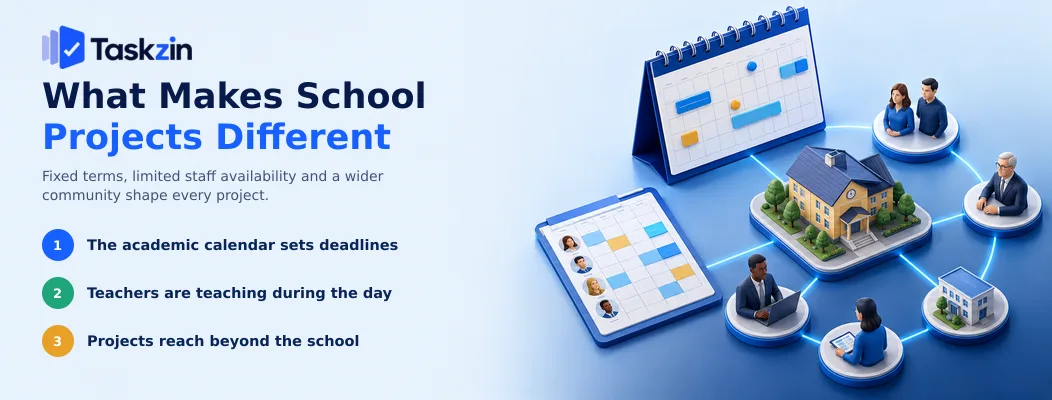
Deadlines come from the academic calendar rather than being negotiated, the people delivering projects are teaching during the working day, and most projects require coordination with people outside the school.
Each of these constrains the plan in a way that generic project advice does not account for.
The academic calendar sets every deadline
Term dates, exam windows, admissions deadlines, reporting cycles and inspection windows are all fixed externally. A project cannot slip a fortnight because a fortnight later is half term.
This makes backwards planning from fixed dates the natural default. It also means genuine contingency has to sit inside a term rather than after it, because the boundary is hard.
Teachers are not available during the day
A teacher's non-contact time is a few hours a week, often fragmented. A project needing three hours of input from six teachers is not a scheduling puzzle — it is a resourcing question.
Twilight sessions, INSET days and directed time are the realistic slots, and they are limited and heavily contested. Any plan requiring more staff time than those slots contain will not happen, regardless of how important it is.
Almost every project involves people outside the school
Parents, governors, local authorities, external providers, feeder or partner schools, examination boards. None of them work to your timetable, and several respond slowly.
Building external response time into the plan is essential. A consultation requiring a four-week parental response window cannot be compressed because a deadline is approaching. Governor
approval has the same property — governing bodies meet on a fixed cycle, so a decision needing their sign-off is constrained by when they next sit, not by when the work is ready.
The School Year as a Set of Recurring Projects
Cycle Timing Main constraint Frequent failure Admissions Autumn–spring External deadlines Late data returns Options and transition Spring Parent communication window Rushed information evenings Exams and assessment Spring–summer Fixed board dates Invigilation staffing Reporting to parents Termly Teacher writing time Compressed into one week School improvement plan Annual, termly review Staff capacity No interim checkpoints Inspection readiness Ongoing Evidence gathering Assembled reactively Staff CPD Termly Directed time Displaced by urgent needs Events and productions Termly Volunteer coordination Rebuilt from scratch yearly Budget and staffing Spring Funding confirmation Late notification
Setting Up Project Management in a School
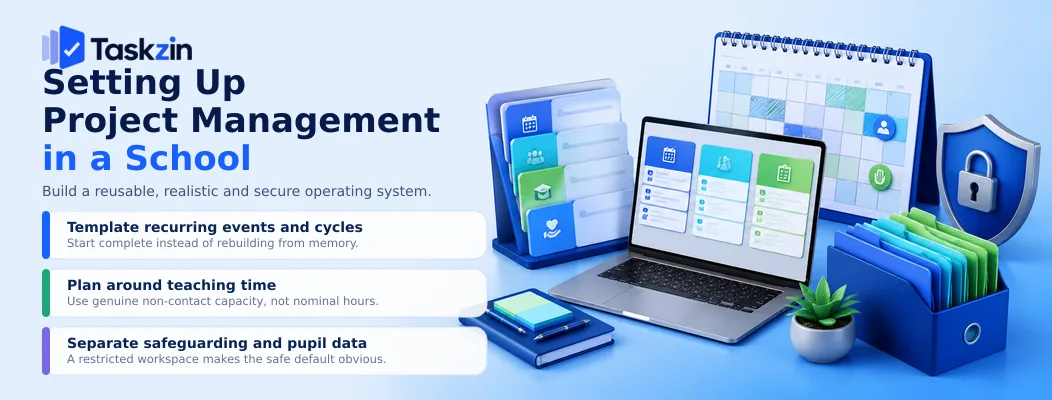
Template every recurring event and cycle, build plans around non-contact time rather than nominal working hours, and keep anything involving pupil data or safeguarding in a separate restricted space.
Template the recurring events and cycles
Open evening, parents' evenings, transition week, the summer production, results day. Each runs the same way every year with different dates.
Building each once as a template — tasks, owners, relative dates, supplier contacts, room bookings — converts an annual scramble into an assignment exercise. The larger benefit is institutional memory: when the person who always ran the open evening leaves, the process leaves with them unless it is written down.
This is where a shared tool earns its place. In Taskzin, for example, a template can hold the full task list with owners and dates relative to the event, so next year's version starts complete rather than being reconstructed from last year's emails.
Plan around teaching time, not working hours
Before committing to a project, establish how many hours of staff time genuinely exist for it in the term. Count the directed time slots, not the notional working week.
Then size the project to fit. A plan requiring more capacity than exists is not ambitious — it is a plan that will partially fail, and partial failure across four initiatives is worse than completing two properly.
Keep safeguarding and pupil data separate
Anything involving individual pupils, safeguarding concerns, staff matters or attendance interventions belongs in a restricted space with controlled membership, not in the general staff workspace.
Use structural separation rather than per-item privacy settings, so the safe option is the default and exposure requires a deliberate action.
Running an Inspection or Accreditation Readiness Project
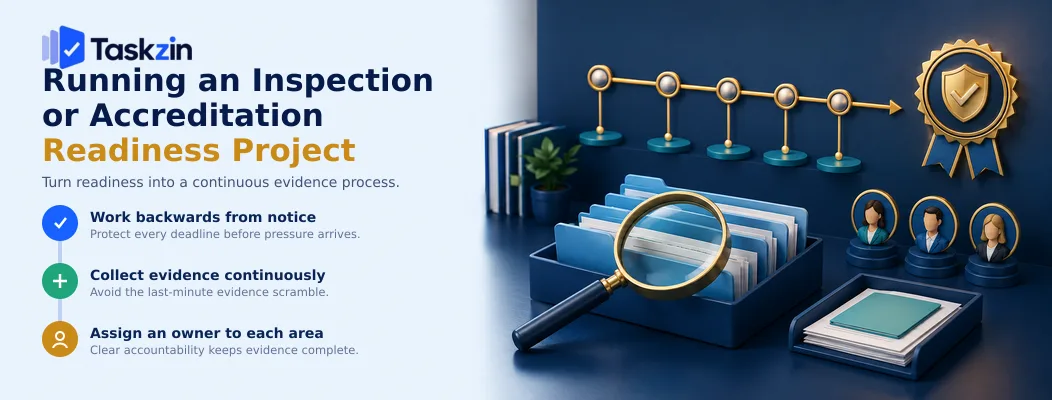
Plan from the notice period backwards, gather evidence continuously through the year rather than reactively, and assign each evidence area a named owner.
Work backwards from the notice period
Inspection frameworks typically give short notice. Whatever cannot be produced in that window must already exist.
That reframes the project. It is not "prepare for inspection" — it is "maintain a state of readiness", which is a continuous responsibility with periodic checks rather than a burst of activity.
Collect evidence continuously
Monitoring records, work scrutiny, pupil voice, CPD logs, safeguarding checks, governor minutes. Each is produced during normal operation and each is difficult to reconstruct months later.
Recording them as they happen, in one findable place, is the whole task. Schools that do this find inspection preparation is largely a matter of organising what exists; those that do not spend the notice period generating documentation instead of preparing people.
Assign evidence owners by area
Divide the framework into areas and give each a named owner responsible for keeping evidence current and knowing where it is.
Distributing this prevents it landing entirely on one senior leader, and it means the person who can speak to an area is the person who maintained the evidence for it.
Managing Improvement Plans That Actually Progress
Break the improvement plan into termly deliverables, give every action one named owner, and review at fixed points rather than when someone remembers.
Break the plan into termly deliverables
An annual objective with a July deadline receives no attention until May. Splitting it into what must be true by December, by March and by July creates checkpoints while there is still time to act.
Each termly deliverable should be specific enough to be assessable. "Improve literacy across the curriculum" is not; "all departments have identified subject-specific vocabulary and it appears in schemes of work" is.
Give each action a named owner
Actions assigned to a department or to "SLT" are assigned to nobody. One person per action, even where several contribute.
The owner's role is not to do all the work but to ensure it happens and to report honestly if it is not going to.
Review at fixed points in the term
Put three review dates in the calendar at the start of the year and hold them. Ten minutes per objective — is it on track, what is blocking it, what changes.
The review is what makes the plan real. An improvement plan written in September and next opened in June is a document produced for governors rather than a tool for running the school.
Common Mistakes Schools Make
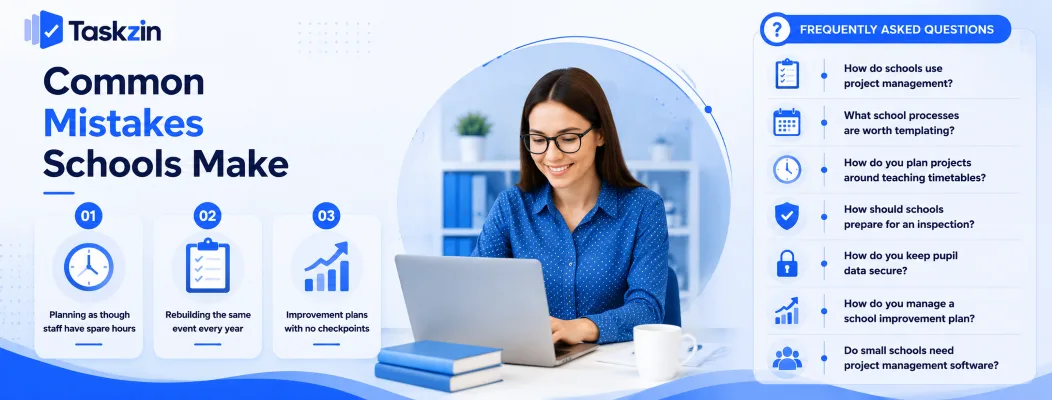
The three habits that cause most difficulty are planning as though staff have spare hours, rebuilding annual events from memory, and improvement plans without interim checkpoints.
Planning as though staff have spare hours
The most common cause of stalled school projects. Enthusiasm at the planning stage produces commitments that the timetable cannot support, and the shortfall appears months later as a list of things that did not happen.
Count the available directed time honestly and plan within it. Two completed initiatives beat five started.
Rebuilding the same event every year
Running the open evening from memory means every year takes longer than necessary and each one forgets something different — a different room unbooked, a different letter sent late.
Template it once. This is an afternoon of work that pays back every year.
Improvement plans with no interim checkpoints
A plan with only end-of-year deadlines cannot tell you it is failing until it has failed. Termly checkpoints turn an annual document into something that can be corrected while correction is still possible.
The checkpoint also protects staff. An objective quietly falling behind generates private anxiety for whoever owns it; a scheduled review where it can be raised, resourced differently or explicitly deprioritised removes that. Deciding not to pursue something is a legitimate outcome, and it is far better than an action sitting on a plan all year while everyone knows it will not happen.
Frequently asked
How do schools use project management?
Mainly to template recurring cycles — admissions, reporting, events, CPD — and to manage improvement plans and inspection readiness with named owners, termly checkpoints and a maintained evidence trail.
What school processes are worth templating?
Anything that runs annually: open evening, parents' evenings, transition, admissions, results day, productions and the reporting cycle. Templating captures institutional knowledge that otherwise leaves with staff.
How do you plan projects around teaching timetables?
Count actual directed time and non-contact hours available in the term, then size the project to fit. Planning against nominal working hours produces commitments the timetable cannot support.
How should schools prepare for an inspection?
By maintaining readiness continuously rather than preparing reactively. Assign evidence owners by framework area and record monitoring, CPD and safeguarding evidence as it happens through the year.
How do you keep pupil data secure in a project tool?
Use a structurally separate restricted space for anything involving individual pupils, safeguarding or staff matters, rather than relying on per-item privacy settings in the general workspace.
How do you manage a school improvement plan?
Break each objective into termly deliverables, assign one named owner per action, and hold three fixed review points during the year so problems surface while there is still time to respond.
Do small schools need project management software?
A shared template and calendar is often enough for a very small school. The value grows with staff numbers and with the number of recurring events, where templating saves the most repeated effort.
Sujan Sharma is a content writer at Taskzin with a strong focus on productivity systems, task management, workflow optimization, team collaboration, and SaaS technology. He creates research-driven, practical content that helps professionals and growing teams improve operational efficiency, streamline processes, and make informed decisions about modern work management tools.
All posts by Sujan Sharma

Comments