Project Management for Software Engineering Teams
A practical guide to project management for software engineering teams, covering why software resists traditional planning, how to set up delivery, managing bugs and technical debt, flow metrics, and common mistakes.


The recurring failure is a plan built as though software delivery were construction: scope fixed, tasks sequenced, dates committed. It survives until the first thing turns out harder than expected, which is usually week two.
This guide covers why software behaves differently, how to set up delivery, how to handle the work that is not features, and which metrics actually describe performance.
Why Software Delivery Resists Traditional Project Management

carry real uncertainty, building something changes what you understand about it, and a substantial share of capacity goes to work that never appears on a plan. Managing it well means iterative delivery, honest capacity allocation across work types, and metrics that measure flow rather than effort.
Why Software Delivery Resists Traditional Project Management Three properties make software different: estimates are genuinely uncertain rather than merely imprecise, building reveals information that changes the plan, and much of the real work is invisible to planning.
None of these is an excuse for unpredictability. They are constraints to design around.
Estimates are uncertain by nature
An experienced builder estimating a wall is drawing on hundreds of near-identical walls. A developer estimating a feature is estimating something nobody has built before, in a codebase with its own history, with dependencies whose behaviour is partly unknown.
This is why software estimates skew optimistic consistently rather than randomly. The unknowns are all in one direction — you discover extra work, not less. Planning practices that assume estimates are symmetrically wrong will systematically overcommit.
The work changes what you know about the work
Halfway through building a feature, the team learns something that changes the right approach.
The API does not behave as documented. The edge case affects more users than assumed.
In construction this would be a change order. In software it is Tuesday. A process that treats new information as a failure of planning will either suppress the information or generate constant change requests, and both outcomes are worse than designing for it.
Invisible work consumes real capacity
Code review, production incidents, helping a colleague debug, answering support escalations, upgrading dependencies, interviewing candidates. None appears on the sprint board; all consume the week.
Teams that plan against nominal capacity without accounting for this overcommit every sprint and never understand why. Making the invisible work visible — either by tracking it or by subtracting it explicitly — is usually the single largest improvement available.
The Engineering Delivery Flow
Stage Typical wait What causes delay Fix Backlog to refined Days–weeks Unclear requirements Regular refinement session Refined to started Days WIP already full Limit work in progress In development Hours–days Unexpected complexity Smaller stories In code review Hours–days Reviewer availability Review-first norm In QA / testing Hours–days Manual test bottleneck Automated coverage Awaiting deploy Hours–weeks Release batching More frequent releases In production — — —
Setting Up Engineering Project Management
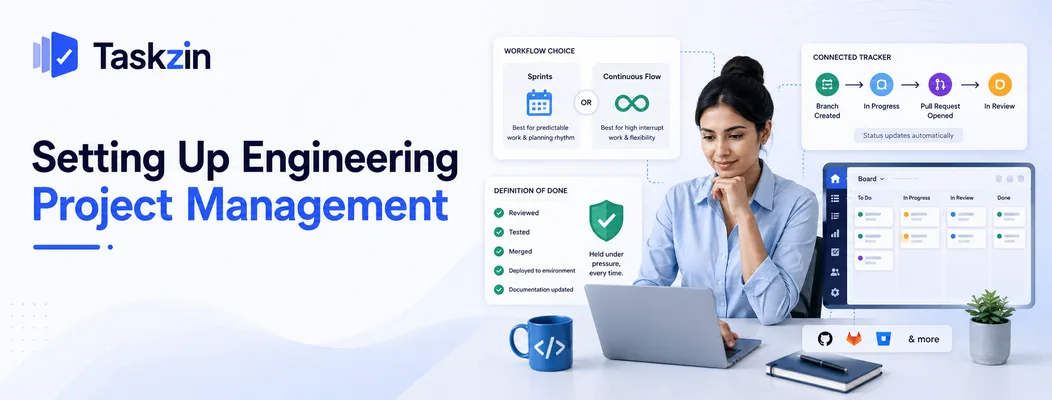
Choose between sprints and continuous flow based on how predictable your work is, connect the tracker to the repository so status updates itself, and agree a definition of done the team will actually hold.
Decide between sprints and continuous flow
Sprints suit teams with reasonably predictable work and stakeholders who need a planning rhythm. Continuous flow suits teams with high interrupt volume — platform teams, support-heavy teams — where committing two weeks ahead is unrealistic.
The wrong choice is visible quickly. A team abandoning its sprint commitment most sprints because of urgent work should be running Kanban with WIP limits rather than pretending the sprint boundary means something.
Connect the tracker to the repository
An issue that moves to In Progress when a branch is created, and to In Review when a pull request opens, stays accurate without anyone maintaining it.
This eliminates a category of stale data — the ticket still marked In Progress three weeks after the work shipped — and removes a small recurring chore. It also makes cycle time measurable automatically, which is otherwise tedious enough that nobody does it.
Define done and hold it
Agree a short list of conditions every item must meet: reviewed, tested, merged, deployed to a defined environment, documentation updated.
The value comes from holding it under pressure. A definition of done abandoned when a release date approaches is not a standard, and each abandonment converts a quality decision into unmanaged technical debt that someone pays for later.
Managing the Work That Isn't Features
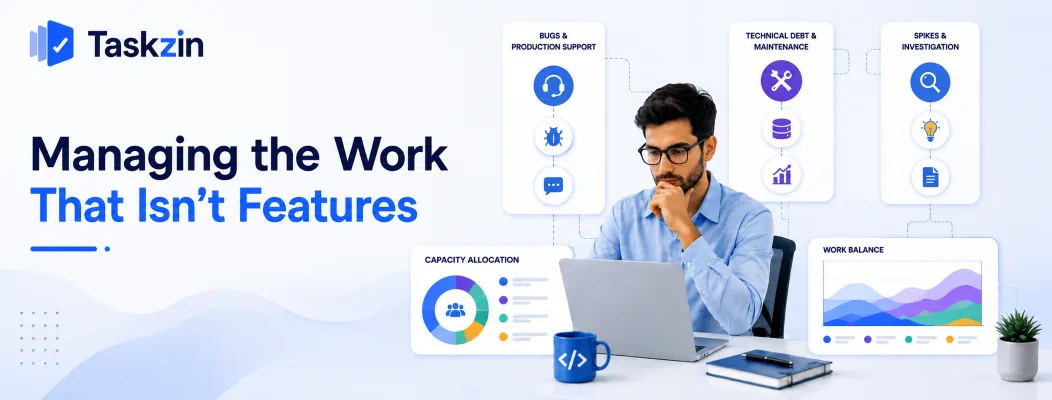
Bugs, technical debt and investigation work all consume real capacity, so allocate for them explicitly rather than treating them as interruptions to the real plan.
Bugs and production support
Decide in advance how bugs are handled: fixed immediately, triaged into the sprint, or handled by a rotating support role.
The rotation approach works well for most teams. One person handles interrupts for the sprint while everyone else stays on planned work, which contains the disruption rather than fragmenting five people's weeks. Rotate it, and subtract that person from sprint capacity.
Technical debt and maintenance
Debt work loses every prioritisation argument against features, because its cost is diffuse and its benefit is invisible. Left to compete on merit, it never gets done, and delivery slows gradually until it becomes a crisis.
The workable approach is a standing allocation — commonly 10 to 20 percent of capacity — that does not require justification each sprint. Making it routine avoids the recurring negotiation and stops debt accumulating to the point where a rewrite starts sounding reasonable.
Spikes and investigation
When work is too uncertain to estimate, timebox an investigation rather than guessing. Two days to understand the problem, then estimate the real work.
The output of a spike is knowledge, so define what question it must answer before starting.
Open-ended investigation expands to fill whatever time is available. Write the finding down somewhere durable too — a spike whose conclusion lives only in the head of whoever ran it will be repeated within a year by someone who did not know it had already been answered.
Metrics That Describe Engineering Delivery
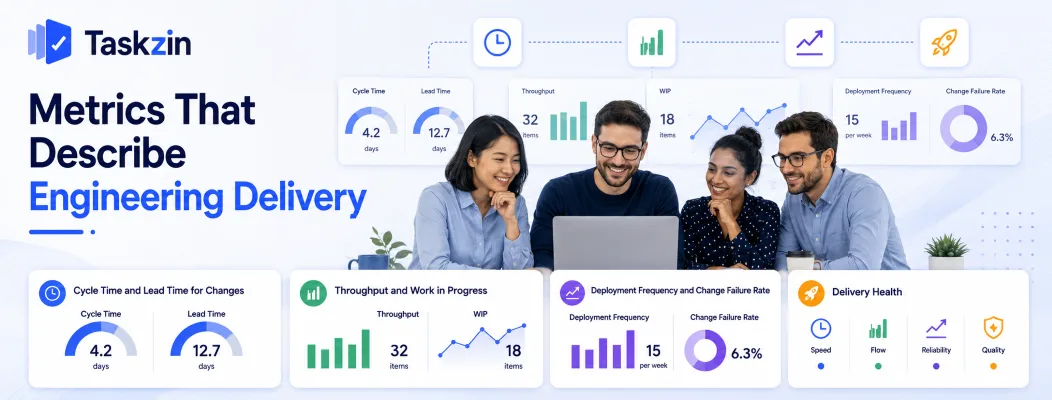
Measure cycle time, throughput and work in progress for flow, and deployment frequency with change failure rate for delivery health — all are objective and none depends on estimation.
Cycle time and lead time for changes
Cycle time measures how long work takes once started. Lead time for changes measures commit to production.
Both are objective, which is their advantage. Nobody estimates them, so nobody can inflate them, and improvements represent real change rather than shifted estimation habits.
Throughput and work in progress
Throughput counts completed items per period. Work in progress counts open items.
Watch them together. Rising WIP with flat throughput means the team is starting more than it finishes, which lengthens cycle time for everything. This pattern usually appears before anyone notices delivery slowing, which makes it a genuinely useful early signal.
Deployment frequency and change failure rate
How often you release, and what proportion of releases cause a problem requiring remediation.
These two are informative together and misleading apart. Frequency alone rewards shipping recklessly; failure rate alone rewards shipping rarely. Improving both simultaneously is what indicates a genuinely healthier delivery pipeline.
Common Engineering Project Management Mistakes
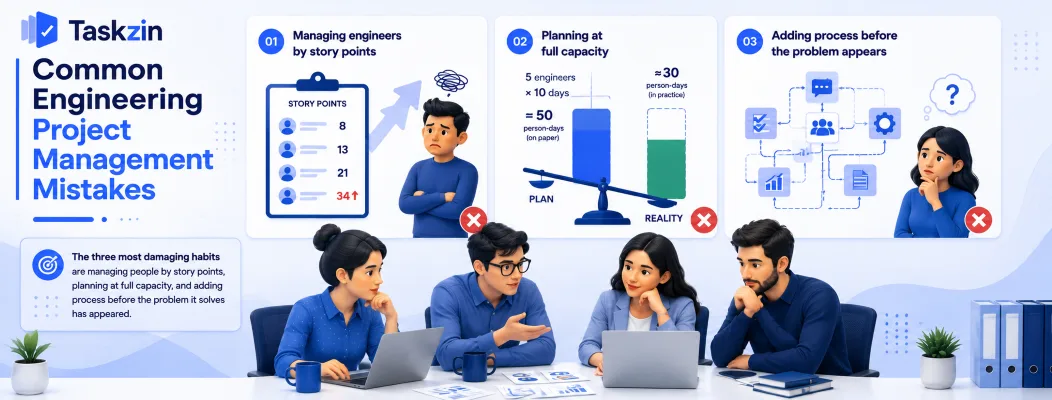
The three most damaging habits are managing people by story points, planning at full capacity, and adding process before the problem it solves has appeared.
Managing engineers by story points
The moment velocity becomes a performance measure, estimates inflate and the number stops describing anything. It also damages trust in a way that persists long after the practice stops.
Points are a forecasting aid for one team over time. They are not comparable between teams and not a productivity measure.
Planning at full capacity
Five engineers times ten days is fifty person-days on paper and roughly thirty in practice, after meetings, review, support and interruptions.
Measure your team's actual focus factor over three sprints and plan against that. Most teams find it lands between 60 and 75 percent, and planning honestly against that number removes most chronic carryover.
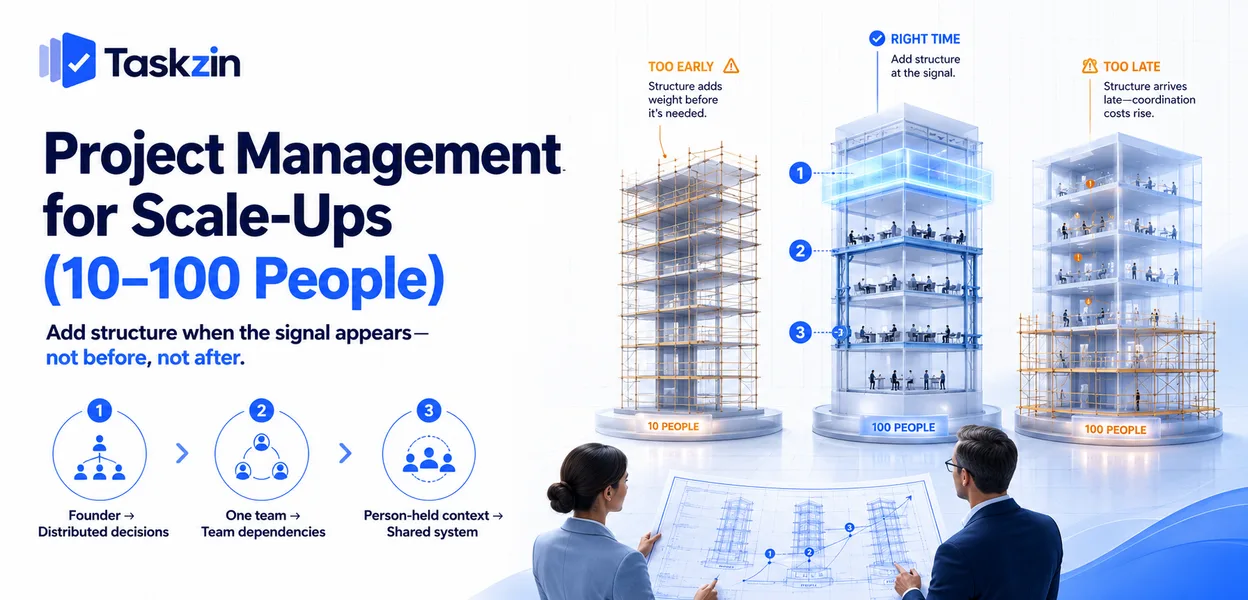
Adding process before the problem appears
Teams frequently adopt full Scrum ceremonies at four engineers, then spend more time in meetings than the coordination problem justified.
Add practices in response to observed failures. Missed dependencies justify planning; unclear priorities justify a refined backlog. Adopting a framework wholesale teaches the team that process is overhead, which makes the process they genuinely need later much harder to introduce.
A reasonable default at small scale is a prioritised list, a short daily sync, and a fortnightly look back at what went wrong. That is enough structure for most teams under about eight engineers, and every addition beyond it should be traceable to a specific problem someone can describe.
Frequently asked
How do software engineering teams manage projects?
Through iterative delivery — a prioritised backlog, short cycles or continuous flow, a definition of done, and flow metrics such as cycle time — rather than fixed long-range plans, because estimates carry genuine uncertainty.
Should engineering teams use Scrum or Kanban?
Scrum suits predictable work and stakeholders who need a planning rhythm. Kanban suits high-interrupt work such as platform or support-heavy teams. A team that abandons its sprint commitment most sprints should be running Kanban.
How do you estimate software work accurately?
You improve it rather than achieving it. Break work smaller, estimate relatively rather than in hours, and forecast from historical throughput. Accept that estimates skew optimistic and plan with buffer accordingly.
How much capacity should go to bugs and technical debt?
Commonly 10 to 20 percent as a standing allocation that does not need re-justifying each sprint. Making it routine prevents debt losing every prioritisation argument against features.
What metrics should engineering managers track?
Cycle time, throughput, work in progress, deployment frequency and change failure rate. All are objective and none depends on estimation, unlike velocity.
How do you handle interruptions to sprint work?
A rotating support role works well — one person handles interrupts each sprint while others stay on planned work. Subtract that person from sprint capacity rather than treating their time as available.
Do engineering teams need a project manager?
Not usually a traditional one. Most need a product owner setting priority and someone facilitating process. Teams coordinating across many other teams sometimes benefit from a delivery manager focused on dependencies.
Sujan Sharma is a content writer at Taskzin with a strong focus on productivity systems, task management, workflow optimization, team collaboration, and SaaS technology. He creates research-driven, practical content that helps professionals and growing teams improve operational efficiency, streamline processes, and make informed decisions about modern work management tools.
All posts by Sujan Sharma

Comments