Project Management for Architecture Firms
A practical guide to project management for architecture firms, covering the work stage structure, managing fee and scope together, coordinating consultants and drawing revisions, planning shared studio resource, and the habits that damage profitability.

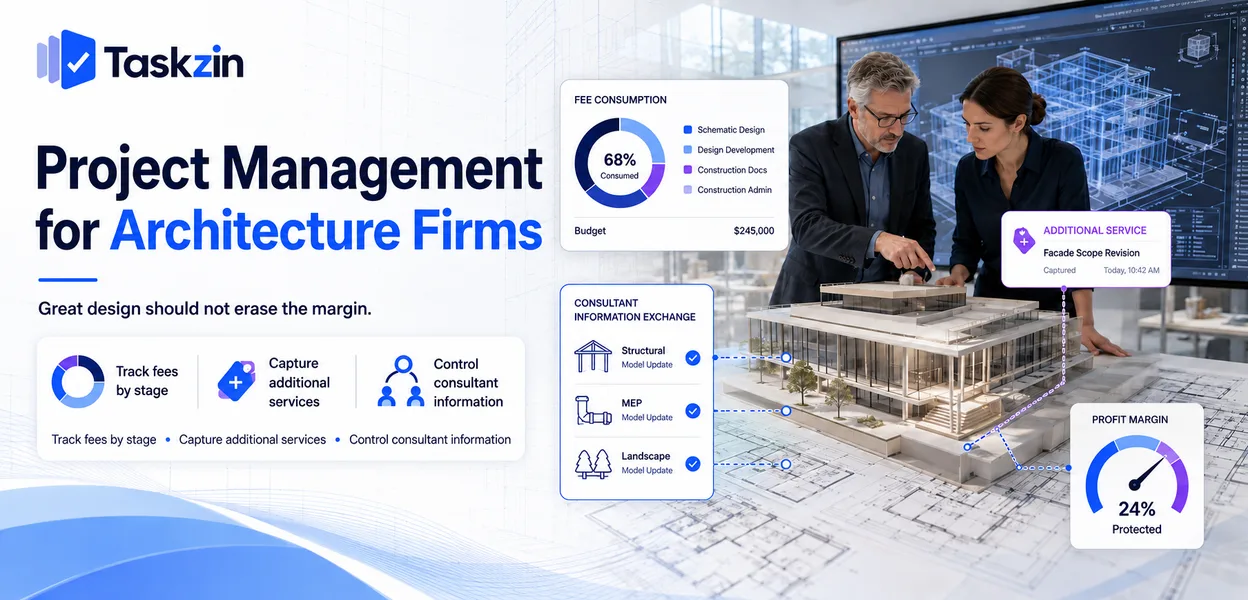
The characteristic failure is a project that produced excellent architecture and lost money — usually because scope expanded gradually and nobody costed it until the final invoice.
Quick answer: Architectural projects are structured by defined work stages, priced before the scope is fully understood, and delivered through coordination with consultants the practice does not employ. Managing them well means tracking fee consumption against stage rather than against the project total, recording every additional service at the moment it is requested, and controlling information exchange between parties.
What Makes Architectural Projects Distinctive
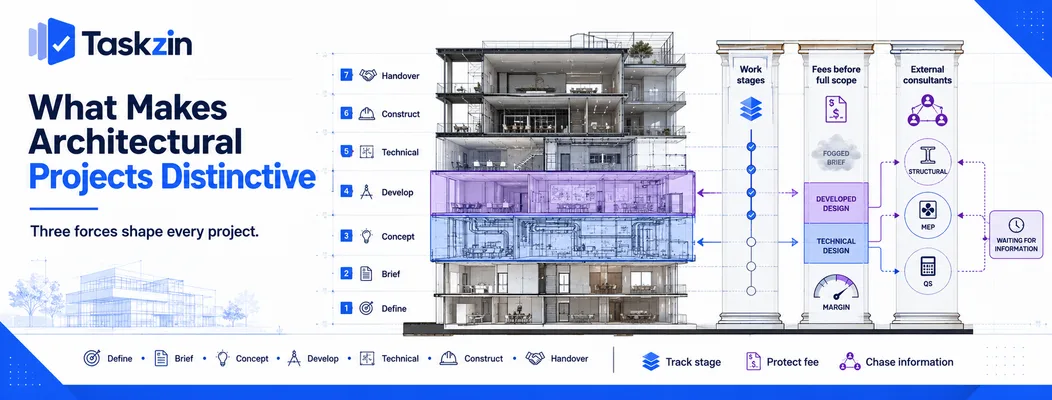
Three features shape architectural project management: the work stage structure, fees agreed against incomplete information, and dependence on external consultants.
Work stages structure everything
Projects run through defined stages — broadly strategic definition, preparation and brief, concept design, developed design, technical design, construction, and handover.
The stages determine the deliverables, the fee tranches, the information exchanges and the approval points. This is unusually helpful for project management, because the structure is standardised across the industry and templates transfer between projects almost unchanged.
Fees are agreed before scope is understood
A fee proposal is typically issued when the brief is still developing. The practice commits to a price for work whose extent will only become clear later.
This is the central commercial risk. Under a fixed fee, every hour of scope expansion is absorbed by the practice, which makes recording additional services at the point of request a commercial necessity rather than administrative diligence.
Coordination with consultants you do not employ
Structural engineers, services engineers, quantity surveyors, planning consultants — engaged by the client or by the practice, working to their own priorities and timescales.
Progress depends on information arriving from them. That makes tracking what you are waiting for, and from whom, as important as tracking your own production.
The Work Stages and What Each Demands
Stage Main output Fee share (typical) Main risk Strategic definition Business case, requirements Small Brief undefined
Preparation and brief Project brief, feasibility Small Scope not pinned down Concept design Concept proposals Moderate Client indecision, iterations Developed design Coordinated developed design Largest Consultant coordination Technical design Technical information, specifications Large Detail volume underestimated Construction Site queries, inspections, instructions Moderate Open-ended site support Handover and close As-built information, close-out Small Documentation gaps
Fee distribution varies by appointment and project type — this shows the typical shape rather than fixed proportions.
Managing Fee and Scope Together
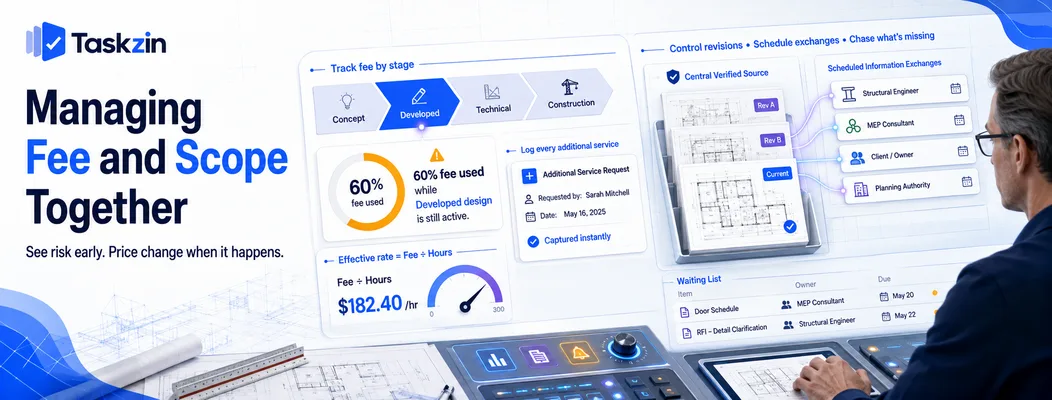
Track hours against the current stage rather than the project total, log every additional service when it is requested, and calculate your effective rate per project.
Track hours against stage, not project
Knowing you have used 60 percent of the fee tells you little. Knowing you have used 60 percent while still in developed design tells you the project is in difficulty.
Stage-level tracking gives you time to act — to raise the scope conversation, adjust resourcing, or change approach. Total-level tracking tells you at 95 percent, when absorbing the cost is the only option left.
Record every additional service
Clients request changes constantly, and most are individually reasonable. A revised layout after concept sign-off, an additional visualisation, a second planning submission.
Log each as an additional service item against the project when it is requested, with who asked and when. This converts the eventual fee conversation from a disagreement into a factual review of a list — and clients frequently accept the additional fee readily when it is raised at the time rather than in the final account.
Know your effective rate per project
Divide the fee received by the hours spent. That figure, not your charge-out rate, is what the project actually earned.
The results usually reorder assumptions about which clients and project types are worth pursuing. Tracking time against tasks within the project — rather than in a disconnected timesheet system — is what makes this calculable without a monthly reconciliation exercise.
Coordinating Consultants and Information
Manage the information exchanges at stage boundaries, control drawing revisions rigorously, and track what you are waiting for from each party.
Information exchange at stage boundaries
Each stage boundary involves an exchange: the practice issues information, consultants respond, the client reviews and approves.
Treat each exchange as a scheduled event with a date and a required list rather than as something that happens organically. Missed exchanges are the most common cause of stage slippage, and they are usually visible weeks in advance.
Drawing issue and revision control
Someone working from a superseded drawing is an expensive error, and on site it becomes a liability question.
Maintain a single controlled source for current information, issue formally with a record of who received which revision, and keep the issue history. This is the most important administrative discipline in architectural delivery and the one most often relaxed under deadline pressure.
Chasing what you are waiting for
Maintain a live list of outstanding items — structural information not yet received, a client decision on specification, a planning response.
Each needs a date and an owner. Most delay in architectural projects is waiting rather than working, and a practice that chases systematically rather than reactively recovers a meaningful amount of programme.
Managing Studio Resource Across Projects
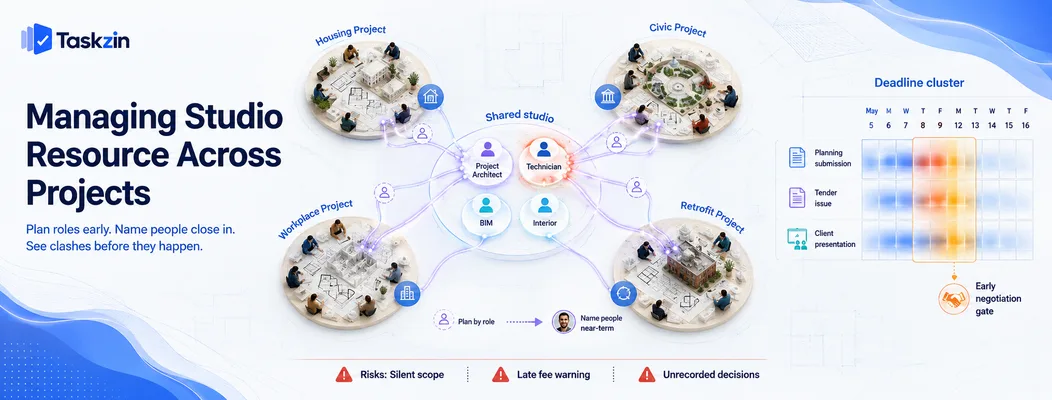
Architectural staff are shared across projects rather than allocated to one, so plan by role at distance, name people close in, and watch for deadline clustering.
People are shared, not allocated
A technician works across four projects in a week. A project architect runs three. Nobody is dedicated.
This means per-project resource plans are misleading. What matters is the studio-wide view:
who is committed to what, and whether anyone is over-allocated across the total. Without that view, three project leads can each reasonably plan the same person's week.
Plan by role before naming people
For work more than a few weeks out, plan by role — two weeks of technician time, one week of project architect time — rather than naming individuals.
Named allocation far ahead creates false precision and constant rework as priorities move.
Role-level planning answers the useful question: do we have enough of the right capability, and if not, when do we need to recruit?
Watch the deadline clustering
Architectural deadlines cluster. Planning submission dates, tender issues and client presentations across several projects frequently land in the same fortnight.
Look at the combined deadline calendar across all live projects monthly. Clustering is visible well in advance and is far easier to negotiate three months out than three weeks out.
Common Mistakes in Architectural Practice
The three habits that most damage profitability are absorbing scope changes silently, discovering fee overrun at invoicing, and leaving design decisions unrecorded.
Absorbing scope changes silently
The most expensive habit in the sector. Each accommodation is small and reasonable; collectively they consume a substantial share of the fee.
Record and raise them at the time. The conversation is far easier when it concerns one item than when it concerns fourteen months of accumulated goodwill.
Discovering fee overrun at invoicing
By the time the final account is prepared, the choices are to write off the excess or to have a difficult conversation with a client who was never warned.
Stage-level fee tracking converts both into an earlier, easier discussion while options still exist.
Design decisions with no record
Design decisions get revisited repeatedly over a multi-year project, often by people who were not present when they were made.
Recording each significant decision with its reasoning and date prevents relitigating settled questions and is valuable if a dispute arises. Attaching that record to the project rather than to an individual's email means it survives staff changes.
Frequently asked
How do architecture firms manage projects?
Through the work stage structure, tracking fee consumption against the current stage, recording additional services as they are requested, controlling information exchange with consultants, and planning studio resource across all live projects.
What are RIBA work stages?
The standard stage structure used in UK architectural practice, running from strategic definition through preparation, concept design, developed design, technical design, construction and handover, with defined deliverables at each.
How do you track fees against project stages?
Record time against the stage rather than the project as a whole, so you can see whether fee consumption matches stage progress. Total-level tracking only reveals problems when it is too late to act.
How do architects handle scope creep?
By logging every additional service at the point it is requested, with who asked and when, then reviewing that list with the client periodically rather than presenting it in the final account.
How do you manage drawing revisions?
Maintain a single controlled source of current information, issue formally with a record of who received which revision, and keep the full issue history as an audit trail.
How do architecture firms plan studio resource?
At studio level rather than per project, since staff are shared. Plan by role beyond a few weeks and by named individual close in, watching the combined deadline calendar for clustering.
What causes architectural projects to become unprofitable?
Almost always accumulated unrecorded scope — small accommodations absorbed without additional fee — combined with fee tracking that only reveals the overrun at final account stage.
Sujan Sharma is a content writer at Taskzin with a strong focus on productivity systems, task management, workflow optimization, team collaboration, and SaaS technology. He creates research-driven, practical content that helps professionals and growing teams improve operational efficiency, streamline processes, and make informed decisions about modern work management tools.
All posts by Sujan Sharma


Comments