Project Management for Video Production Teams
A practical guide to project management for video production teams, covering why projects fail in post rather than production, planning pre-production, managing review cycles, asset and version control, and common mistakes.

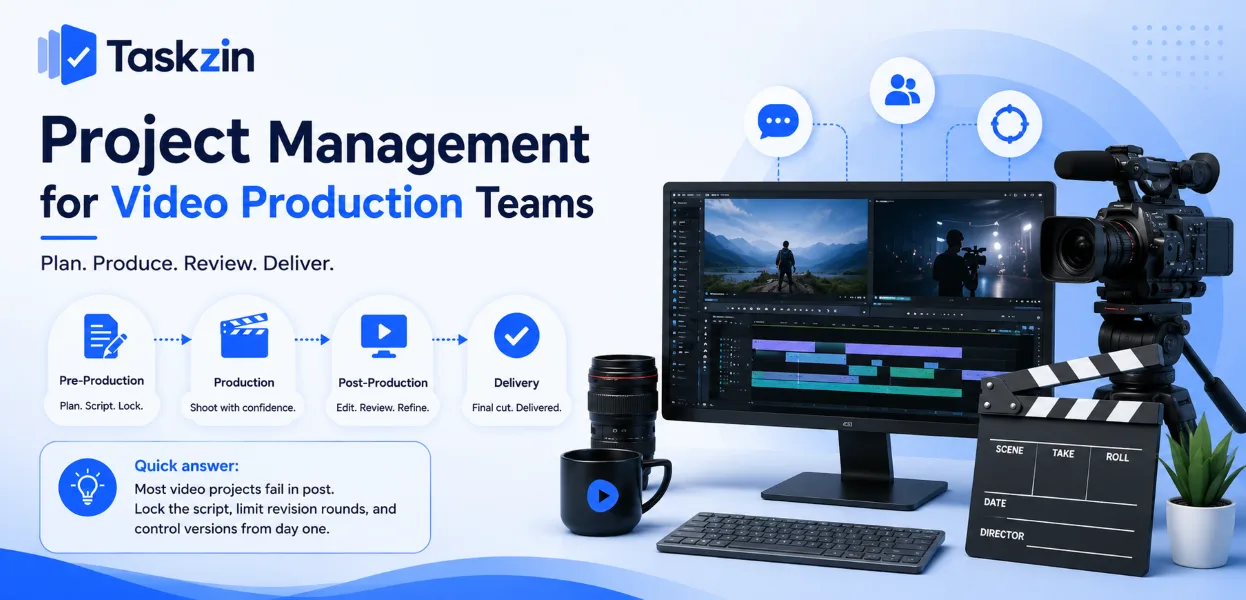
The shoot is the visible, expensive, carefully planned part, and it usually goes to plan. Then a three-week edit becomes seven weeks because feedback arrived twice from two people who disagreed, and the fourth round introduced a change that undid the second.
This guide covers the pipeline, planning pre-production, managing review cycles, and keeping control of assets and versions.
Quick answer: Video projects rarely fail during the shoot — they fail in post, where revision rounds expand, feedback arrives from several people at once, and versions multiply until nobody is certain which file is current. Managing production well means locking the script before booking anything, defining the number of revision rounds contractually, and imposing a version discipline from the first day.
Why Video Projects Fail in Post, Not in Production
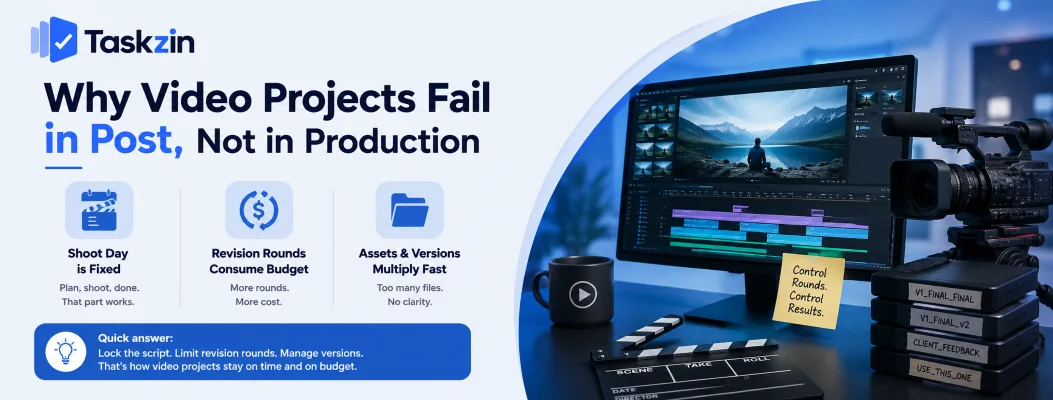
The shoot day is the only genuinely fixed point in the process, revision rounds consume the budget that overruns, and asset volume grows faster than most teams' organisation.
The shoot day is the only truly fixed point
Crew, kit, location and talent are booked for specific dates. Everything before must be ready by then and everything after depends on what was captured.
That makes the shoot both an anchor and a risk. Arriving under-prepared means shooting the wrong things, and you cannot re-shoot cheaply. Everything in pre-production exists to make sure the shoot captures what post will actually need.
Revision rounds are the real budget
The edit itself is estimable. The number of times it will be revised is not, unless it is contractually defined.
Unlimited revisions in a proposal is the single largest source of unprofitable video work. Each round costs editor time, and rounds four onwards frequently reverse decisions from rounds two and three, which means paying twice to end up where you already were.
Assets and versions multiply fast
A single project generates raw footage, selects, proxies, graphics, music, voiceover, multiple cuts, format variants and client review copies.
Without a convention imposed from the start, teams reach a state where locating the current master takes real time, and the risk of delivering the wrong version becomes genuine. This is entirely preventable and rarely prevented.
The Production Pipeline, Stage by Stage
Stage Typical share of timeline Fixed or flexible Main risk Brief and concept 10% Flexible Unclear objective Scripting and storyboard 15% Flexible Late script changes
Planning Pre-Production Properly
planning 15% Deadline-driven Under-prepared shoot Shoot 5–10% Fixed Weather, talent, overrun Ingest and organise 5% Flexible No naming convention Rough cut 15% Flexible Built before script lock Revision rounds 20%+ Contractual Unlimited rounds Grade, mix, graphics 10% Flexible Started before picture lock Delivery and archive 5% Deadline-driven Format spec discovered late
Planning Pre-Production Properly Lock the script before booking anything, build the shoot schedule around whichever constraint is tightest, and confirm crew, kit and locations in writing.
Lock the script before anything is booked
The script determines locations, talent, crew size, kit, shoot duration and schedule. Booking before it is locked means booking against assumptions.
A script change after booking cascades into every one of those, often with cancellation costs attached. Treat script lock as a hard gate: nothing gets booked until the client has signed it off, and changes after lock are a variation rather than an adjustment.
Build the shoot schedule around the constraint
Every shoot has one binding constraint — location access hours, talent availability, daylight, a venue's operating times.
Identify it first and build the schedule around it, rather than sequencing scenes in script order and discovering the constraint at three in the afternoon. Group by location and by setup rather than by narrative sequence: moving lighting is what actually consumes shoot days.
Confirm crew, kit and locations in writing
Verbal bookings fail. A crew member who thought the date was provisional, a kit hire not formally confirmed, a location where nobody told the facilities team.
Confirm everything the day it is agreed, and reconfirm the week before. Keeping this in a shared production plan rather than one producer's inbox matters when they are unavailable — in
Taskzin, for instance, each booking can be a task with the supplier, the date and the confirmation status visible to whoever is covering.
Managing Post-Production and Review Cycles
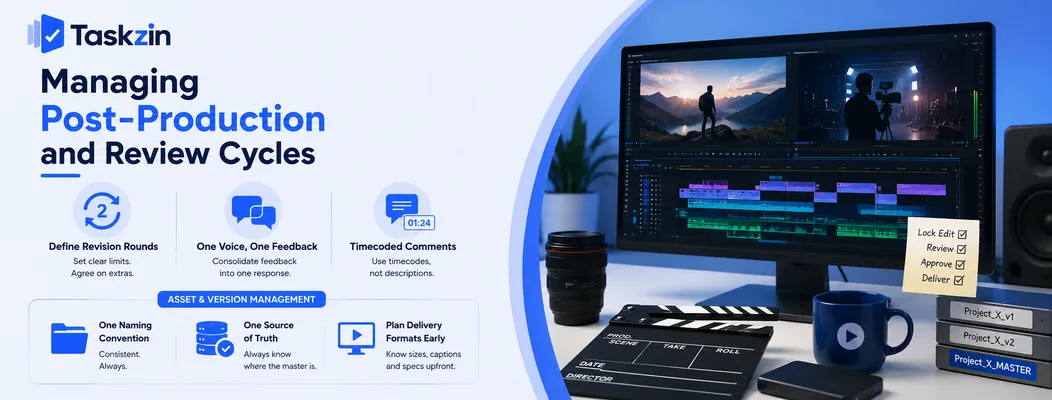
Define the number of included revision rounds, require the client to consolidate feedback into one response, and insist on timecoded comments rather than written descriptions.
Define how many rounds are included
State in the proposal how many revision rounds are included — commonly two or three — what constitutes a round, and the rate for additional rounds.
This is not adversarial. Clients generally accept it readily when stated upfront, and it gives them a reason to consolidate their feedback rather than sending it piecemeal. The absence of the clause is what produces the difficult conversation later.
Consolidate feedback into one voice
Feedback from four stakeholders arriving separately, sometimes contradicting each other, is the most common cause of post-production overrun. The editor either implements conflicting changes or waits while the client resolves it internally.
Require one named client contact to gather and reconcile all feedback before sending it.
Resolving disagreement is the client's job, not the editor's, and making that explicit at kickoff saves days.
Use timecoded comments, not descriptions
"The bit near the middle where the music gets loud" costs the editor time to locate and invites misinterpretation.
Timecoded review tools eliminate this entirely — a comment attached to 01:24 needs no interpretation. This single change typically shortens each revision round meaningfully and reduces the misunderstandings that generate extra rounds.
Asset and Version Management
Apply one naming convention across everything, always know where the current master lives, and confirm delivery formats before the edit begins.
One naming convention, applied everywhere
Decide the convention at project setup: project, stage, version, date. Apply it to footage, sequences, exports and review copies without exception.
The convention matters less than the consistency. Any scheme applied rigorously beats an elegant one applied to half the files, and inconsistency is what makes the wrong version get delivered.
Know where the master lives
One location holds the current master, and everyone knows which. Working copies live elsewhere and are clearly marked as such.
The expensive failure is an editor working on a version superseded two days earlier — a day's work lost, and it usually surfaces the day before delivery.
Plan for delivery formats early
Different platforms require different aspect ratios, durations, caption formats and specifications.
A client asking for square and vertical cuts after picture lock is a substantial additional job.
Establish the full delivery list before the edit begins, so the edit can be built with the crops in mind. Shooting and editing for multiple ratios from the start is considerably cheaper than adapting afterwards — framing with safe areas costs nothing on the day and saves a reframe of every shot later.
Captions and accessibility requirements belong in the same list. Burned-in subtitles, separate caption files and audio description each have different implications for the edit, and discovering the requirement after picture lock means revisiting work already signed off.
Common Video Production Mistakes
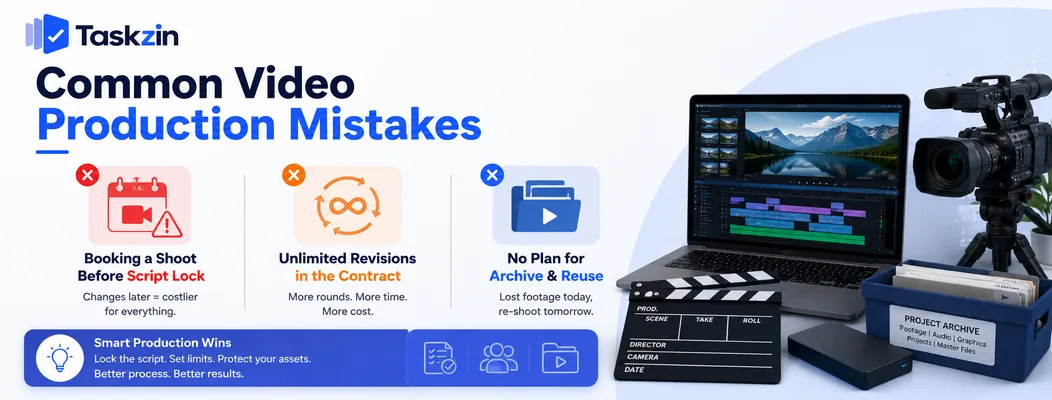
The three habits that cost most are booking a shoot before script lock, offering unlimited revisions, and having no plan for archive and reuse.
Booking a shoot before the script is locked
The most expensive sequencing error in video production. Every downstream booking rests on the script, and changing it after booking cascades through all of them.
Unlimited revisions in the contract
It wins work and loses money. Define the included rounds and price additional ones. Clients who genuinely need more rounds will pay for them, and most will simply consolidate their feedback better.
No plan for archive and reuse
Projects finish, drives fill, and footage from eighteen months ago is either gone or unfindable.
Then a client asks for a re-cut, and the answer is a re-shoot.
Agree an archive policy: what is kept, where, for how long, and how it is catalogued. Footage is an asset with real reuse value, and clients pay for re-cuts when the material can actually be found.
Settle the ownership question at the same time. Whether the client owns the raw footage or only the finished deliverable affects what you must retain and for how long, and it is far easier to agree in the contract than to negotiate two years later when someone wants the rushes.
Frequently asked
How do video production teams manage projects?
By treating script lock as a hard gate before booking, planning shoots around the binding constraint, defining revision rounds contractually, consolidating client feedback, and applying strict version and naming discipline.
How many revision rounds should a video project include?
Two or three included rounds is standard, with additional rounds charged. Defining this in the proposal is what prevents post-production consuming the project's margin.
How do you handle conflicting client feedback?
Require one named client contact to consolidate and reconcile all feedback before sending it. Resolving internal disagreement is the client's responsibility, and stating this at kickoff prevents the editor being caught between stakeholders.
What should be locked before a shoot day?
The script, the shot list, the schedule, all crew and kit bookings, location permissions, talent confirmations and the call sheet. Anything unresolved on the day costs shoot time that cannot be recovered cheaply.
How do you manage video files and versions?
One naming convention applied to everything, one known location for the current master, working copies clearly marked, and review exports labelled with version and date.
How long should post-production take?
It varies with complexity, but revision rounds usually account for more elapsed time than the initial edit. Building a realistic estimate means budgeting for the defined rounds plus client turnaround time between them.
Do small production teams need project management software?
Yes, primarily for pre-production coordination and version tracking. Even a two-person team manages multiple suppliers, bookings and file versions where a shared record prevents the errors that cost shoot days.
Sanju Shrestha is a SaaS content writer at Taskzin who explores smarter ways to manage work, organize priorities, and improve team performance. Her content covers productivity strategies, digital workflows, collaboration, and task management, with a focus on helping modern teams work more efficiently and stay aligned.
All posts by Sanju Shrestha


Comments