What Is a Statement of Work (SOW)?
An explainer on the statement of work, covering where it sits in a contract, what it contains, how it compares with related documents, how to write one that prevents disputes, and common mistakes.

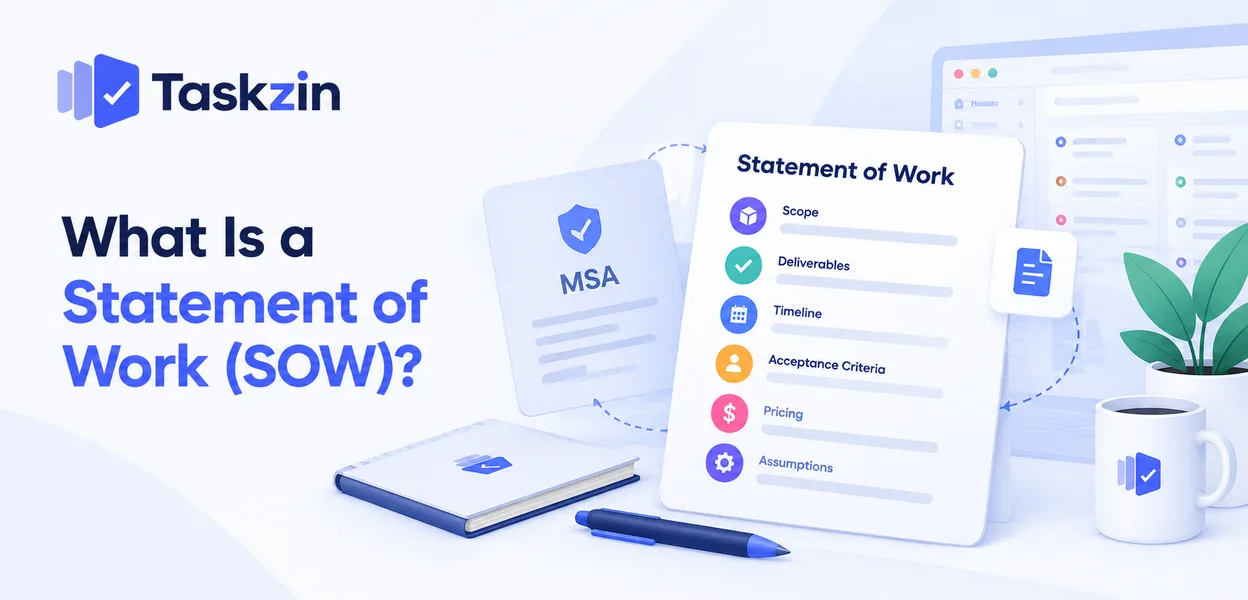
A statement of work is where most client disputes are either prevented or created. The clauses that matter are rarely the ones people spend time on.
Quick answer: A statement of work is a document defining exactly what a supplier will deliver to a client — scope, deliverables, timeline, acceptance criteria, pricing and assumptions. It usually sits beneath a master services agreement, which covers legal terms, while the SOW covers the specific engagement.
The SOW, Defined
The SOW is the engagement-specific part of an agreement: what, when, how much, and how you will know it is done.
Where it sits in the contract
Ongoing client relationships usually have a master services agreement (MSA) setting the legal terms — liability, confidentiality, payment terms, intellectual property.
Each individual project then gets its own SOW under that MSA. This means legal terms are negotiated once, and each new piece of work only needs its scope agreed.
Who writes it
Usually the supplier drafts it, since they understand the work, and the client reviews and negotiates.
In procurement-led organisations the client sometimes issues a SOW as part of a tender, and suppliers respond to it. Either way, both sides should read it as the document they will be held to.
Why it matters more than people think
When a disagreement arises about whether something was included, the SOW is what gets read.
A vague SOW does not avoid conflict — it postpones it to a point where both parties have invested heavily and changing course is expensive.
What a SOW Contains
Section Contains Why it matters Purpose and background Why the work is happening Context for interpreting everything else Scope What work is included Defines the boundary Out of scope What is explicitly excluded Prevents the most common disputes Deliverables Specific outputs, each named What the client is paying for
Acceptance criteria must be testable
How each deliverable is judged complete Defines "done" objectively Timeline and milestones Key dates and checkpoints Sets expectations and payment triggers
Roles and responsibilities What each party provides Client dependencies become visible Assumptions What is taken on trust Makes hidden risks explicit Pricing and payment Fee, basis, payment schedule Commercial terms for this engagement
No change process
How changes are raised, approved, priced Makes the first change procedural
SOW Compared With Related Documents
Document Purpose Legally binding? Covers
What is a statement of work?
Defines a specific engagement Usually, as part of the contract Scope, deliverables, acceptance, price Master services agreement Sets ongoing legal terms Yes Liability, IP, confidentiality, payment terms Project charter Authorises a project internally No, internal Objectives, sponsor, budget authority Scope of work Describes the work only Part of the SOW The work itself, without commercial terms Proposal Offers to do the work Usually not, until accepted Approach and price, persuasive in tone
This is general information, not legal advice — have contracts reviewed by a qualified professional in your jurisdiction.
Writing a SOW That Prevents Disputes
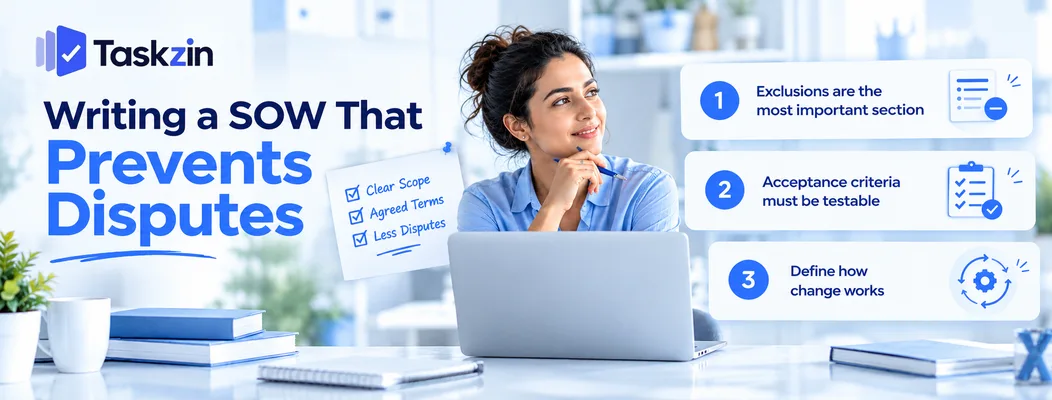
Three sections do most of the work: exclusions, acceptance criteria and the change process.
Exclusions are the most important section
List what a reasonable person might assume is included and is not. "Migration of existing content is out of scope." "Ongoing hosting is not included." "Two rounds of revisions; further rounds are billable."
Every dispute about scope traces back to an assumption nobody wrote down. Ten minutes on exclusions prevents weeks of argument later, and it is the section most often left thin.
Acceptance criteria must be testable "Website is completed to a high standard" cannot be tested. "All pages load in under three seconds on a standard connection, pass WCAG 2.1 AA checks, and render correctly in the current versions of Chrome, Safari and Firefox" can.
Each deliverable needs criteria that both parties could independently check and agree on.
Without them, "done" becomes a negotiation.
Define how change works
State how changes are requested, who approves them, how they are priced, and that they affect timeline.
Agreeing this before any change arises means the first change request is administrative rather than confrontational. Tracking agreed deliverables and client-owned dependencies as tasks with owners — Taskzin lets clients see these as free guests — keeps the SOW visible during delivery rather than filed at signature.
Common SOW Mistakes
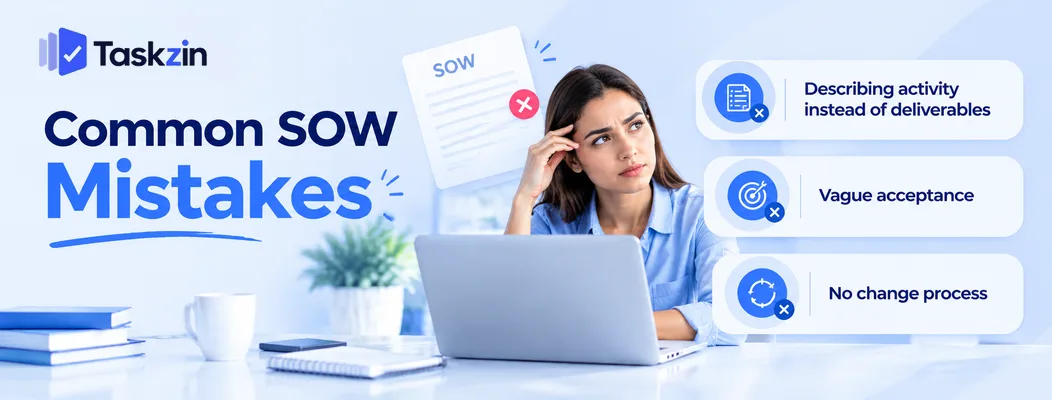
Describing activity rather than outcomes, leaving acceptance vague, and omitting the change process.
Describing activity instead of deliverables
"Supplier will conduct research and design work" describes effort. It does not say what the client receives.
Name deliverables as outputs — "a research report of findings from twelve customer interviews", "three homepage design concepts" — so there is something concrete to accept.
Vague acceptance
Without testable criteria, acceptance depends on the client's mood on the day, and final payment depends on acceptance.
This is where suppliers lose money most often — not on pricing, but on endless revision cycles against an undefined standard.
No change process A SOW without a change process makes every change an informal negotiation, usually conducted under deadline pressure.
The result is typically absorbed work and a resentful supplier, or a dispute and a damaged relationship. Neither is necessary.
Frequently asked
What is a statement of work?
A document defining what a supplier will deliver to a client for a specific engagement — scope, deliverables, timeline, acceptance criteria, pricing and assumptions.
What should a SOW include?
Purpose, scope, explicit exclusions, named deliverables, testable acceptance criteria, timeline and milestones, responsibilities on both sides, assumptions, pricing and a change process.
Who writes the statement of work?
Usually the supplier drafts it and the client reviews and negotiates. In procurement-led organisations, the client may issue it as part of a tender.
What is the difference between a SOW and a contract?
The SOW defines a specific engagement and is usually part of the contract. A master services agreement typically sets the broader legal terms that the SOW sits under.
What is the difference between a SOW and a project charter?
A SOW is an external agreement between supplier and client. A project charter is an internal document authorising a project and naming its sponsor.
Is a SOW legally binding?
Usually, when signed as part of a contract, though this depends on how it is drafted and your jurisdiction. Have contracts reviewed by a qualified professional.
How detailed should a SOW be?
Detailed enough that both parties could independently judge whether each deliverable is complete. The exclusions and acceptance criteria deserve the most detail.
Sanju Shrestha is a SaaS content writer at Taskzin who explores smarter ways to manage work, organize priorities, and improve team performance. Her content covers productivity strategies, digital workflows, collaboration, and task management, with a focus on helping modern teams work more efficiently and stay aligned.
All posts by Sanju Shrestha


Comments