Product Roadmap Template
A product roadmap template using the now-next-later format with a worked example, covering what a roadmap is actually for, four format options, how to present it to executives, sales and the team, and common mistakes.

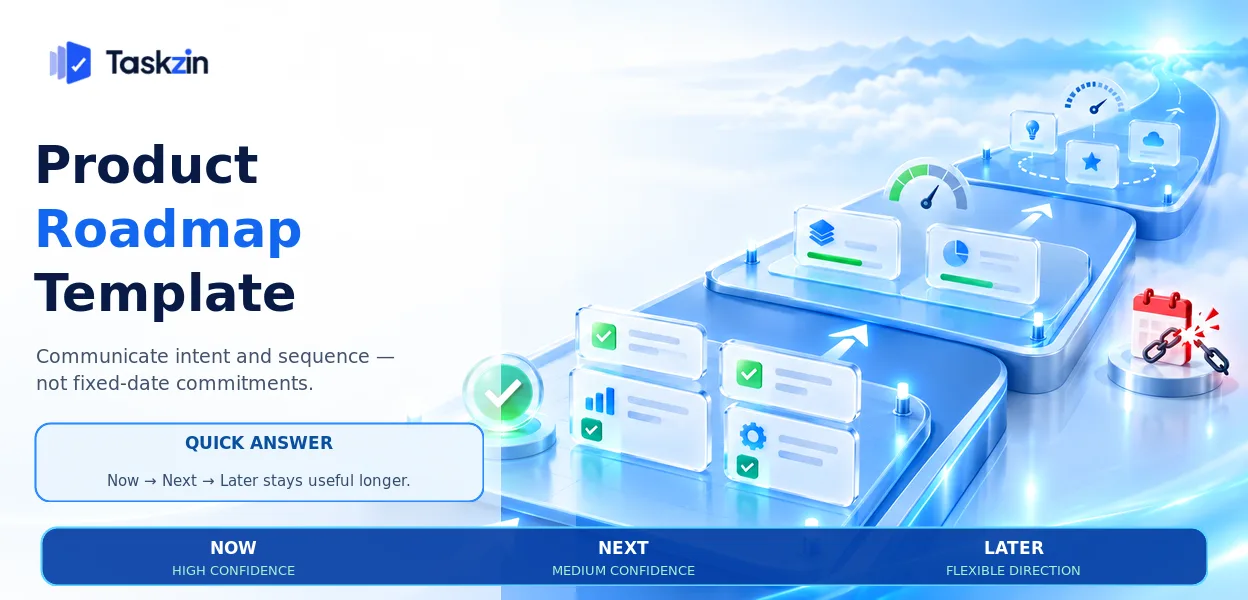
The template below works for most product teams and can be adapted to quarterly themes where stakeholders need more structure.
Quick answer: A roadmap communicates intent and sequence, not commitment to dates. The most durable format is now, next and later — with confidence decreasing as you move right — because it tells people what is coming without promising when. Date-based roadmaps fail predictably: they are read as commitments, they go stale within a quarter, and every slip becomes a credibility problem.
What a Roadmap Is For
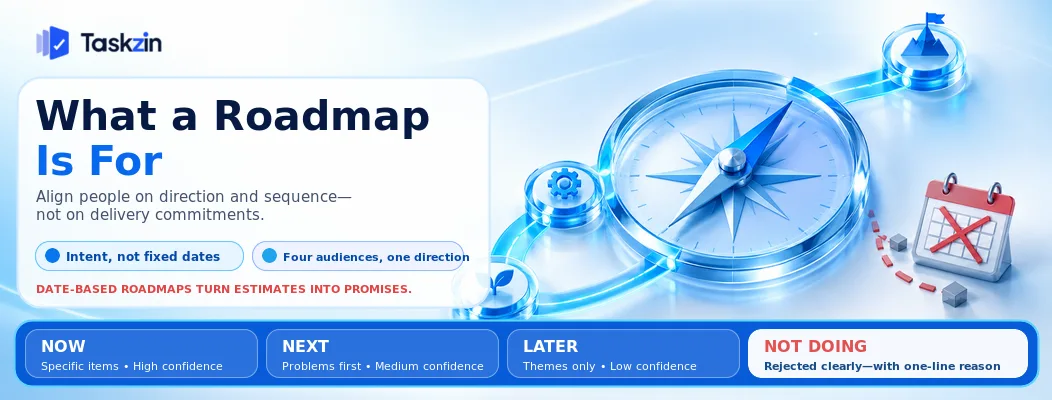
A roadmap exists to align people on direction and sequence, which is a different job from planning delivery.
Communicating intent, not committing dates
The roadmap says what problems you intend to address and roughly in what order. The sprint plan says what is actually being built this fortnight.
Confusing the two is the origin of most roadmap trouble. A roadmap that functions as a delivery commitment must be updated constantly and is wrong most of the time.
Who actually reads it
Executives checking that product direction matches strategy. Sales wanting to know what they can talk about. Support anticipating what changes. The team wanting context for why their work matters.
Four audiences with genuinely different needs, which is why a single artefact serving all of them badly is so common.
Why date-based roadmaps fail
Once a date appears next to a feature, it is treated as a promise regardless of any caveat attached.
Sales tells a customer. The customer plans around it. The date slips for entirely reasonable reasons, and the cost lands on trust rather than on the schedule. Withholding dates you cannot stand behind is more honest, not less.
The Now-Next-Later Template
Three horizons with decreasing certainty, plus the problem each item addresses and why it matters.
Horizon Timeframe Confidence What to include
Now Current cycle, in progress High Specific items, named outcome, roughly known delivery Next Following cycle or two Medium Problems being addressed, approach not fixed Later Beyond that Low Themes and directions only, no specifics Not doing — — Explicitly rejected, with a one-line reason
The "not doing" row is the most useful and most often omitted.
A Filled Example
A now-next-later roadmap for a small SaaS product, showing the level of detail each horizon needs.
Horizon Item Problem it solves Confidence Now Card retry on decline Customers with declined cards contact support to complete purchase Shipping this cycle Now Onboarding checklist New users do not reach first value; 40% never complete setup Shipping this cycle Next Team permissions Larger accounts cannot control who sees what; blocking three deals Approach not fixed Next Usage reporting Admins cannot show internal stakeholders the value they are getting Approach not fixed Later Public API Customers want to integrate with their own systems Direction only Later Mobile experience Increasing share of sessions on mobile, currently poor Direction only Not doing Native desktop app Low demand relative to cost; web performance work addresses most of it — Not doing White labelling Two requests only, both from accounts below our target segment —
Choosing a Roadmap Format
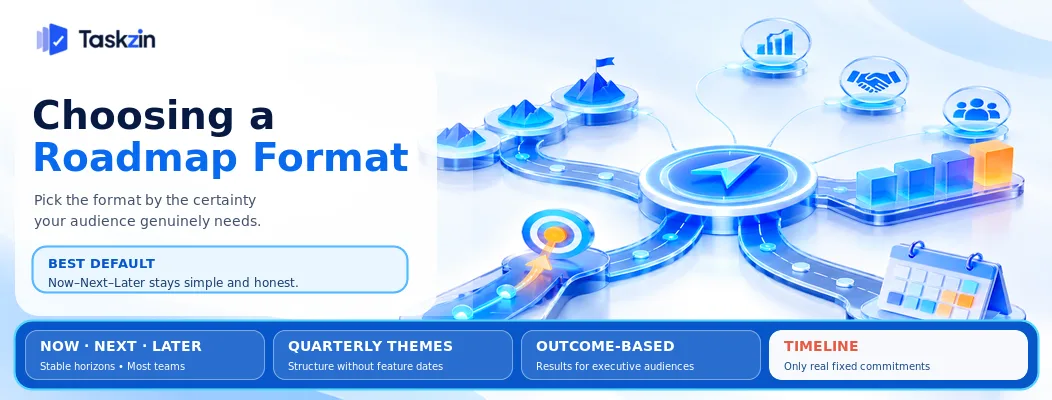
Four formats suit different situations, and the right one depends on how much certainty your audience genuinely needs.
Now, next, later
The default for most product teams. Simple, honest about uncertainty, and stable enough that it does not need rewriting monthly.
Its weakness is that stakeholders wanting dates find it evasive. That is usually a conversation worth having rather than a reason to change format.
Theme-based by quarter
Themes assigned to quarters — "Q3: reduce onboarding friction", "Q4: enterprise readiness" — without committing to specific features.
This suits organisations with quarterly planning cycles and gives more structure than now-next-later while still avoiding feature-level date commitments.
Outcome-based
Organised around the results you intend to achieve rather than what you will build: "reduce time to first value from 14 days to 5".
The strongest format for executive audiences, because it connects product work to business outcomes directly. It requires a team confident enough to be measured on results rather than on delivery.
When a timeline roadmap is right
Sometimes dates are genuinely necessary — regulatory deadlines, contractual commitments, a hardware launch, a partner integration with a fixed window.
Use a timeline for those specific items and keep the rest in horizons. A mixed roadmap is more honest than pretending everything has a date or that nothing does.
Presenting It to Different Audiences
Executives want outcomes, sales wants dates and honesty about them, and the team wants the reasoning.
Executives want outcomes
Five lines: what we are trying to achieve, why it matters commercially, and what we have decided not to do.
Feature lists lose executive attention quickly. Outcomes tied to business metrics hold it, and the "not doing" list demonstrates that prioritisation is actually happening.
Sales wants dates and honesty
Sales will ask for dates, and giving them soft dates that slip is worse than giving none.
A workable arrangement: "now" items can be discussed with customers, "next" items can be described as directions without timing, and "later" items are not to be mentioned externally.
Making those rules explicit prevents the most damaging version of this problem.
The team wants context
The team needs to know why items are prioritised, what problem each addresses, and what was rejected.
This is the audience most often neglected and the one where context changes decisions daily.
Keeping the roadmap where the work lives — attached to the project rather than in a slide deck somebody has to find — means people actually see it.
Common Roadmap Mistakes
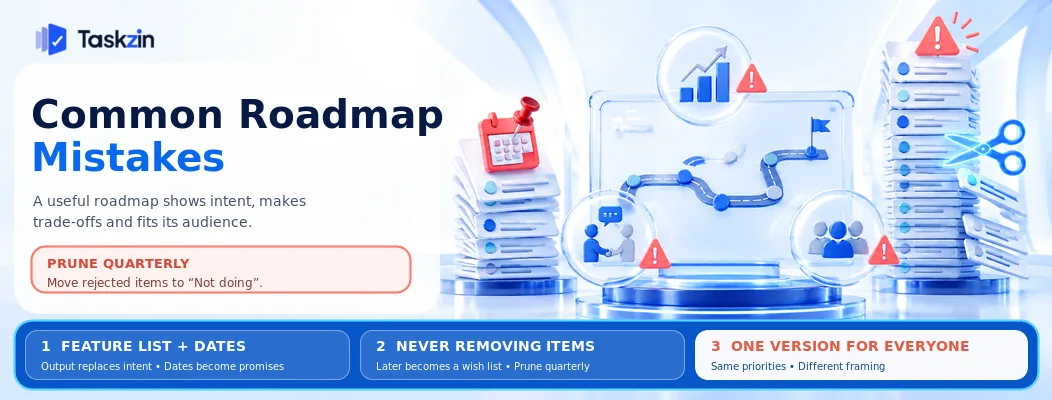
Three failures: a feature list with dates, a roadmap that only ever grows, and one version for every audience.
A feature list with dates attached
The default roadmap in most organisations, and the least useful. It communicates output rather than intent, and every date becomes a commitment somebody plans around.
State the problem each item solves. If you cannot, that item may not belong on the roadmap yet.
Never removing anything
Roadmaps that only accumulate become wish lists. Items sit in "later" indefinitely, and stakeholders keep expecting them.
Prune quarterly. Move things to "not doing" with a stated reason. That reason is what protects you from the same request arriving every month.
One roadmap for every audience
A single document serving executives, sales, support and the team serves all of them poorly.
Maintain one underlying set of priorities and present it differently — outcomes for executives, discussable items for sales, full context for the team. Same content, appropriate framing.
Frequently asked
What is a product roadmap?
A communication of product intent and sequence — what problems you plan to address and roughly in what order. It is not a delivery plan or a commitment to dates.
Should a roadmap have dates?
Generally no, except where dates are genuinely fixed by regulation, contract or an external event. Dates on a roadmap are read as promises regardless of the caveats attached.
What is a now-next-later roadmap?
A format with three horizons of decreasing certainty: specific work in progress now, problems being addressed next, and directions only for later. It communicates sequence without committing timing.
How far ahead should a roadmap go?
Two to four quarters for most products. Beyond that, specificity is false — the "later" horizon should hold directions rather than items.
How often should you update a roadmap?
Review quarterly, with the "now" section reflecting current work continuously. Pruning matters as much as adding — move rejected items to a "not doing" list with reasons.
What is the difference between a roadmap and a backlog?
A roadmap communicates direction to stakeholders at theme level. A backlog is the prioritised list of specific work the team draws from. The roadmap should never be a rendering of the backlog.
How do you say no using a roadmap?
Keep an explicit "not doing" section with a one-line reason for each item. It converts repeated requests into a settled decision you can point to rather than relitigate.
Binita Ray is a content writer at Taskzin, creating insightful and practical content on task management, team collaboration, productivity, workflow optimization, and SaaS solutions. She focuses on helping businesses, teams, and professionals simplify their work processes, improve efficiency, and make better use of modern productivity tools.
All posts by Binita Ray

Comments