OKR Template With Examples
An OKR template with worked examples by function, showing what separates an objective from a key result, bad OKRs paired with their fixes, how to set and run a quarter, and the mistakes that break the framework.


An objective states what you are trying to achieve, qualitatively. Key results state how you will know you achieved it, measurably. The single test that catches most bad OKRs is whether a key result could be completed by doing work without anything actually changing. If it could, it is a task wearing the wrong label.
The template and examples below cover the format, what good and bad versions look like side by side, and how to run a quarter without the framework becoming administrative overhead.
What Makes an OKR an OKR

The objective is direction, the key results are evidence, and neither should describe activity.
The objective is qualitative
One sentence stating what you want to be true at the end of the quarter. Ambitious, memorable, and deliberately not a number.
"Make onboarding something customers finish without help" is an objective. "Increase activation by 20 percent" is a key result that has been mislabelled — it is measurable, which means it belongs in the other column.
Key results are measurable outcomes
Two to four per objective, each with a number and a direction. They should be things that change in the world, not things you produce.
The distinction matters because outputs are within your control and outcomes are not entirely.
That discomfort is the point — an OKR you fully control is a plan, not a goal.
Why outputs are not key results
"Ship the new onboarding flow" is an output. You can ship it and have nothing improve.
"Reduce median time to first value from 14 days to 5" is an outcome. Shipping the flow is how you might achieve it, and if the flow ships and the number does not move, you have learned something valuable rather than declared success.
The OKR Template
One objective, two to four key results, with the initiatives kept separate.
Element Content Rules Objective What we want to be true by quarter end Qualitative, one sentence, no numbers Key result 1 Measurable outcome with a baseline and target From X to Y by date Key result 2 Measurable outcome From X to Y by date
Key result 3 Measurable outcome From X to Y by date Owner One person accountable for the objective Not a team Initiatives The work you think will move the key results Separate list — these are tasks, not OKRs Confidence Current belief you will hit ~0.7 Updated fortnightly
Worked Examples by Function
Four OKRs written properly, across different teams.
Function Objective Key results Product Make onboarding something customers complete without contacting us Median time to first value from 14 days to 5. Setup completion rate from 58% to 85%.
Onboarding-related support tickets from 120/month to under 40.
Marketing Become the place teams look first when researching project tools Organic sessions from 18k to 30k/month. Demo requests from organic from 40 to 90/month.
Rank in top 3 for 8 of our 12 priority terms (currently 2).
Engineering Make the platform something customers trust under load p95 response time from 1.8s to under 800ms. Unplanned downtime from 4.2 hours to under 1 hour per quarter. Escaped defects from 14 to under 5 per quarter.
Customer success Turn our largest accounts into active advocates Accounts above $10k renewing from 82% to 92%.
Reference-willing customers from 6 to 15. Median NPS among top 20 accounts from 31 to 45.
Bad OKRs and Their Fixes
The same intentions, written badly and then correctly.
Bad version Why it fails Fixed version KR: Launch the new website An output — you can launch it and change nothing KR: Increase demo requests from the site from 40 to 90/month KR: Hire 3 engineers A task with a checkbox KR: Reduce median time from ticket start to merge from 9 days to 4 Objective: Increase revenue by 20% A number, so it is a key result, not an objective Objective: Make expansion the main source of our growth. KR:
Expansion revenue from 15% to 35% of new ARR KR: Improve customer satisfaction Not measurable KR: CSAT from 3.8 to 4.4 across all support interactions
KR: Run 12 webinars Activity, fully within your control KR: Pipeline sourced from events from $180k to $500k Objective: Do the Q3 roadmap A task list Objective: Make the product usable by teams over 50 people.
KR: Accounts above 50 seats from 4 to 12
Setting OKRs Without Wasting a Quarter

Three objectives at most, key results written before you know how to hit them, and 0.7 treated as success.
Three objectives maximum
Per team, per quarter. Two is better. Teams setting seven objectives have written a to-do list and will achieve none of them meaningfully.
The constraint is the value. OKRs are a prioritisation device, and a framework that permits everything prioritises nothing.
Write key results before you know how
If you already know exactly how to hit a key result, it is probably too easy or it is an output in disguise.
Good key results are set at a level where the approach is genuinely uncertain at the start of the quarter. That uncertainty is what makes the framework generate new thinking rather than restating existing plans.
Score at 0.7, not 1.0
Set targets so that hitting roughly 70 percent represents strong performance. A team consistently scoring 1.0 is setting targets it already knew it would hit.
This only works if scoring below 1.0 is genuinely safe. The moment a 0.6 has consequences, everyone sets achievable targets and the framework becomes a slower way of writing a plan.
Running the Quarter
Check in briefly and regularly, keep OKRs separate from daily work, and close the quarter with honest scoring.
Check in fortnightly, briefly
Fifteen minutes per team: current value of each key result, confidence in hitting the target, and anything blocking.
Monthly is too infrequent to change course; weekly is too much overhead. Fortnightly is where most teams settle.
Separate OKRs from your task list
OKRs are the goals; your sprint or board is the work. Keeping them in the same list turns key results into tickets and destroys the distinction the framework depends on.
Where the tool supports goals as their own object linked to the underlying work, this separation holds naturally — you can see which projects contribute to which key result without the key result becoming a task.
Close the quarter honestly
Score each key result, then discuss two questions: did we hit it, and did hitting it matter?
The second question is more useful. A key result achieved that changed nothing means the metric was wrong, and that is worth knowing before you set the next one.
Common OKR Mistakes
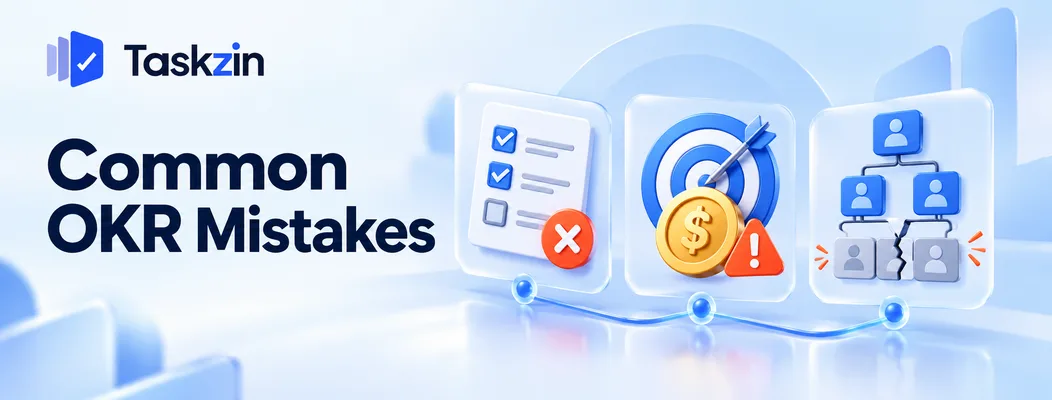
Three failures: OKRs as a task list, OKRs tied to pay, and mechanical cascading through the organisation.
Turning OKRs into a task list
The most common failure by a distance. Every key result is something the team was going to do anyway, rewritten with a checkbox.
Apply the test: could you complete this and have nothing change? If yes, it is a task. Move it to the initiatives list where it belongs.
Tying them to compensation
The moment OKR scores affect pay or promotion, people set targets they know they can hit.
Ambition disappears immediately and permanently.
Keep them separate from performance review. This is the single most consistent piece of advice from organisations that use the framework well, and the one most often ignored.
Cascading them rigidly down the org
Mechanically deriving every team's OKRs from the level above produces alignment on paper and nonsense in practice, because a support team's contribution to a revenue objective is not a smaller revenue objective.
Share company objectives, let teams write their own key results in response, then check for gaps and contradictions. Alignment through conversation rather than arithmetic.
Frequently asked
What does OKR stand for?
Objectives and Key Results. The objective states qualitatively what you want to achieve; key results state measurably how you will know you achieved it.
What is the difference between an objective and a key result?
An objective is qualitative and contains no numbers. A key result is a measurable outcome with a baseline, a target and a date. If your objective has a number in it, it is a key result.
How many OKRs should a team have?
At most three objectives with two to four key results each, per quarter. Two objectives is better. More than three means nothing has been prioritised.
What is a good OKR score?
Around 0.7. Targets should be set so that hitting roughly 70 percent is strong performance. Consistently scoring 1.0 means the targets were too easy.
Should OKRs be tied to performance reviews?
No. Once scores affect pay or promotion, people set targets they know they can hit, and the ambition the framework depends on disappears.
What is the difference between OKRs and KPIs?
KPIs are ongoing health metrics you monitor continuously. OKRs are time-bound goals for changing something specific. A KPI that needs to move becomes a key result for a quarter.
How often should OKRs be set?
Quarterly for teams, annually for company-level objectives. Check in fortnightly during the quarter, and score honestly at the end.
Binita Ray is a content writer at Taskzin, creating insightful and practical content on task management, team collaboration, productivity, workflow optimization, and SaaS solutions. She focuses on helping businesses, teams, and professionals simplify their work processes, improve efficiency, and make better use of modern productivity tools.
All posts by Binita Ray

Comments