What Is a Sprint in Agile?
A beginner-friendly explanation of sprints in agile, covering the definition and purpose, the four sprint events, choosing a sprint length, what happens inside a sprint, common sprint problems, and when sprints are the wrong approach.

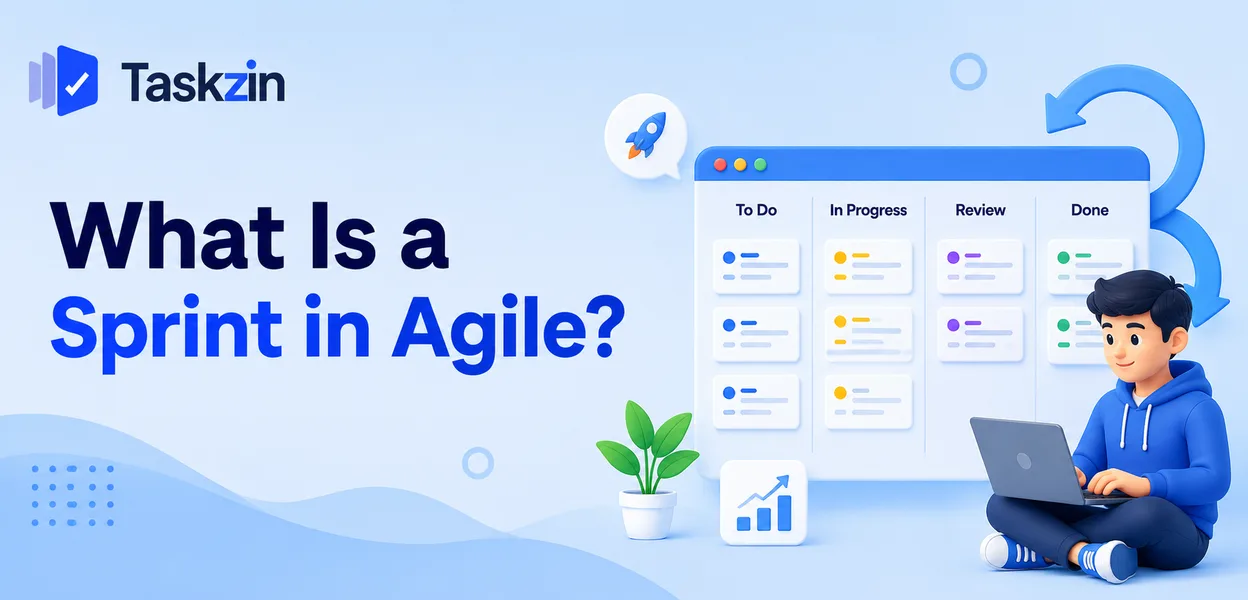
What is a sprint in agile?
Sprints are the most recognisable part of agile working, and one of the most frequently misapplied. Teams adopt the ceremonies, keep the two-week rhythm, and never get the benefit — usually because one specific element was left out.
Understanding what a sprint is for, rather than just what happens during one, is what separates a functioning cadence from a set of recurring meetings.
This guide covers the definition, the four events, how long sprints should be, and when they are the wrong choice.
Quick answer: Quick answer: A sprint is a fixed-length period, usually one to four weeks, during which a team completes an agreed amount of work toward a specific goal. The length stays constant so the team can learn how much it reliably delivers. Each sprint contains four events — planning, daily standup, review and retrospective — and ends with something potentially usable rather than partially finished work.
What a Sprint Actually Is

A sprint is a timebox of fixed length in which a team works toward an agreed goal and produces something usable by the end.
A fixed period with a fixed goal
Two things define a sprint: it has a set length that does not change, and it has a goal describing what the sprint should achieve.
The goal is the part most often skipped and the part that makes the rest work. Without it, a sprint is a batch of unrelated tasks, and when something slips mid-sprint the team drops whatever is easiest rather than whatever matters least.
Why the length never changes
The constant length is not arbitrary. It is what allows the team to learn its own capacity.
If sprints are two weeks every time, then after five or six of them you know roughly how much this team completes in two weeks. That figure becomes the basis for forecasting. Vary the length and you lose the comparison, and every sprint becomes a fresh guess.
What a sprint is not
A sprint is not a deadline imposed on a fixed scope — that is a mini waterfall project with agile vocabulary. It is not a period of working faster, despite the name. And it is not a container into which as much work as possible should be packed.
It is a learning cycle. Plan a realistic amount, build it, inspect the result, and adjust the next one accordingly.
The Four Sprint Events
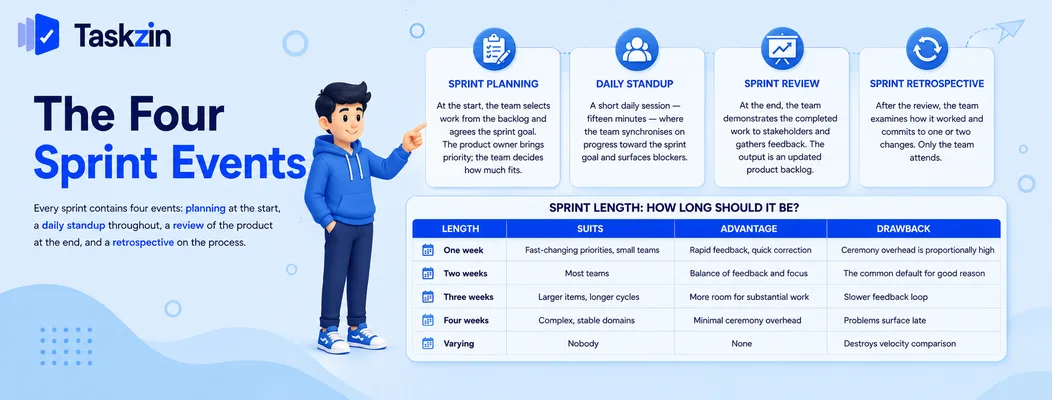
Every sprint contains four events: planning at the start, a daily standup throughout, a review of the product at the end, and a retrospective on the process.
Sprint planning
At the start, the team selects work from the backlog and agrees the sprint goal. The product owner brings priority; the team decides how much fits.
Planning should be selection rather than discovery. If it is the first time anyone has read the stories, it will run for hours. Refining the backlog beforehand is what keeps planning short.
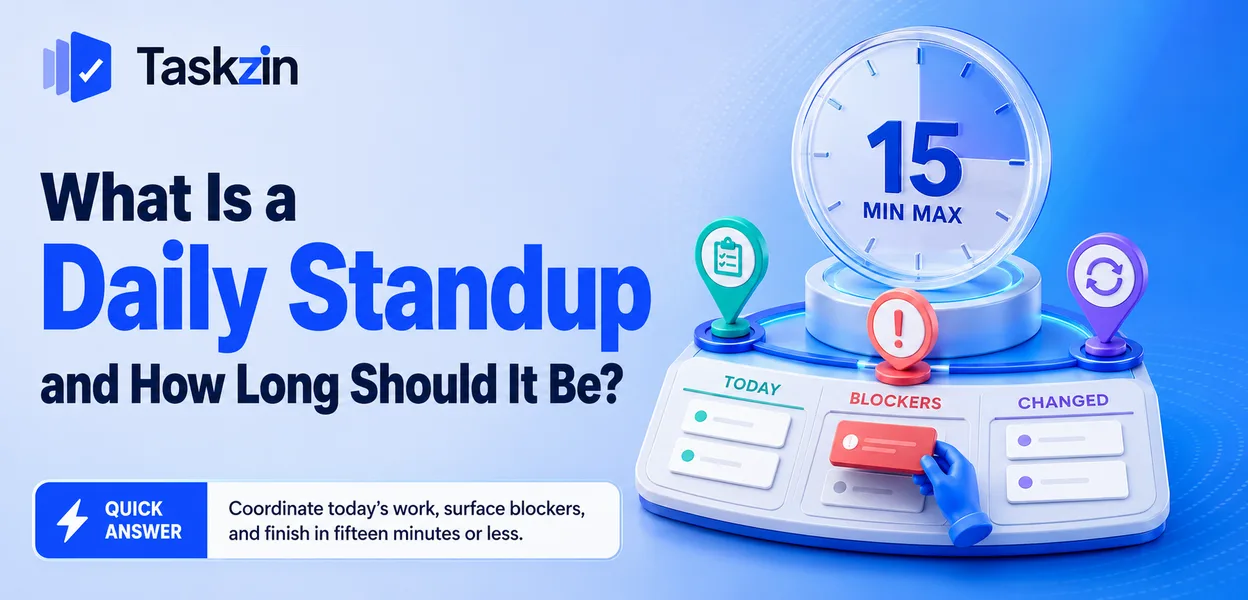
Daily standup
A short daily session — fifteen minutes — where the team synchronises on progress toward the sprint goal and surfaces blockers.
Its purpose is coordination, not reporting. A standup where each person recites what they did yesterday to a manager has become a status meeting, which is a different and less useful thing.
Sprint review
At the end, the team demonstrates the completed work to stakeholders and gathers feedback.
The output is an updated product backlog.
It is a working conversation rather than a presentation. If the backlog is unchanged afterwards, either no feedback was given or none was heard.
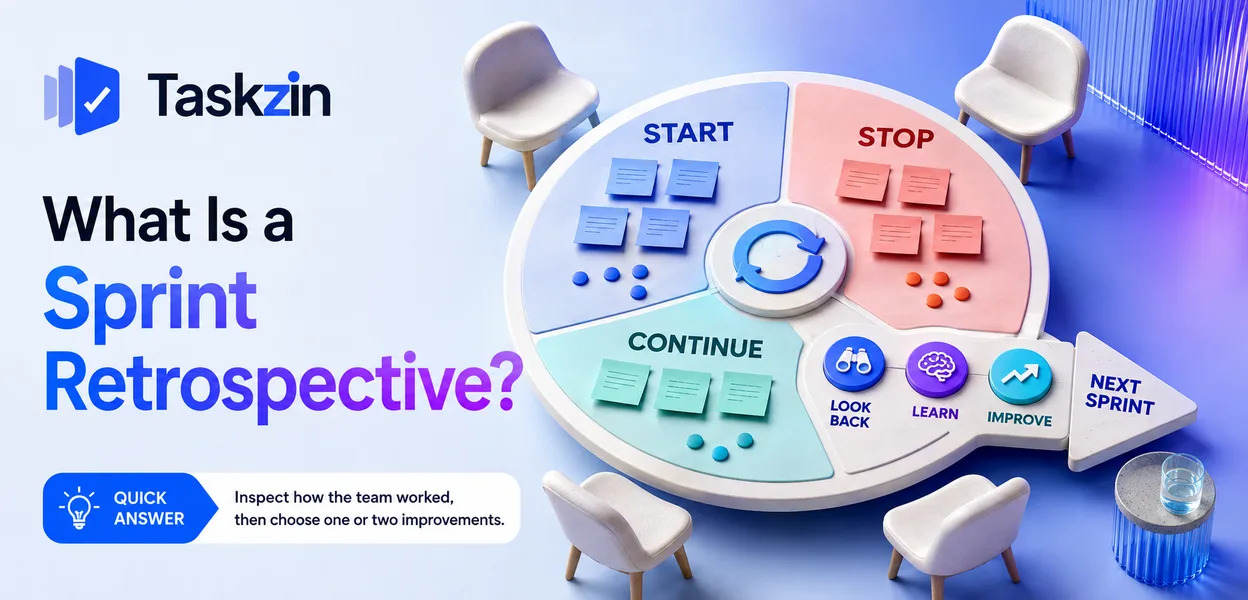
Sprint retrospective
After the review, the team examines how it worked and commits to one or two changes. Only the team attends.
This is where improvement happens. A team that runs planning, standups and reviews but skips retrospectives repeats the same problems indefinitely.
Sprint Length: How Long Should It Be?
Length Suits Advantage Drawback One week Fast-changing priorities,
Very small teams
Rapid feedback, quick correction Ceremony overhead is proportionally high Two weeks Most teams Balance of feedback and focus The common default for good reason Three weeks Larger items, longer cycles More room for substantial
Unpredictable, interrupt-driven work
Slower feedback loop Four weeks Complex, stable domains Minimal ceremony overhead Problems surface late Varying Nobody None Destroys velocity comparison
What Happens Inside a Sprint
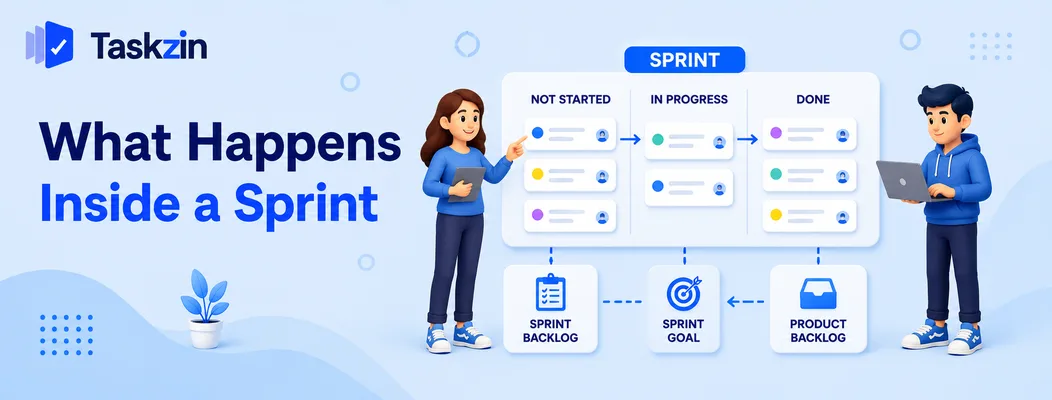
The team pulls selected items into a sprint backlog, works through them toward the goal, and returns anything unfinished to the product backlog at the end.
The sprint backlog and the sprint goal
The sprint backlog is the set of items selected plus the plan for delivering them. The sprint goal is one sentence describing what the sprint should achieve.
The goal gives the team something to protect. When reality intrudes — and it does — the team can decide what to drop by asking what least affects the goal, rather than escalating every trade-off.
Working through the sprint
Items move from not started, through in progress, to done. The team coordinates daily and adjusts the plan as it learns.
The plan inside the sprint is expected to change; the goal and the length are not. That distinction is what makes a sprint adaptive rather than rigid.
What happens to unfinished work
Unfinished items return to the product backlog and are re-prioritised. They are not automatically carried into the next sprint.
This matters because automatic carryover hides the problem. An item that has rolled over three times is telling you something — it is too large, it is blocked, or it was never genuinely a priority — and re-prioritising forces that to be examined rather than deferred again.
Common Sprint Problems

Three problems account for most struggling sprints: chronic carryover, scope added mid-sprint, and sprints without a goal.
Carrying work over every sprint
Persistent carryover almost always means the commitment is too large rather than the team too slow. Capacity was calculated against nominal availability rather than real availability.
Measure what the team actually delivers over three sprints and commit to that, not to what fits on paper.
Scope added mid-sprint
Work inserted after planning displaces something, and if the displacement is not acknowledged the sprint simply fails quietly.
The rule is not that nothing can change — it is that adding something means explicitly removing something. Making that trade visible is the whole point of having a sprint boundary.
Sprints with no goal
A sprint that is just a list of tickets has no organising principle. Every item has equal weight, so there is no basis for deciding what to sacrifice under pressure.
One sentence, agreed at planning, fixes this.
When Sprints Are the Wrong Choice
Sprints suit teams with reasonably predictable work; they suit interrupt-driven teams and very small teams poorly.
Unpredictable, interrupt-driven work A support team, a platform team, or anyone whose queue is filled by other people cannot commit to two weeks of scope meaningfully.
Those teams do better with continuous flow and WIP limits, which manage workload without requiring a commitment that external events will invalidate.
Very small teams Two or three people working closely coordinate in conversation. The full set of ceremonies costs more than the coordination problem they solve.
Take the useful parts — a regular look back, a visible list of work — and skip the ceremony until the team is large enough to need it.
Frequently asked
What Is a Sprint in Agile?
A fixed-length period, usually one to four weeks, in which a team works toward an agreed goal and produces something usable by the end. The length stays constant so the team learns its capacity.
How long is a sprint?
Most commonly two weeks. One week suits fast-changing priorities; three or four suit larger, more stable work. The important thing is that the length stays the same, so velocity remains comparable.
What are the four sprint ceremonies?
Sprint planning at the start, a daily standup throughout, a sprint review of the product with stakeholders at the end, and a retrospective on the team's process afterwards.
What is a sprint goal?
One sentence describing what the sprint should achieve. It gives the team a basis for deciding what to drop when something goes wrong, rather than treating every item as equally important.
What happens to unfinished work at the end of a sprint?
It returns to the product backlog and is re-prioritised rather than automatically rolling into the next sprint. Repeated carryover is a signal to split the item or investigate what is blocking it.
Can you change the sprint scope mid-sprint?
Yes, but adding something should mean explicitly removing something of similar size. Unacknowledged additions are the most common reason sprints fail quietly.
What is the difference between a sprint and an iteration?
Largely terminology. "Sprint" is the Scrum term; "iteration" is used more generally in agile. Some tools, such as Linear, use "cycle" for the same concept.
Sujan Sharma is a content writer at Taskzin with a strong focus on productivity systems, task management, workflow optimization, team collaboration, and SaaS technology. He creates research-driven, practical content that helps professionals and growing teams improve operational efficiency, streamline processes, and make informed decisions about modern work management tools.
All posts by Sujan Sharma
Comments