PRINCE2 Explained in Plain English
A plain-English explanation of PRINCE2, covering what the method is and excludes, its seven principles, themes and processes, how a project runs stage by stage, management by exception, and common mistakes.

It is widely used in the UK, Europe, Australia and public sector procurement, and much less common in North America. It is often caricatured as heavyweight bureaucracy, which is a fair description of PRINCE2 applied without tailoring and a poor description of the method itself.
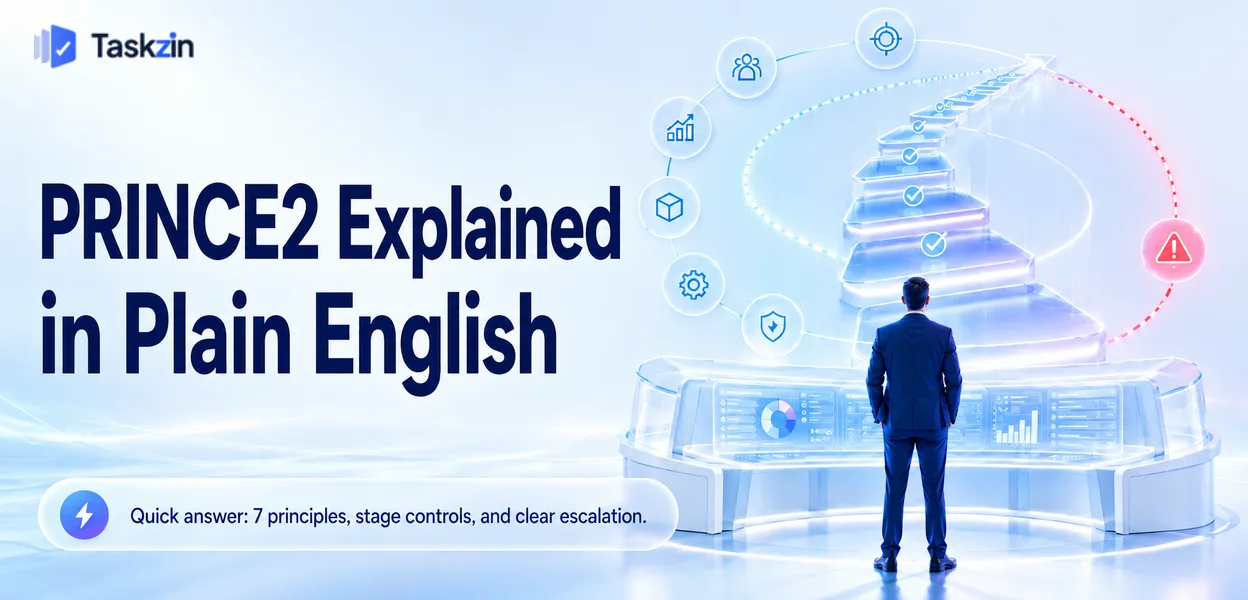
Quick answer: PRINCE2 is a structured project management method built on seven principles, seven themes and seven processes, defining who decides what, when decisions happen, and what must be true for a project to continue. Its defining features are continued business justification — a project that stops being worthwhile should be stopped — and management by exception, where the project manager runs the project within agreed tolerances and only escalates when those are breached.
What PRINCE2 Actually Is [IMG]
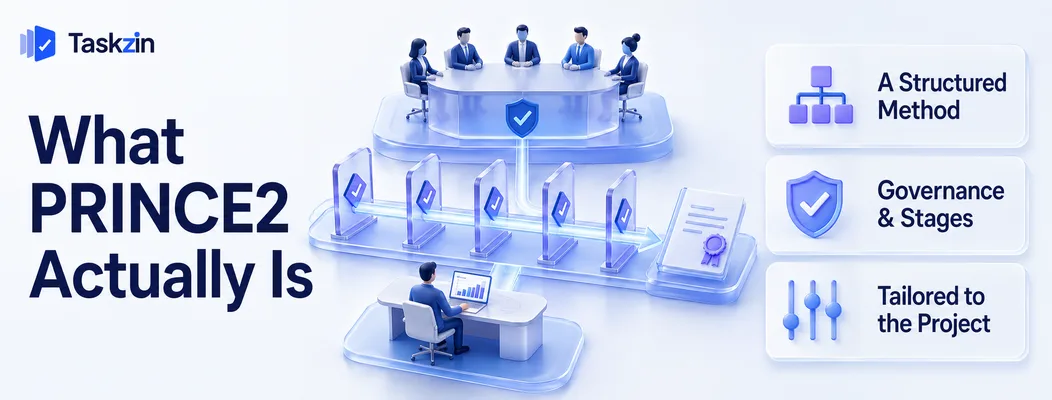
PRINCE2 is a method describing how to run a project — the decision structure, the stages and the documents — rather than a body of knowledge describing techniques.
A method, not a body of knowledge
PMP and PMBOK describe a broad range of techniques a project manager might use.
PRINCE2 prescribes a specific way of organising a project.
That is the practical difference. PRINCE2 tells you there is a project board, that the project runs in management stages, and that the project manager operates within tolerances. It is opinionated where PMBOK is comprehensive.
Where it is used
Strongest in the UK, Ireland, much of Europe, Australia and parts of Asia, particularly in government, public sector and organisations delivering to public sector contracts.
If you work in those markets, PRINCE2 appears in job specifications and procurement requirements regularly. If you work in North America, PMP dominates instead. This geography should largely determine whether learning it is worth your time.
What it deliberately excludes
PRINCE2 does not cover leadership, people management, or specific techniques for estimating, scheduling or risk analysis.
It assumes you bring those. This is why it is sometimes criticised as incomplete — it is, deliberately, because it addresses project governance rather than project execution technique.
The Structure: Principles, Themes and Processes
Category Contains Purpose **7 Principles** Continued business justification, learn from
Business justification and defined roles
responsibilities, manage by Non-negotiable rules — a project not applying all seven is not PRINCE2
stages, manage by exception, focus on products, tailor to suit the project **7 Themes** Business case, organisation, quality, plans, risk, change, progress Aspects that must be addressed continuously throughout **7 Processes** Starting up, directing, initiating, controlling a stage, managing product delivery, managing
Closing
The activities performed, and by whom, across the lifecycle
The Seven Principles [IMG]
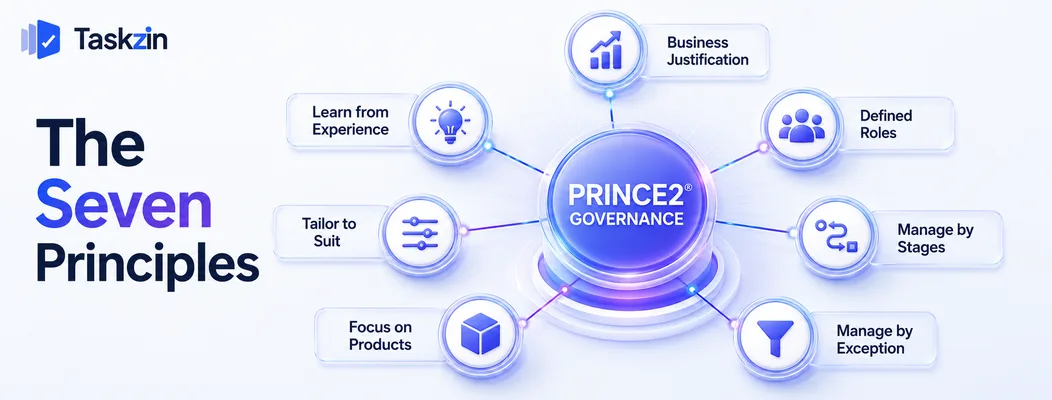
The principles are what make a project PRINCE2 — the themes and processes can be tailored heavily, but all seven principles must apply.
Business justification and defined roles Continued business justification means there must be a documented reason for the project, and it must remain valid throughout. If the business case stops holding, the project should be stopped — including projects already well underway.
Defined roles and responsibilities means everyone knows who decides what. The project board represents business, user and supplier interests, and the project manager runs the project day to day within its authority.
Learning, stages and management by exception
Learn from experience: lessons are sought at the start, recorded during, and passed on at closure.
Manage by stages: the project is planned and authorised one management stage at a time, so the board reassesses viability at each boundary rather than approving everything at the outset.
Manage by exception: the board sets tolerances for time, cost, scope, quality, risk and benefit.
The project manager operates freely within them and escalates only when a tolerance will be breached.
Product focus and tailoring
Focus on products means planning starts from what will be delivered and its quality criteria, rather than from activities. Define the products first; the activities follow.
Tailor to suit the project is the principle most often ignored, and the one that determines whether PRINCE2 helps or hinders. The method is explicitly meant to be scaled to the project's size and risk.
How a PRINCE2 Project Runs
A PRINCE2 project starts up, is initiated, runs through a series of authorised management stages, and closes formally.
Starting up and initiating
Starting up is a short pre-project activity producing a project brief and confirming there is a viable project worth initiating.
Initiating produces the project initiation documentation — the business case, plans, risk approach, quality approach and controls. This is the foundation the board approves before committing significant resource.
Managing by stage
The project runs in management stages. At each boundary, the project manager reports on the stage completed and presents the plan for the next; the board authorises continuation or stops the project.
This is the mechanism that prevents projects continuing on inertia. Each stage boundary is a genuine decision point, and a project whose business case has weakened can be stopped there without embarrassment.
Within a stage, the project manager controls work packages and receives regular progress.
Highlight reports go to the board at agreed intervals — an operating rhythm most project tools support directly through recurring reporting.
Closing Formal closure confirms products were delivered and accepted, evaluates the project against its business case, captures lessons and hands over to operations.
Closure is a defined process rather than an event that happens when people drift away, which is one of PRINCE2's genuine strengths.
Management by Exception in Practice [IMG]
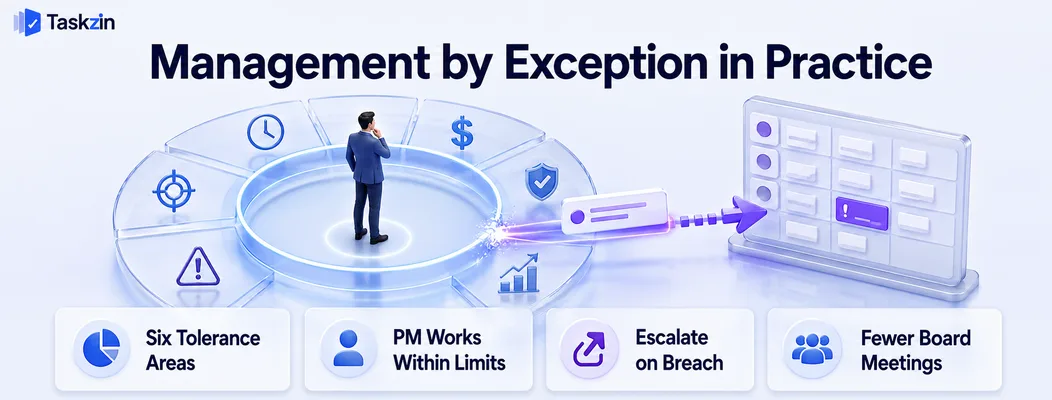
Tolerances define the project manager's authority; breaching one triggers escalation, and everything within them is the project manager's decision.
Tolerances and who sets them
The project board sets tolerances at project and stage level across six areas: time, cost, scope, quality, risk and benefit.
For example: the stage may run up to two weeks late and five percent over budget without escalation. Within that, the project manager decides.
What happens when a tolerance is breached
When the project manager forecasts a breach, they raise an exception report to the board describing the situation, the options and a recommendation.
The board decides: accept the change, approve an exception plan, or stop the project. The escalation is structured, which makes it less politically fraught than an unstructured admission that things are off track.
Why it reduces meetings
Management by exception is the feature that makes PRINCE2 lighter than its reputation suggests.
Because the board only engages when tolerances are threatened or at stage boundaries, there is no need for weekly steering meetings reviewing decisions the project manager was authorised to make. Organisations that hold those meetings anyway have not implemented the principle.
Common PRINCE2 Mistakes
The three failures are applying the full method without tailoring, treating documentation as the objective, and assuming it is incompatible with agile.
Applying it without tailoring
The most common and most damaging. Producing every document at full length for a six-week project generates enormous overhead and gives PRINCE2 its bureaucratic reputation.
Tailoring is a principle, not an option. On a small project the initiation documentation might be a few pages rather than a folder, and that is correct PRINCE2, not a shortcut.
Documentation as the goal
The documents exist to support decisions. When producing them becomes the objective, teams write comprehensive artefacts nobody uses to decide anything.
The test for any PRINCE2 document is which decision it informs. If none, tailor it out.
Treating it as anti-agile
PRINCE2 governs the project; it does not prescribe how the work is done. Delivery within a stage can be entirely iterative, and PRINCE2 Agile exists specifically to combine the two.
The governance layer — business justification, stage boundaries, tolerances — is compatible with agile delivery underneath it, and this combination is common in practice.
Frequently asked
What is PRINCE2?
A structured project management method organised around seven principles, seven themes and seven processes, defining project governance — who decides what, when, and under what authority.
What does PRINCE2 stand for?
Projects IN Controlled Environments, version 2. It originated in UK government and is now used widely across the public and private sectors in the UK, Europe and Australia.
What are the seven principles of PRINCE2?
Continued business justification, learn from experience, defined roles and responsibilities, manage by stages, manage by exception, focus on products, and tailor to suit the project.
Is PRINCE2 compatible with agile?
Yes. PRINCE2 governs the project while delivery within a stage can be iterative. PRINCE2 Agile exists specifically to combine the governance layer with agile delivery practices.
What is management by exception?
The project board sets tolerances for time, cost, scope, quality, risk and benefit. The project manager works freely within them and escalates only when a tolerance will be breached.
Is PRINCE2 recognised internationally?
Strongly in the UK, Europe, Australia and parts of Asia, particularly in public sector contexts. Recognition in North America is considerably lower, where PMP dominates.
Is PRINCE2 suitable for small projects?
Yes, if tailored — which is one of its seven principles. A small project might have a two-page initiation document and short stages. Applying the full method untailored is what makes it unsuitable.
Sanju Shrestha is a SaaS content writer at Taskzin who explores smarter ways to manage work, organize priorities, and improve team performance. Her content covers productivity strategies, digital workflows, collaboration, and task management, with a focus on helping modern teams work more efficiently and stay aligned.
All posts by Sanju Shrestha
Comments