How to Run a Retrospective People Don't Dread
A practical guide to running retrospectives people find worthwhile, covering why they go stale, eight formats compared, the underlying structure that makes any format work, how to create psychological safety, and common mistakes.

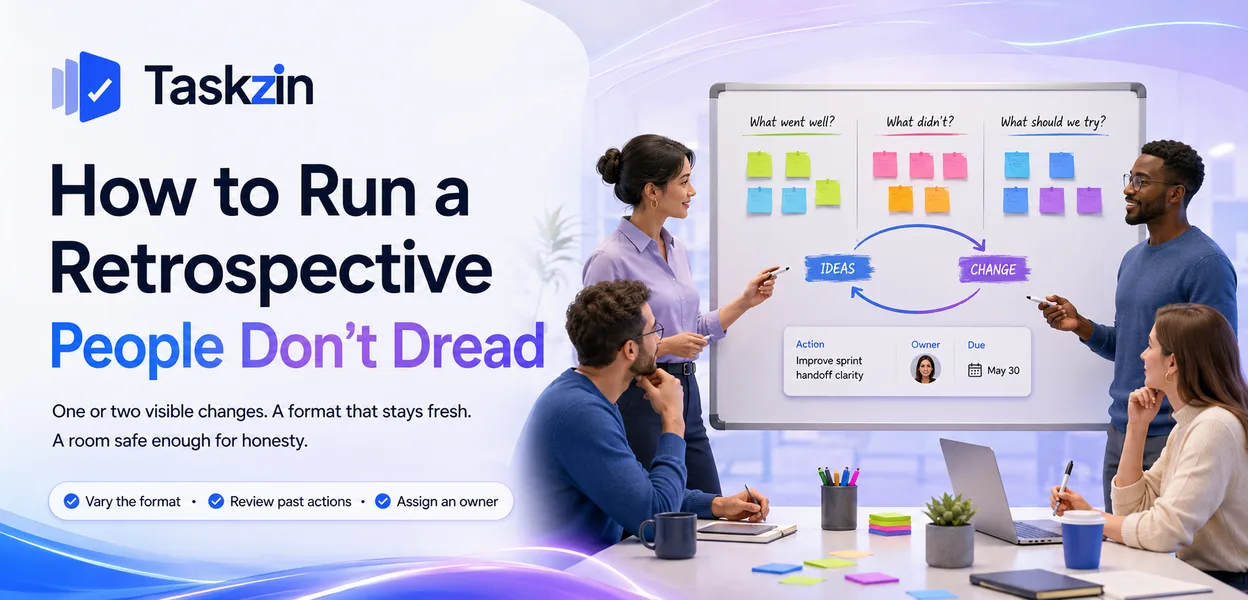
The pattern is recognisable. A team runs the same three columns every fortnight, generates a list of frustrations, agrees a handful of actions, and does none of them. Six sprints later attendance is grudging and the discussion is polite and empty.
This guide covers why that happens, eight formats worth rotating, the structure underneath any of them, and how to make the session safe enough to be worth holding.
Quick answer: A retrospective works when it produces one or two changes people can see, uses a format that varies enough to keep attention, and feels safe enough that the real problem gets named — the format matters far less than whether anything actually changes afterwards.
Most stale retrospectives fail on the follow-through, not the facilitation.
Why Retrospectives Go Stale
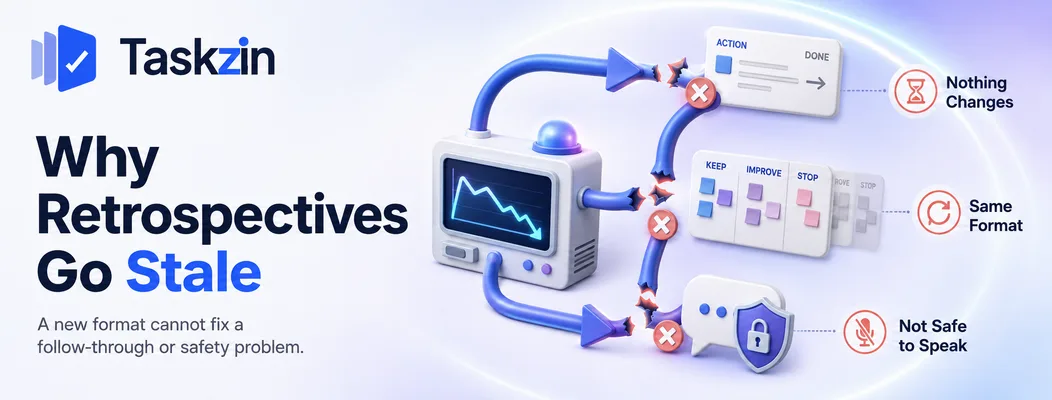
Retrospectives die for three reasons: nothing changes as a result, the format never varies, or people do not feel able to raise the actual problem.
Diagnosing which one applies matters, because they need different fixes. A new format will not solve a follow-through problem, and better follow-through will not solve a safety problem.
Nothing ever changes afterwards
This is the most common cause by a wide margin. The team identifies real issues, agrees actions, and those actions compete unsuccessfully with delivery work for the next two weeks.
After three or four cycles of this, people rationally stop investing effort. Why think hard about a problem when nothing will be done about it? The session continues as a ritual, producing agreeable, safe observations that require no action.
The same format every fortnight
Start, Stop, Continue works well. Used twenty-six times a year, it stops producing new thinking, because people answer from habit rather than reflection.
Format variation is not entertainment. Different structures surface different information — a timeline surfaces things a three-column format never reaches, because it prompts recall of specific moments rather than general impressions.
It isn't safe to say the real thing
If the genuine problem is a person, a management decision, or something political, and the room does not feel safe, the retrospective will discuss build times instead.
The signal is a session that consistently produces small, technical, uncontroversial observations while everyone privately knows what the actual issue is. No format fixes this — it requires changing who is in the room or how the organisation responds to bad news.
Retrospective Formats Compared
Format Best for Time Energy Depth
Start, Stop, Continue
Continue Default, quick sessions 30–45 min Low Medium Mad, Sad, Glad Surfacing feelings 45 min Medium Medium
Sailboat
Visual thinkers, goals 45–60 min Medium Medium 4Ls Learning-focused teams 45 min Medium Medium
Timeline retrospective
Long or eventful periods 60 min High High
Lean coffee format
Teams with lots to say 45–60 min High Varies
Five whys on one problem
One recurring problem 30–45 min Medium Very high Appreciation After hard periods 20–30 min High Low
Eight Retrospective Formats Worth Rotating
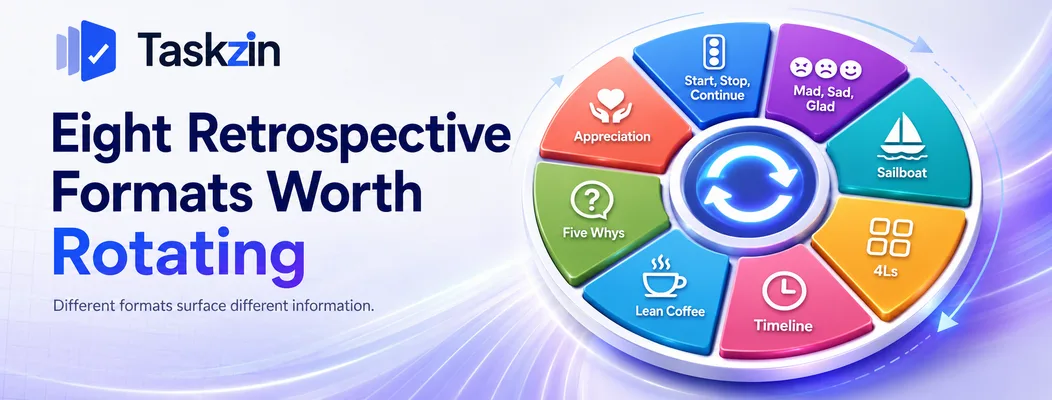
Start, Stop, Continue Three columns: what should we start doing, stop doing, and keep doing. Fast and immediately understood.
Best for: a reliable default and for teams new to retrospectives.
Trade-off: becomes mechanical if used every time.
Mad, Sad, Glad
Participants sort observations by emotional response rather than by category of action.
Best for: surfacing frustration that a process-focused format lets people skip past.
Trade-off: needs a facilitator willing to move from feeling to cause.
Sailboat The team draws a boat: wind pushing it forward, anchors holding it back, rocks ahead, and the island representing the goal.
Best for: teams that respond to visual metaphor, and for looking ahead as well as back.
Trade-off: takes longer to set up, and the metaphor can distract.
4Ls: Liked, Learned, Lacked, Longed For
Four quadrants, with an explicit focus on learning rather than only on problems.
Best for: teams doing exploratory or new work where learning is the main output.
Trade-off: the categories overlap, which can slow sorting.
Timeline retrospective The team builds a timeline of the period, marking events, then annotates high and low points.
Best for: long periods, project endings, or sprints where a lot happened.
Trade-off: the most time-consuming format here, and needs firm facilitation.
Lean coffee format The team generates discussion topics, votes, and works through them in priority order with a timer on each.
Best for: teams with more to discuss than time available.
Trade-off: lower-voted topics never get discussed, which can frustrate.
Five whys on one problem Rather than surveying everything, the team picks the single most significant issue and asks why repeatedly to reach a root cause.
Best for: a recurring problem that surface-level retrospectives keep re-identifying.
Trade-off: deliberately narrow — other issues go unaddressed that session.
Appreciation retrospective
The session focuses entirely on recognising contributions between team members.
Best for: after a difficult release, or when morale rather than process is the constraint.
Trade-off: produces no process actions, so use it occasionally rather than as a substitute.
The Structure That Makes Any Format Work
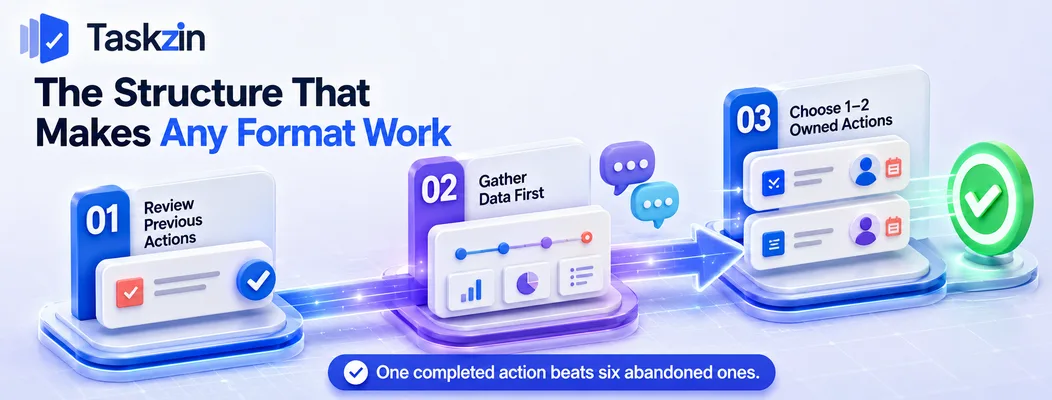
Every effective retrospective follows the same underlying shape: set the stage and review previous actions, gather concrete data before opinions, then commit to one or two actions with named owners.
Set the stage and check the previous actions
Open by reviewing what was agreed last time and what happened. This takes three minutes and is the single most important item on the agenda.
Reviewing actions publicly creates accountability and, more importantly, demonstrates that the session has consequences. Teams that skip this step are teaching everyone that retrospective outcomes are optional, which is the fastest way to make the meeting pointless.
Gather data before opinions
Start with facts before interpretations: what actually happened, what the numbers were, which events occurred when.
Opening with "how did the sprint feel?" produces impressions dominated by whatever happened most recently or most emotionally. Grounding in data first means the discussion addresses the period rather than the last three days.
Decide on one or two actions with owners
Not five. One or two, each with a named owner and a specific due date, sized so they can genuinely be completed alongside delivery work.
A single completed action beats six abandoned ones, because it proves the session produces change. Once that pattern is established, people invest real thought; until it is, they will not.
Making It Safe Enough to Be Useful
Read the prime directive aloud, have people write silently before discussing, and think carefully about who is in the room.
Establish the prime directive
The retrospective prime directive states that everyone did the best job they could given what they knew, their skills, the resources available and the situation at the time.
Reading it at the start is not ceremony. It sets an explicit frame that the discussion is about systems rather than individuals, and it gives the facilitator something to point at when the conversation turns toward blame.
Silent writing before discussion
Give everyone five minutes to write their observations privately before anything is said aloud.
This prevents the loudest or most senior voice from setting the agenda, and it means quieter people arrive with something written rather than having to interject. The difference in the range of issues surfaced is substantial.
What to do when a manager attends
A line manager in the room changes what people say, regardless of intent. That is not a criticism of the manager; it is how reporting relationships work.
Options in ascending order of formality: the manager attends but does not speak first, the manager attends alternate sessions, or the team retrospects alone and shares a summary. If the team consistently avoids the real issue, try removing the manager for two sessions and observe whether the content changes.
Common Retrospective Mistakes
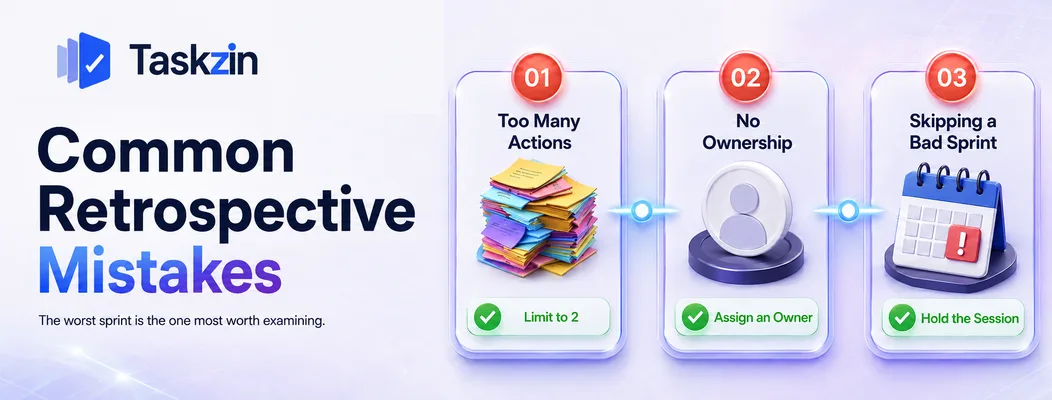
The three failures are generating too many actions to complete, letting the session become complaints without ownership, and skipping it after a bad sprint.
Producing ten actions and completing none
A long action list feels productive and guarantees failure. The team has a full sprint of delivery work; improvement actions compete with it directly.
Limit to two, make them small, and complete them. Credibility comes from completion, not from the length of the list.
Letting it become a complaints session
Surfacing frustration is legitimate and necessary. Stopping there is not. Every significant complaint should end with either an action the team can take, a decision to escalate with a named person, or an explicit acknowledgement that it cannot be changed.
The facilitator's job at this point is a single question: what would we like to be different, and who could make that happen? Asked consistently, it converts venting into decisions without shutting anyone down.
That last option is underused and genuinely valuable. Naming something as outside the team's control lets people stop expending energy on it.
Skipping it when the sprint went badly
The sprints most worth examining are the ones that went wrong, and those are exactly the sprints where people want to skip the retrospective and move on.
Hold it. If emotions are high, consider a different format — five whys on the specific failure often works better than a general survey when something has clearly gone wrong.
It also helps to delay by a day or two rather than cancelling. A retrospective held immediately after a difficult release tends to produce blame; the same discussion two days later produces analysis, and the intervening time costs nothing compared with losing the session entirely.
Frequently asked
How do you run a good retrospective?
Review previous actions first, gather concrete data before opinions, use silent writing to surface a full range of issues, and finish with one or two actions that have named owners and due dates.
How long should a retrospective be?
Roughly 45 minutes to an hour for a two-week sprint. Scrum guidance suggests up to three hours for a one-month sprint, but most teams find shorter, well-facilitated sessions more productive.
What are the best retrospective formats?
Start, Stop, Continue as a default; sailboat for visual teams; timeline for eventful periods; five whys for recurring problems; and lean coffee when there is more to discuss than time. Rotating between them keeps attention.
Should managers attend retrospectives?
It depends on the relationship. A line manager's presence changes what people say. If sessions consistently avoid the real issue, try running two without the manager and compare what surfaces.
What is the prime directive in a retrospective?
A statement that everyone did the best they could given what they knew, their skills, the resources available and the circumstances. It frames the discussion around systems rather than individual blame.
How many action items should come out of a retrospective?
One or two, each with a named owner and a due date. Longer lists compete with delivery work and typically result in nothing being completed, which undermines the whole practice.
How do you run a retrospective remotely?
Use a shared board for silent writing, keep cameras on where possible, timebox strictly, and have the facilitator explicitly invite quieter participants. Remote sessions need firmer facilitation than in-person ones.
Sujan Sharma is a content writer at Taskzin with a strong focus on productivity systems, task management, workflow optimization, team collaboration, and SaaS technology. He creates research-driven, practical content that helps professionals and growing teams improve operational efficiency, streamline processes, and make informed decisions about modern work management tools.
All posts by Sujan Sharma

Comments