Taskzin vs Redmine and OpenProject (Open Source Compared)
An honest comparison of Taskzin with Redmine and OpenProject, covering what self-hosted open source actually costs beyond the free licence, where data sovereignty and scale make it the right choice, and how Redmine and OpenProject differ.

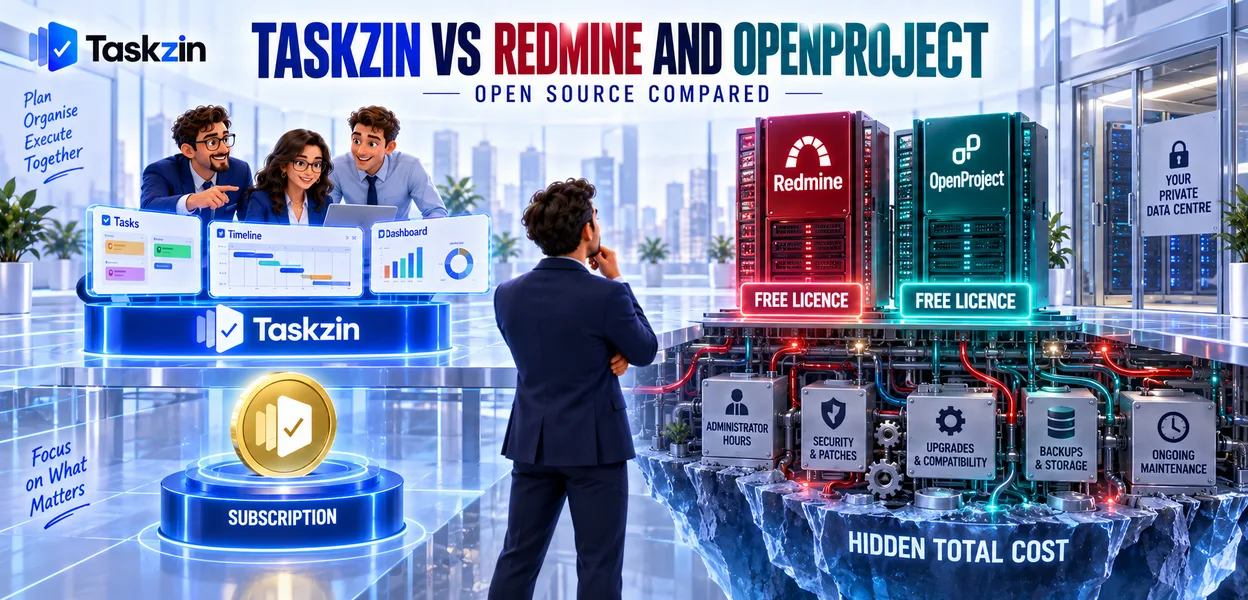
For everyone else, "free" describes the licence rather than the total. This comparison models the real numbers rather than pretending the choice is between paying and not paying.
Quick answer: Redmine and OpenProject have no licence cost and no user limits. They do have infrastructure costs, administrator time, security patching and upgrade work — which for most teams exceeds a subscription. Self-hosting genuinely wins where data must stay on your infrastructure, where user counts are very large, or where you already have platform engineering capacity.
What Open Source Actually Costs
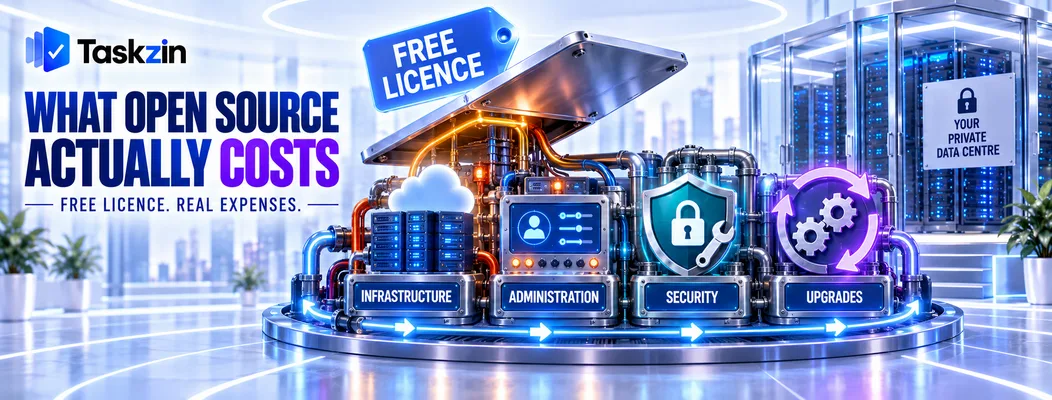 The licence is free; hosting, administration, security and upgrades are not, and they recur every year.
Free licence, real expenses
Downloading Redmine or OpenProject costs nothing. Running it in production for a team of thirty involves a server, a database, backups, monitoring, TLS certificates and someone responsible for all of it.
None of that is hidden or dishonest — it is simply omitted from most comparisons, which present a licence cost of zero against a subscription and stop there.
The four ongoing costs
Infrastructure: server, database, storage, backup, monitoring.
Administration: installation, configuration, user management, plugin management.
Security: patching, vulnerability monitoring, access control, incident response.
Upgrades: version migrations, plugin compatibility, testing, downtime.
The last two are the ones teams underestimate, and they are the ones that cause real problems when neglected.
When self-hosting genuinely wins
Three cases. Data sovereignty requirements that prohibit external hosting. User counts in the hundreds where per-seat pricing becomes substantial. Existing platform engineering capacity where the marginal cost of one more service is genuinely small.
If none of these applies, self-hosting is usually a false economy — and recognising that early saves an expensive detour.
Taskzin, Redmine and OpenProject Compared
Redmine vs OpenProject
Licence cost Subscription Free Free (community) Hosting Managed Self-hosted Self-hosted or cloud User limits Per member pricing Unlimited Unlimited (community)
Modern interface and adoption
Views List, Board, Calendar, Gantt, Table, Timeline Lists, basic Gantt Lists, board, Gantt WIP limits and swimlanes Yes Via plugin Limited Sprints, velocity, burndown Starter and above Via plugin Available Dependencies and critical path Yes, recalculates Basic Yes Docs linked to tasks Yes Wiki Wiki Automations All plans Via plugin Limited Dashboards 30+ widgets on Business Via plugin Available Guests Free, unlimited Unlimited Unlimited SSO, SCIM, audit logs Business and above Via plugin Enterprise edition
Data sovereignty and control
Vendor hosted, full export Complete Complete Admin required None Yes Yes Setup time Under an hour Days Days
OpenProject offers a commercial cloud and enterprise edition — verify current pricing.
Where Open Source Is Stronger

Open source wins on data control, on cost at large user counts, and on the ability to modify the software.
Data sovereignty and control Your data sits on infrastructure you control, in a jurisdiction you choose, with backups you hold.
For organisations with regulatory constraints — certain public sector, healthcare, defence and financial contexts — this is not a preference but a requirement, and it settles the question immediately.
No per-user cost at scale
At five hundred users, per-seat pricing is substantial and a self-hosted instance costs the same as at fifty.
This is the strongest financial argument for open source, and it only applies at scale. Below roughly a hundred users, the administration cost usually exceeds the licence saving.
Modification and extension
You can read the source, change behaviour, and build integrations against the database directly.
Redmine's plugin ecosystem in particular allows substantial extension. Whether you have the capacity to use this is a separate question, and most organisations that cite it never do.
Where Taskzin Is Stronger
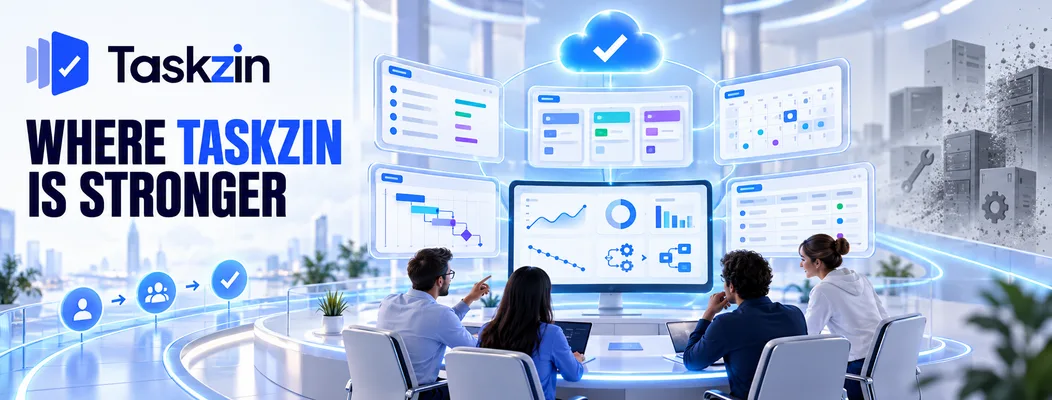
Taskzin wins on requiring no operations, on interface and adoption, and on features being present rather than assembled from plugins.
Nothing to operate
No server, no database, no patching, no upgrade planning, no backup verification.
For a team without dedicated platform capacity, this is the entire argument. The alternative is that someone's job quietly includes maintaining a project tool, and that person's absence becomes a risk.
Modern interface and adoption Redmine's interface reflects its age. This matters practically rather than aesthetically — adoption failure is more common than capability failure, and tools people dislike opening do not get updated.
Taskzin is designed for a real project to be running within an hour, with six views over one dataset so different people work the way they prefer. OpenProject is considerably more modern than Redmine and closes much of this gap.
Features without plugins
WIP limits and swimlanes, sprints with velocity and burndown, dependencies with critical path recalculation, automations on all plans, dashboards on Business — all present rather than assembled.
In Redmine, several of these require plugins, and plugins are the main source of upgrade friction. A plugin that breaks on a version upgrade blocks the upgrade, which is how self-hosted instances end up running unpatched versions.
The Honest Cost Comparison

Model infrastructure and administrator time properly, and the crossover point becomes clear rather than theoretical.
Model the infrastructure
A production instance for thirty to a hundred users needs an application server, a database, storage, backup and monitoring — modest but real recurring cost.
Add a staging environment if you want to test upgrades safely, which you should.
Price the administrator time
This is the number that decides it. Realistically: initial setup and configuration measured in days, then ongoing patching, upgrades, user management and incident handling.
Even at a few hours a month, an administrator's time costs more than a subscription for a team of thirty. Price it at their actual rate rather than treating it as free because it is internal.
Where the crossover falls
Below roughly fifty users, hosted is almost always cheaper once administration is priced honestly.
Between fifty and a few hundred, it depends on whether you already have platform capacity — if the marginal cost of one more service is genuinely low, self-hosting becomes competitive.
Above a few hundred, per-seat pricing dominates and self-hosting is usually cheaper, assuming you can operate it well.
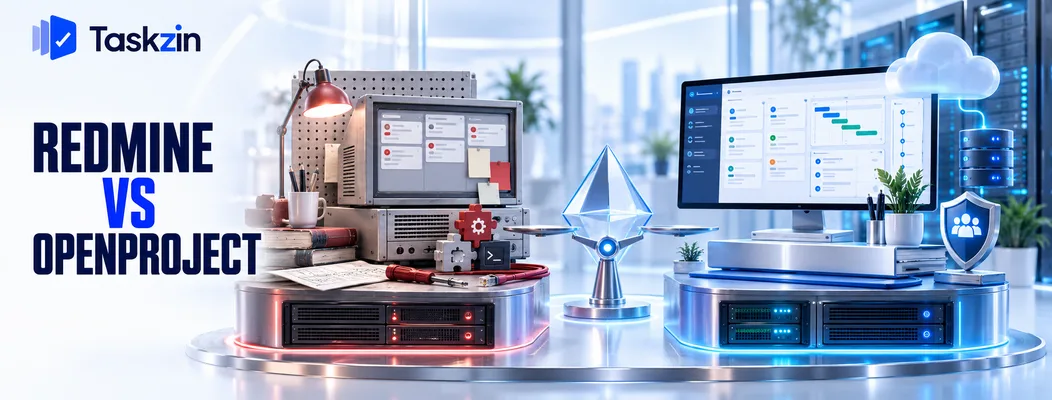
Redmine vs OpenProject Redmine is older, lighter and plugin-driven; OpenProject is modern, more structured and commercially backed.
Redmine: older, lighter, plugin-driven
Long-established, stable, modest resource requirements, and extensible through a large plugin ecosystem.
Its interface is dated and much of its modern capability depends on plugins whose maintenance varies. It suits organisations with technical capacity and tolerance for a functional rather than polished experience.
OpenProject: modern, structured, commercially backed
A modern interface, more built-in capability, and a company behind it offering enterprise features and a hosted cloud option.
The community edition is free; several enterprise features sit behind a paid edition. This makes it closer to a SaaS product with a self-hosted option than to traditional open source.
Which self-hosted option fits
Redmine if you have technical capacity, want minimal resource usage, and are comfortable managing plugins.
OpenProject if you want self-hosting without a dated experience, and are willing to pay for the enterprise edition where you need its features. Compare that edition against hosted SaaS pricing, since at that point the cost gap narrows considerably.
Frequently asked
Is Redmine still used?
Yes, particularly in organisations with data sovereignty requirements or existing technical capacity. Its interface is dated, and much of its modern capability comes through plugins.
Is open source project management really free?
The licence is free. Infrastructure, administrator time, security patching and upgrades are not, and for teams under about fifty users those costs typically exceed a subscription.
What is the difference between Redmine and OpenProject?
Redmine is older, lighter and extended through plugins. OpenProject has a modern interface, more built-in capability, a commercial company behind it, and a paid enterprise edition alongside the free community version.
Which is better, self-hosted or SaaS?
Self-hosted where data sovereignty is required, user counts are in the hundreds, or you already have platform engineering capacity. SaaS otherwise, once administration time is priced honestly.
Does OpenProject have a cloud version?
Yes, it offers a commercially hosted option alongside the self-hosted community edition, which makes it a middle path between traditional open source and SaaS.
Can you import Redmine data into Taskzin?
Via CSV rather than the one-click importer, which covers ClickUp, Jira, Asana and Trello. Issues map to tasks with assignees and dates; wiki content and plugin data need separate handling.
When does self-hosting become cheaper?
Usually above a few hundred users, or immediately if regulatory requirements prohibit external hosting. Below fifty users it is almost always more expensive once administrator time is counted.
Sujan Sharma is a content writer at Taskzin with a strong focus on productivity systems, task management, workflow optimization, team collaboration, and SaaS technology. He creates research-driven, practical content that helps professionals and growing teams improve operational efficiency, streamline processes, and make informed decisions about modern work management tools.
All posts by Sujan Sharma
Comments