Asana vs Wrike
An honest comparison of Asana and Wrike, covering their different design assumptions, where Wrike's resource management and proofing win, where Asana's adoption and portfolios win, and how to diagnose which fits.

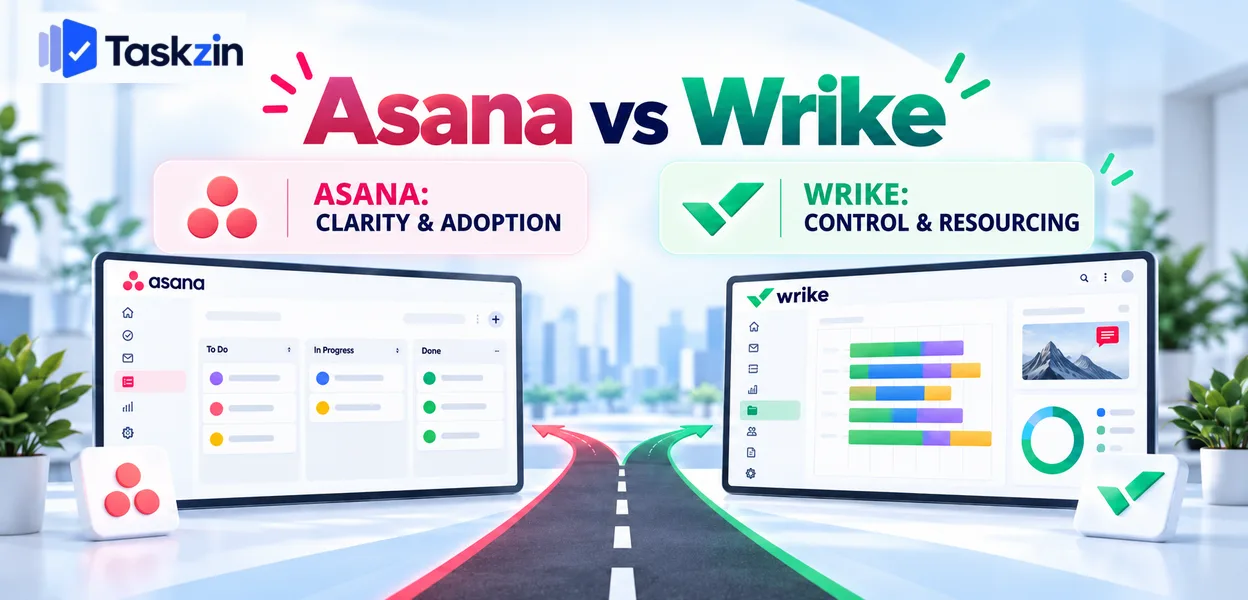
These two land on the same shortlist constantly, usually at organisations between fifty and three hundred people, and the evaluation often turns into a feature audit that does not settle anything.
Quick answer: Asana protects clarity — fewer options, better adoption, a tool people outside project management will actually use. Wrike solves a specific expensive problem — allocating people across many concurrent projects — and adds creative proofing. If resourcing is your bottleneck, Wrike; if adoption is, Asana
Clarity or Control
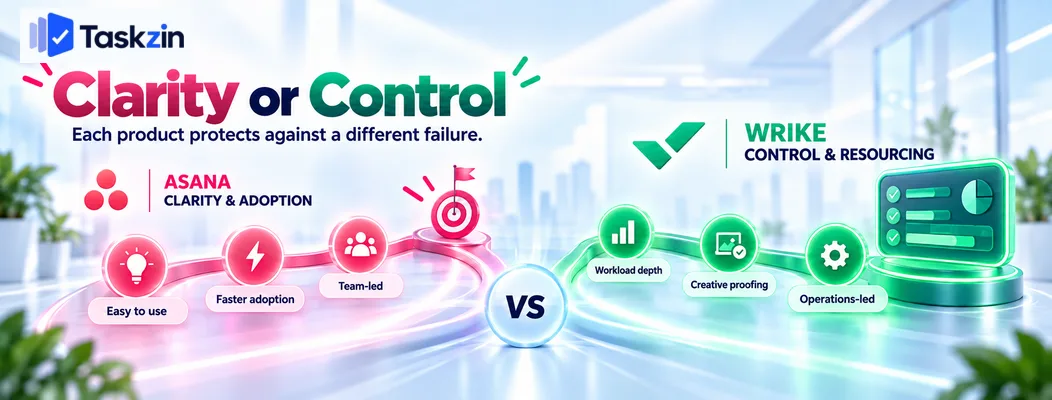
Each product is shaped by a different assumption about what goes wrong.
What Asana is built to protect
The assumption is that tools fail through non-adoption. So Asana constrains what you can configure, keeps the interface uncluttered, and makes the common path obvious.
The result is a tool that a marketing coordinator, a designer and an operations manager can all use without training, at the cost of some depth.
What Wrike is built to solve
The assumption is that services organisations lose money through bad allocation. So Wrike builds around workload — who is assigned across everything and whether they have the hours.
Around that sit request forms, blueprints for standardised project creation, proofing for creative output, and utilisation reporting.
Who buys each
Asana is frequently bought by a team lead and spreads sideways as other teams see it working.
Wrike is usually bought through a process, by someone whose role includes operations or delivery, to solve a named problem. That difference shows in how much configuration each expects.
Asana vs Wrike at a Glance
Is Asana or Wrike better?
Design priority Clarity and adoption Resource control Resource management Workload view, basic Strong Utilisation reporting Limited Strong Proofing and approvals Approvals as tasks Strong, with markup Portfolios Yes, higher tiers Available Goals / OKRs Yes, higher tiers Available Request forms Forms available Strong, with blueprints Custom fields Moderate Extensive Views List, board, timeline, calendar, gantt Multiple, incl. workload Automation Rules, tiered Available, tiered
Non-technical adoption Strong Moderate Implementation effort Low to moderate Higher Typical buyer Team lead Operations or delivery lead
Verify current pricing and tier contents for both before relying on cost comparisons.
Where Wrike Is Stronger
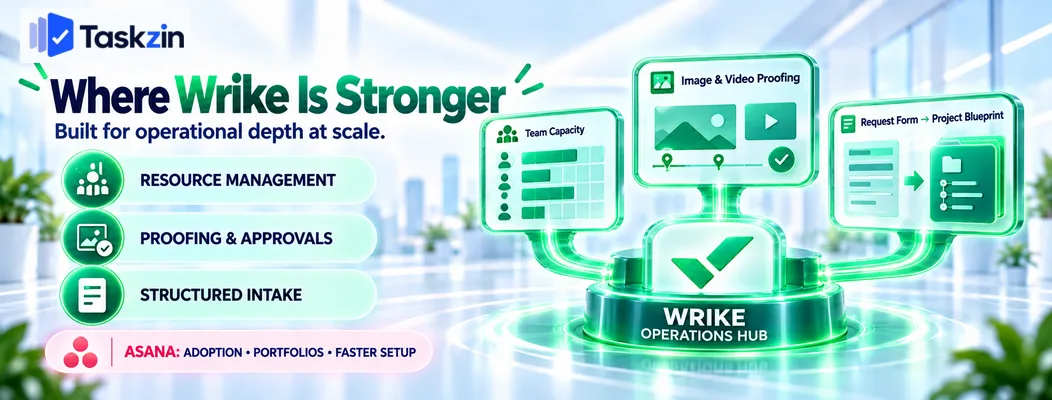
Wrike wins on resourcing, on proofing, and on structured intake at organisational scale.
Resource management and utilisation
Seeing across every concurrent project whether assigned people actually have capacity, and rebalancing when they do not.
Asana's workload view shows load. It does not support the allocation decisions Wrike is built for, and it does not produce utilisation reporting. For an organisation where billable capacity is the commercial constraint, this gap is the whole comparison.
Proofing and creative approvals
Markup directly on images, video and documents, with structured approval workflows and version comparison.
Asana handles approvals as task states with owners and dates. That covers sign-off; it does not let a reviewer annotate a specific frame or compare two versions side by side.
Structured intake and blueprints
Request forms that capture the right fields, route work appropriately, and instantiate standardised projects from templates.
Asana has forms and templates. Wrike's version is more configurable where an organisation receives many distinct request types with different approval paths.
Where Asana Is Stronger
Asana wins on adoption, on portfolios and goals, and on getting to useful faster.
Adoption across non-project people
This is Asana's genuine strength and it is worth more than it looks on a feature grid.
A tool that half the organisation avoids produces incomplete data, and incomplete data makes every report wrong — including the resourcing reports Wrike is good at. Wrike's depth is only available if people keep it current.
Portfolios and goals
Asana's portfolio view across many projects, with goals connecting work to intended outcomes, is clean and widely used.
Wrike has equivalents. Asana's are more approachable, and approachable features get used by more people, which is the point of having them.
Lower implementation burden
Asana can be genuinely useful in days. Wrike expects weeks, particularly if you are implementing resourcing properly.
Where you do not have someone to own a multi-week implementation, that difference frequently decides the outcome regardless of capability.
The Question That Settles It
Three questions resolve this faster than any feature audit.
Is your bottleneck people or clarity?
Deadlines slipping because the named person was elsewhere, no answer to who has capacity next month, utilisation discovered retrospectively — that is a resourcing bottleneck and Wrike addresses it.
Nobody knowing project status without asking, work lost between teams, half the organisation avoiding the tool — that is a clarity bottleneck and Asana addresses it.
Who will own the configuration?
Name the person. Not a team, a person, with time allocated.
If that person does not exist, Wrike's depth will not be realised and you will be paying for capability nobody operates. Asana degrades more gracefully without an owner.
What are you currently working around?
The most honest diagnostic. What spreadsheet exists alongside your current tool, and what does it contain?
If it contains people and hours, that points to Wrike. If it contains project status because nobody updates the tool, that points to Asana — or to something lighter still. Teams whose honest answer is "we just need dependencies, timelines and reporting for eighty people" are frequently over-buying with both; Taskzin covers that at flat per-member pricing with free unlimited guests.
Frequently asked
Is Asana or Wrike better?
Wrike for resource allocation across many concurrent projects and creative proofing. Asana for adoption, clarity and cross-project visibility. The right answer depends on which bottleneck is costing you.
Which is cheaper?
They are broadly comparable per user at equivalent tiers, with the deciding factor being which tier contains what you need. Wrike's resourcing and Asana's portfolios both sit on higher plans.
Does Asana have resource management?
It has a workload view showing capacity across projects. It does not attempt Wrike's depth of allocation, levelling and utilisation reporting.
Does Wrike have goals and portfolios?
Yes, it has equivalents for both. Asana's implementations are more approachable, which in practice means more people use them.
Which is easier to learn?
Asana, clearly. Fewer options, cleaner interface and a shallower learning curve for people whose job is not project management.
Which suits agencies better?
Wrike if staff allocation across clients or creative proofing is the problem. Asana if adoption across a mixed team and simpler client reporting matter more.
Can you migrate between them?
Yes, in both directions via CSV. Tasks, assignees, dates and custom fields transfer; automations, dashboards, proofing history and resourcing data need rebuilding.
Sanju Shrestha is a SaaS content writer at Taskzin who explores smarter ways to manage work, organize priorities, and improve team performance. Her content covers productivity strategies, digital workflows, collaboration, and task management, with a focus on helping modern teams work more efficiently and stay aligned.
All posts by Sanju Shrestha


Comments