Jira vs Azure DevOps
An honest comparison of Jira and Azure DevOps, covering why they are different categories of product, where Azure DevOps' integrated toolchain wins, where Jira's tracking depth and ecosystem win, and how the common hybrid works.

For most teams the question resolves on two facts: whether you are already in the Microsoft estate, and whether anyone outside engineering needs the tool.
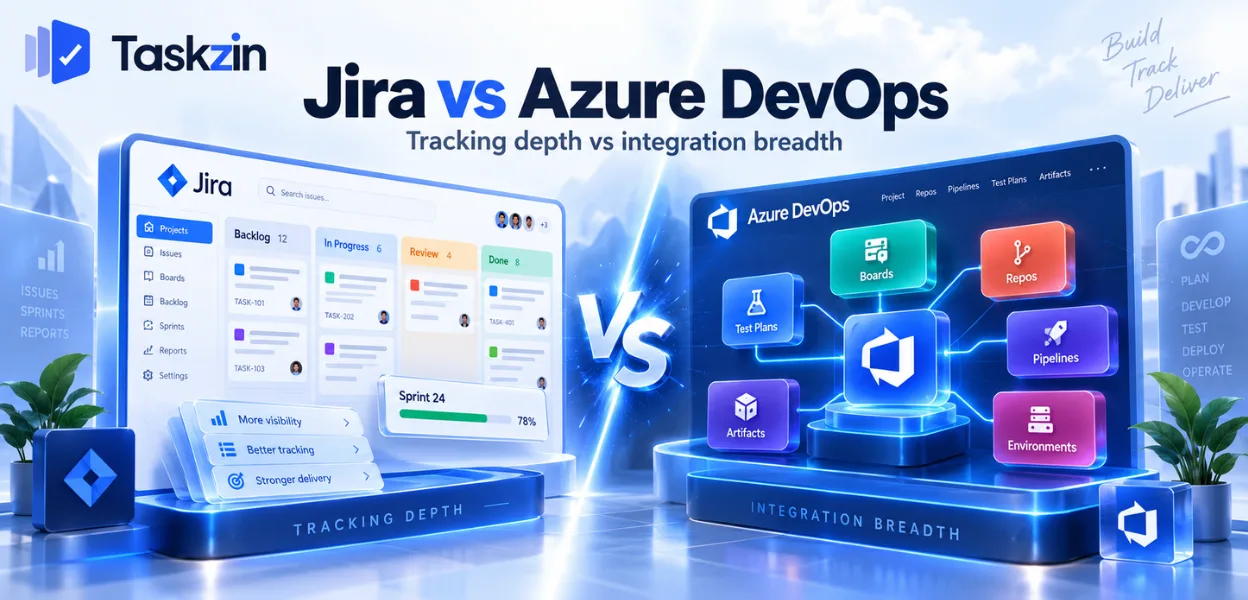
Quick answer: Jira is an issue tracker with a large ecosystem. Azure DevOps is an integrated toolchain where boards are one component alongside repos, pipelines, test plans and artifacts. Comparing them as equivalents understates what Azure DevOps includes and overstates what its boards do. The honest comparison is between Jira's tracking depth and Azure DevOps' integration breadth.
A Tracker and a Toolchain

These are different categories of product that overlap in one component.
What Jira is
A configurable issue and project tracker. Work items, workflows, boards, reporting, with everything else — documentation, code hosting, CI — coming from other Atlassian products or the marketplace.
Jira's depth is in tracking. That is what it does, and it does it further than anything else.
What Azure DevOps is
Five services in one: Boards (work tracking), Repos (Git hosting), Pipelines (CI/CD), Test Plans (test management) and Artifacts (package management).
Boards is the piece that competes with Jira, and it is the least developed of the five relative to its competition. Pipelines is the piece most teams actually adopt it for.
Why comparing them directly misleads
A feature comparison of Jira against Azure DevOps Boards makes Azure DevOps look weak. A comparison against the whole suite makes Jira look narrow.
Neither framing is useful. What matters is which parts you need and what you already have for the rest.
Jira vs Azure DevOps at a Glance
Where Azure DevOps Is Stronger
Category Issue tracker Integrated DevOps toolchain Work tracking Deep, highly configurable Capable, less configurable Git hosting Via Bitbucket or GitHub Built in (Repos) CI/CD Via integration Built in (Pipelines) Test management Via marketplace app Built in (Test Plans) Package management Via other tools Built in (Artifacts) Documentation Via Confluence Wiki included Non-engineering teams Jira Work Management Poor fit Workflow customisation Extensive Moderate Marketplace / apps Very large Smaller
Licensing Per user, tiered Per user, with free tiers Best fit Tracking across many team types Microsoft-estate engineering orgs
Microsoft's DevOps positioning shifts relative to GitHub — verify current licensing and roadmap directly.
Where Azure DevOps Is Stronger
Azure DevOps wins on having the whole delivery chain in one product, on cost inside a Microsoft estate, and on single-vendor simplicity.
Integrated pipelines, repos and artifacts
Code, builds, releases, test plans and packages in one system with native traceability from a work item to the commit that closed it to the build that shipped it.
Assembling that chain across Jira plus a Git host plus a CI tool plus a test manager is possible and involves maintaining integrations. Azure DevOps gives it to you as a property of the product.
Cost inside a Microsoft estate
Organisations with existing Microsoft agreements frequently find Azure DevOps effectively bundled or heavily discounted.
That is a real and often decisive argument. Check what your enterprise agreement already includes before comparing list prices — many teams pay for Jira alongside an Azure DevOps entitlement they already hold.
One vendor for the whole chain
One procurement, one support relationship, one security review, one set of credentials.
For organisations where adding a vendor is a months-long process, this is worth more than a feature comparison suggests.
Where Jira Is Stronger Jira wins on tracking depth, on serving non-engineering teams, and on the ecosystem around it.
Issue tracking depth and configurability
Workflow schemes, screen schemes, field configurations, issue type hierarchies and permission schemes. Azure DevOps Boards is configurable; it is not configurable to the same degree.
If your organisation has genuinely distinct processes that must coexist, Jira models them and Boards will eventually not.
Non-engineering teams
Jira Work Management extends Jira to marketing, HR, legal and operations with a more approachable interface.
Azure DevOps has no equivalent and is not intended for those teams. An organisation standardising on one system across functions will not standardise on Azure DevOps.
Ecosystem and marketplace
A very large marketplace covering time tracking, advanced reporting, test management, diagramming and nearly every niche requirement.
Azure DevOps has extensions; the ecosystem is substantially smaller. Where you need a specific capability, Jira is more likely to have something.
The Decision Most Teams Actually Face

Three questions resolve this faster than a feature matrix.
Are you already in the Microsoft estate?
Azure AD, Microsoft 365, Azure hosting, an existing enterprise agreement.
If yes, Azure DevOps starts with a significant cost and integration advantage, and the burden falls on Jira to justify a separate vendor.
Do you need one tool beyond engineering?
If marketing, operations and support need to be in the same system as engineering, Azure DevOps is not a candidate.
This single question eliminates it for a lot of organisations, regardless of how good Pipelines is.
What is your CI/CD situation?
If you already run GitHub Actions, GitLab CI or Jenkins and are happy with it, most of Azure DevOps' advantage does not apply to you.
In that case you are really comparing Jira against Azure DevOps Boards alone, and Jira wins that comparison on depth.
Running Them Together
A hybrid is common, works in one specific shape, and creates duplication in others.
The common hybrid
Jira for work tracking across the organisation, Azure DevOps for Pipelines and Repos on the engineering side, connected so commits reference Jira issues.
This gives you Jira's tracking and Microsoft's delivery chain, at the cost of maintaining the integration.
Where it works
When engineering is one part of a larger organisation that needs shared tracking, and when the CI/CD investment in Azure is already made.
The boundary is clean: work items live in Jira, build and release artefacts live in Azure DevOps, and the link between them is one integration rather than many.
Where it creates duplication
When teams start using Azure DevOps Boards as well, so work items exist in both and neither is authoritative.
Turn Boards off, or turn Jira off for those teams. Two trackers is the failure mode, and it is easy to drift into without anyone deciding to.
If the reason you are evaluating is that Jira has become heavy for a team that does not need its depth, the alternative is a lighter tracker rather than a different toolchain — tools like Taskzin cover boards, sprints and dependencies with a fraction of the configuration surface.
Frequently asked
What is the difference between Jira and Azure DevOps?
Jira is an issue tracker with a large ecosystem. Azure DevOps is a five-service toolchain — boards, repos, pipelines, test plans and artifacts — where work tracking is one component.
Is Azure DevOps free?
There are free tiers for small teams and limited pipeline minutes, and many Microsoft enterprise agreements include entitlements. Check what your organisation already holds before comparing list prices.
Which is better for agile teams?
Jira has deeper agile tracking — more configurable boards, richer reporting and a larger app ecosystem. Azure DevOps Boards is capable but less developed relative to its competition.
Can Azure DevOps replace Jira?
For engineering-only organisations already in the Microsoft estate, frequently yes. For organisations needing non-engineering teams in the same system, no.
Do teams use both together?
Commonly — Jira for tracking, Azure DevOps for Repos and Pipelines, linked so commits reference issues. The rule is to use only one of the two for work items.
Which suits non-technical teams?
Jira, via Jira Work Management. Azure DevOps has no equivalent and is not designed for marketing, HR or operations.
Is Azure DevOps being replaced by GitHub?
Microsoft's investment has shifted noticeably toward GitHub, and the relationship between the two products has evolved. Verify Microsoft's current roadmap and positioning before making a long-term commitment.
Binita Ray is a content writer at Taskzin, creating insightful and practical content on task management, team collaboration, productivity, workflow optimization, and SaaS solutions. She focuses on helping businesses, teams, and professionals simplify their work processes, improve efficiency, and make better use of modern productivity tools.
All posts by Binita Ray
Comments