Taskzin vs Height
An honest comparison of Taskzin and Height, covering their opposing bets on AI-led upkeep versus explicit structure, where each is genuinely stronger, an honest assessment of what AI does in project tools today, and how to choose.

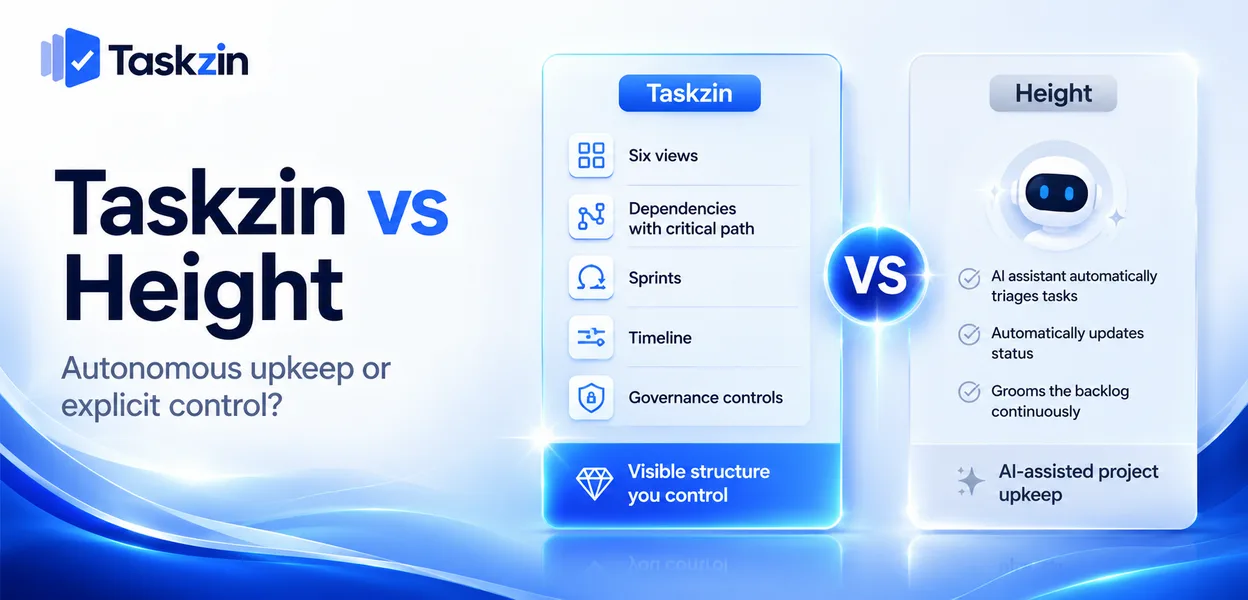
Both are reasonable bets. Which suits you depends on team size, on whether you need planning depth, and on how much of the AI claim survives contact with your actual workflow.
Quick answer: Height positions itself around autonomous, AI-assisted project management — reducing the manual upkeep of triage, grooming and status. Taskzin is an explicit tool with six views over one dataset, dependencies with critical path, sprints and admin controls. The choice is between betting on automation reducing your admin and having capabilities you can see and control directly.
Two Different Bets
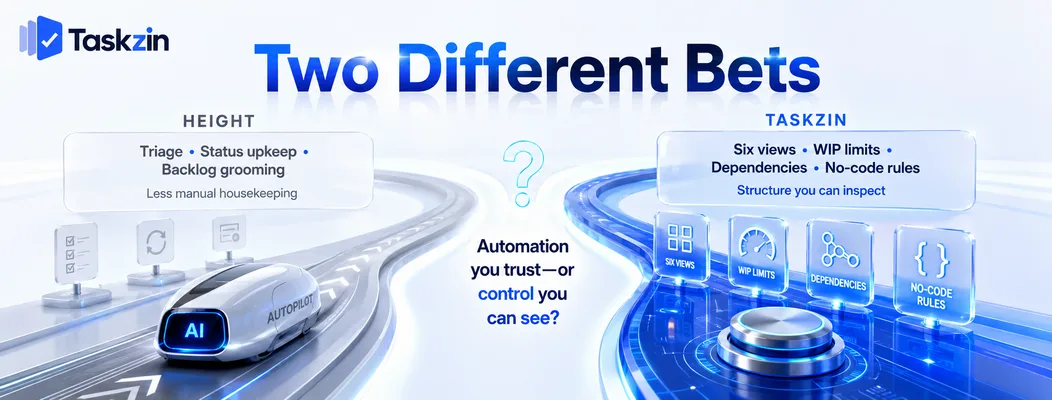
Height bets that AI can absorb project housekeeping; Taskzin bets that explicit structure with low friction is more dependable.
Height's autonomous, AI-led approach
Height's proposition is that much of what a project tool asks people to do — updating status, grooming the backlog, triaging incoming work — can be handled automatically.
For small teams where that housekeeping is a real tax and nobody wants to be the person maintaining the board, the appeal is genuine.
Taskzin's explicit, view-led approach
Taskzin's approach is that the structure should be visible and the friction should be low: six views over one dataset, board WIP limits and swimlanes, dependencies that recalculate the critical path, no-code automation rules on all plans.
Nothing decides on your behalf. Automations do what you configured them to do, and you can see why anything happened.
What you are choosing between
Automation you trust to handle upkeep, versus structure you control and can inspect.
The first is lower effort when it works. The second is more predictable, and predictability matters more as team size and governance requirements grow.
Taskzin vs Height at a Glance
Taskzin Height Positioning Explicit project tool AI-assisted, autonomous
Reducing manual upkeep
Breadth of views
List, Board, Calendar, Gantt, Table, Timeline Task list, board, spreadsheet-style Dependencies and critical path Yes, recalculates Limited
Timeline and Gantt Yes Limited WIP limits and swimlanes Yes Limited Sprints, velocity, burndown Starter and above Limited Automation No-code rules on all plans AI-driven plus rules Docs linked to tasks Yes Available Dashboards 30+ widgets on Business Limited SSO, SCIM, audit logs Business and above Higher tiers Free plan Yes, up to 10 members Available Pricing Flat per member, no seat tiers Per user Guests Free, unlimited, view and comment Varies Data export JSON or CSV, any plan Available Best for
Planning and dependencies
Governance and admin controls
Suits small product teams
Height evolves quickly — verify current features and pricing directly.
Where Height Is Stronger
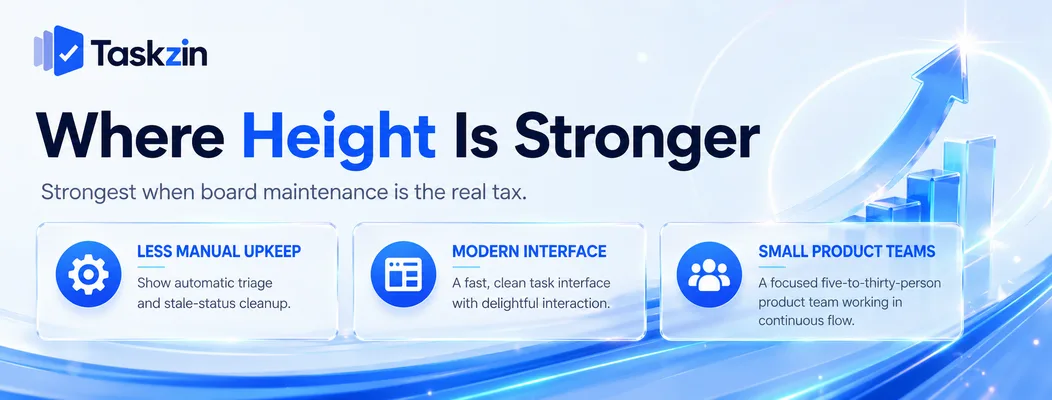
Height wins on reducing manual upkeep, on interface quality, and on fitting small product teams that dislike process.
Reducing manual upkeep The strongest part of Height's proposition. Automatic triage and status maintenance genuinely removes work that nobody enjoys and that most teams do badly.
If your board is always stale because updating it feels like overhead, a tool that reduces that requirement addresses the actual problem rather than exhorting people to try harder.
A genuinely modern interface
Height is well designed, fast, and pleasant to use. That is not a trivial advantage — adoption failure is more common than capability failure, and tools people enjoy opening get updated.
Suits small product teams Height is aimed at product and engineering teams of roughly five to thirty, working continuously rather than in formal phases.
For that shape of team, its lighter structure is appropriate rather than limiting, and the absence of Gantt charts is not a gap because they were never going to use one.
Where Taskzin Is Stronger
Taskzin wins on view breadth, on planning depth, and on the governance features larger organisations require.
Breadth of views Six views over one dataset means the same work appears as a board for engineers, a timeline for a stakeholder and a table for operations — without duplication or reconciliation.
Height's views are narrower. For cross-functional teams where different people need genuinely different representations, this is a practical daily difference.
Planning and dependencies Dependencies with critical path recalculation, so a slip upstream visibly moves what follows.
Gantt and timeline views built for sequence.
Height is oriented toward continuous flow rather than scheduled delivery. If you need to show a client or a board a credible timeline, that is a real gap.
Governance and admin controls SAML SSO, SCIM, audit logs and 2FA on Business and above, with Google and Microsoft sign-in on all plans.
For organisations with compliance requirements or an IT function that reviews tooling, these are gating features rather than preferences.
The AI Question, Honestly
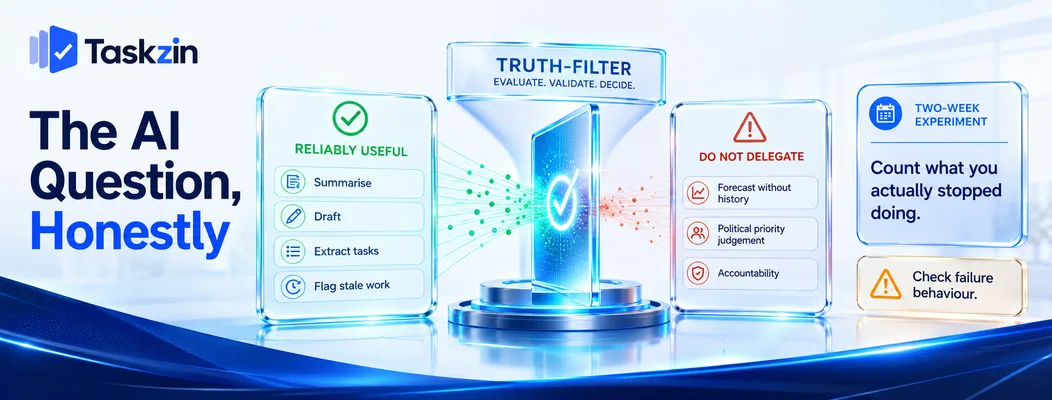
AI reliably reduces administrative work; it does not reliably forecast, prioritise or replace judgement — and evaluating the claim matters more than the marketing.
What AI reliably does today
Summarising, drafting, extracting tasks from unstructured text, and flagging items that have not moved.
These share a property: the output is immediately verifiable. If a summary is wrong, someone sees it. That is why they work, and Height's upkeep automation sits largely in this category.
What it does not
Reliable forecasting on projects without substantial history. Judgement about priority when the relevant context is political rather than in the data. Anything requiring accountability for a decision.
These fail for structural reasons rather than because the technology is immature. Be cautious of any tool implying otherwise.
How to evaluate the claim
Run a real project for two weeks and count what you actually stopped doing. Not what the demo suggested — what changed in your week.
Also check the failure behaviour. A tool that automates incorrectly and confidently is worse than one that does nothing, because the error is invisible until it matters.
Choosing Between Them
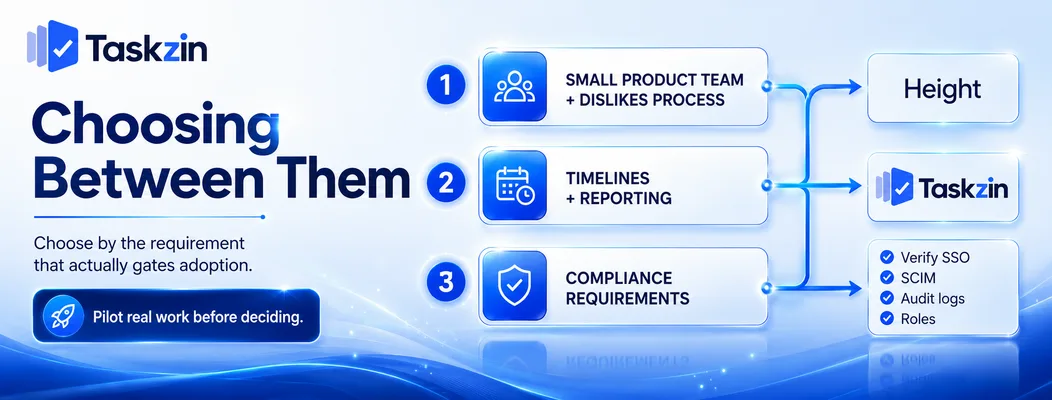
Small product teams that dislike process suit Height; teams needing timelines, reporting or compliance features suit Taskzin.
If you are a small product team
Under about twenty people, working continuously, no formal reporting obligations, and irritated by tool maintenance.
Height's bet is aimed exactly at you, and the reduced upkeep is a genuine benefit rather than a marketing claim.
If you need timelines and reporting
Client commitments, stakeholder reporting, dependencies that genuinely constrain sequence, or anyone asking for a Gantt chart.
Taskzin covers this and Height largely does not. This is the clearest dividing line between them.
If you have compliance requirements
SSO, SCIM provisioning, audit logs and role controls are frequently non-negotiable above a certain organisation size.
Check both against your actual requirements list. This tends to decide the matter regardless of everything else, because a tool that cannot meet a security requirement is not a candidate.
Frequently asked
What is Height?
A project management tool positioned around AI-assisted autonomous upkeep — automating triage, status maintenance and backlog housekeeping — aimed primarily at small product and engineering teams.
Is Height better than traditional project tools?
For small teams whose main complaint is tool maintenance, its reduced upkeep is a real advantage. For teams needing timelines, dependencies or governance features, traditional tools remain stronger.
Does Height replace a project manager?
No. AI reliably reduces administrative work; it does not handle stakeholder judgement, scope negotiation or accountability for decisions, which is most of what a project manager actually does.
Which is cheaper?
Taskzin is free up to 10 members then flat per member with no seat tiers, and includes free unlimited guests. Verify Height's current pricing, as it changes with the product.
Does Height have Gantt charts?
Its timeline and dependency capability is limited compared with tools built for scheduled delivery. Taskzin provides Gantt and timeline views with critical path recalculation.
Can you import Height data into Taskzin?
Via CSV rather than the one-click importer, which covers ClickUp, Jira, Asana and Trello. Tasks, assignees and dates transfer; check what your export contains before committing.
Which suits a larger organisation?
Taskzin, generally — SSO, SCIM, audit logs, dashboards and dependency management matter more as organisations grow and as IT and compliance functions review tooling.
Sanju Shrestha is a SaaS content writer at Taskzin who explores smarter ways to manage work, organize priorities, and improve team performance. Her content covers productivity strategies, digital workflows, collaboration, and task management, with a focus on helping modern teams work more efficiently and stay aligned.
All posts by Sanju Shrestha
Comments