Event Planning Template
An event planning template covering a twelve-week phased timeline, a run sheet for the day itself, budget and supplier tracking, how to plan backwards from a fixed date, and the mistakes that cause last-minute panic.


Events differ from other projects in three ways: the date cannot move, everything converges on a single day, and suppliers with long lead times sit on your critical path.
Those three facts should shape how you plan — backwards from the date, with the point of no return identified early.
The template below covers a twelve-week timeline, the run sheet for the day itself, and budget tracking with the contingency most event budgets omit.
What Makes Events Different

A fixed date, a single convergence point, and external dependencies you cannot accelerate.
The date does not move
Most projects can absorb a slip. An event cannot — the venue is booked, the invitations are sent, and people have arranged travel.
This changes how you treat risk. In normal delivery, a delay costs time. In an event, a delay means something does not happen at all, so the response to slippage is cutting scope rather than extending the schedule.
Everything converges on one day
Catering, AV, speakers, signage, registration, staffing and content all have to be ready simultaneously. Any one of them failing is visible to every attendee.
There is no partial delivery. This is why events reward checklists more than most work — the failure mode is forgetting something small and obvious under pressure.
Suppliers are on your critical path
Venues, caterers, AV companies and printers have lead times you cannot compress, and they are booked by other people.
A venue that needs six weeks' notice for a menu change is not being difficult; that is the constraint. Planning that ignores supplier lead times fails predictably in the final fortnight.
The Event Planning Timeline
Twelve weeks for a mid-sized event. Compress proportionally for smaller ones.
When Item Owner 12 weeks Objective and success measures agreed Event owner
Budget approved with contingency Event owner + finance
Date confirmed and checked against conflicts Event owner
Venue shortlisted and booked Event owner
Format and rough agenda agreed Event owner 10 weeks Speakers invited and confirmed Programme lead
Catering brief sent, dietary process agreed Ops
AV requirements scoped with venue Ops
Registration page live Marketing
Save-the-date sent Marketing 8 weeks Full agenda published Programme lead
Promotion campaign begins Marketing
Signage and print items briefed Marketing
Accessibility requirements confirmed Ops 4 weeks Registration numbers reviewed against target Marketing
Final catering numbers estimated Ops
Speaker materials requested Programme lead
The Run Sheet
On-the-day roles assigned Event owner 2 weeks
Identify the point of no return
numbers to venue Ops
Print items sent to production Marketing
Attendee joining instructions sent Marketing
Speaker briefing call held Programme lead
Run sheet circulated to all staff Event owner 1 week Change freeze in effect Event owner
Venue walkthrough Event owner + ops
AV test Ops
Contingency plans confirmed for top 3 risks Event owner Day before Materials packed and checked against list Ops
Final headcount confirmed Ops
Staff briefed on run sheet Event owner After Thank-you and follow-up sent within 48 hours Marketing
Debrief held within one week Event owner
Final budget reconciled Finance
One person owns the run sheet
The document that runs the day. Times, actions, owners — nothing else.
Time Action Owner Notes
07:00 Venue access, setup begins Ops lead Contact: venue manager, 98xxxxxxx 07:30 AV setup and test AV supplier + ops Backup laptop on site 08:15 Registration desk set up Reg lead Badges sorted alphabetically 08:30 Catering arrives, breakfast set Ops lead 120 confirmed, 8 dietary 08:45 Staff briefing Event owner All staff, 10 minutes 09:00 Doors open, registration Reg lead 2 people on desk 09:30 Welcome and opening Event owner 10 min 09:40 Keynote Programme lead Speaker mic'd by 09:30 10:30 Break, refreshments Ops lead 20 min 10:50 Session 2 Programme lead
12:00 Lunch Ops lead Dietary table clearly signed 13:00 Afternoon sessions Programme lead
16:00 Close Event owner
16:15 Breakdown begins Ops lead Venue clear by 18:00
Budget and Supplier Tracking
Every line with a supplier, a lead time and a payment deadline.
Category Budget Supplier Lead time Paid by Notes Venue hire 40% Venue 12 weeks 50% deposit at booking Cancellation terms checked Catering 25% Caterer Final numbers 2 weeks out On invoice Numbers cannot reduce after deadline AV 12% AV supplier 4 weeks On invoice Includes on-site technician Print and signage 6% Printer 2 weeks On order No changes after send Speaker costs 7% Various — On invoice Travel and accommodation Contingency 10% — — — Not allocated — do not spend early
Planning Backwards From the Date
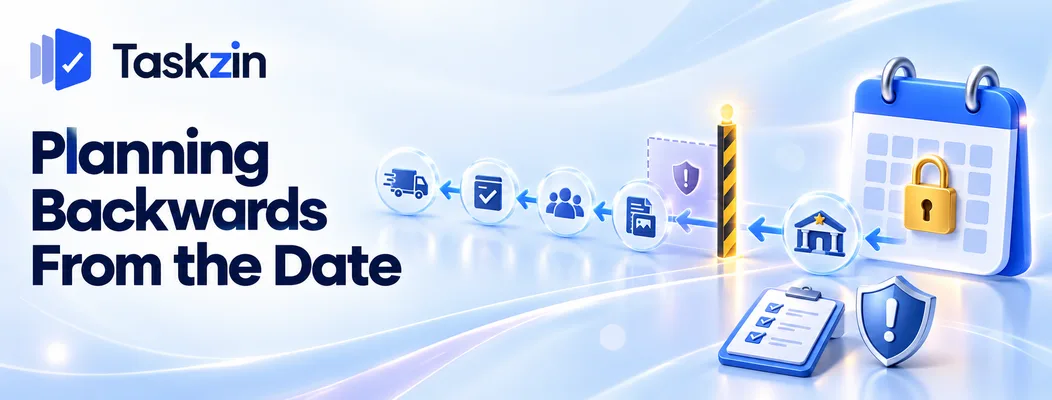
Derive deadlines from supplier lead times, find the point of no return, and place contingency where it is cheapest.
Work out the true deadlines
Ask every supplier one question: what is the last date you can accept a change? Then work backwards from that.
Those dates are your real deadlines, not the dates you would prefer. A caterer needing final numbers fourteen days out means your registration effectively closes then, whatever your marketing calendar says.
Identify the point of no return There is a date after which costs are committed and the event happens regardless — usually when final numbers go to the venue and print goes to production.
Mark it clearly. Before it, cancelling or resizing is possible. After it, you are committed. Everyone involved should know which side of that line they are on, because it changes what decisions are still available.
Build in contingency where it is cheap
Ten percent budget contingency, unallocated, plus time contingency in front of the point of no return rather than at the end.
Time contingency after the point of no return is worthless — nothing can change by then. Placed a week earlier, it is what lets you absorb a supplier problem while options still exist. Where the plan lives as a project with dependencies, a slip in one supplier task visibly moves what follows rather than being discovered late.
The Week Of, and the Day Itself
Freeze changes, give one person the run sheet, and prepare for the failures most likely to occur.
Freeze changes
One week out, stop accepting changes to the agenda, materials or logistics unless something has genuinely broken.
Late changes are where most event-day failures originate — a slide deck swapped the night before, a room layout changed after the AV test. The freeze is the protection.
One person owns the run sheet On the day, one person holds the run sheet and makes timing decisions. Not a committee, and not whoever is nearest.
Everyone else knows who that is. Events go wrong quietly when three people each assume someone else is watching the clock.
Plan for the three most likely failures
Not every risk — the three most probable. Usually: a speaker does not arrive, the AV fails, or attendance is significantly different from expected.
Write a one-line response for each. A speaker who does not arrive is a crisis without a plan and a schedule adjustment with one.
Common Event Planning Mistakes

Three failures: no run sheet, underestimated lead times, and no debrief afterwards.
No run sheet, just a plan
A project plan tells you what needs to happen. A run sheet tells you what happens at 09:30 and who does it.
On the day, nobody reads a plan. The run sheet is the only document that matters, and it should exist two weeks out rather than being written the night before.
Underestimating supplier lead times
Assuming a printer can turn something around in three days, or that catering numbers can change up to the day.
Ask every supplier for their real deadlines at the start and build the schedule around them. This is the single most common cause of last-fortnight panic.
No post-event debrief
The event ends, everyone is relieved, and nothing is recorded. The next event repeats the same mistakes.
Thirty minutes within a week: what worked, what did not, what would we do differently, and what were the actual costs against budget. Written down, in the same place as the plan, so the next event starts from it.
Frequently asked
What should an event plan include?
A phased timeline working backwards from the date, a run sheet for the day, a budget with supplier lead times and payment deadlines, assigned on-the-day roles, and contingency plans for the most likely failures.
How far ahead should you plan an event?
Twelve weeks for a mid-sized event, longer where venues or speakers have long lead times. The real driver is your suppliers' deadlines rather than the size of the event.
What is a run sheet?
A minute-by-minute schedule for the event day listing time, action and owner. It is the only document anyone reads on the day and should exist two weeks in advance.
What is the point of no return for an event?
The date after which costs are committed and the event happens regardless — usually when final numbers go to the venue and print goes to production. Mark it clearly and make sure everyone knows it.
How much contingency should an event budget have?
Around 10 percent, unallocated, plus time contingency placed before the point of no return rather than at the end where it cannot be used.
Who should own the event on the day?
One named person holding the run sheet and making timing decisions. Shared ownership on the day means nobody is watching the clock.
What should happen after the event?
Follow-up to attendees within 48 hours, a debrief within a week covering what worked and what did not, and a budget reconciliation. Record all of it where the next event's planning will start.
Sujan Sharma is a content writer at Taskzin with a strong focus on productivity systems, task management, workflow optimization, team collaboration, and SaaS technology. He creates research-driven, practical content that helps professionals and growing teams improve operational efficiency, streamline processes, and make informed decisions about modern work management tools.
All posts by Sujan Sharma


Comments